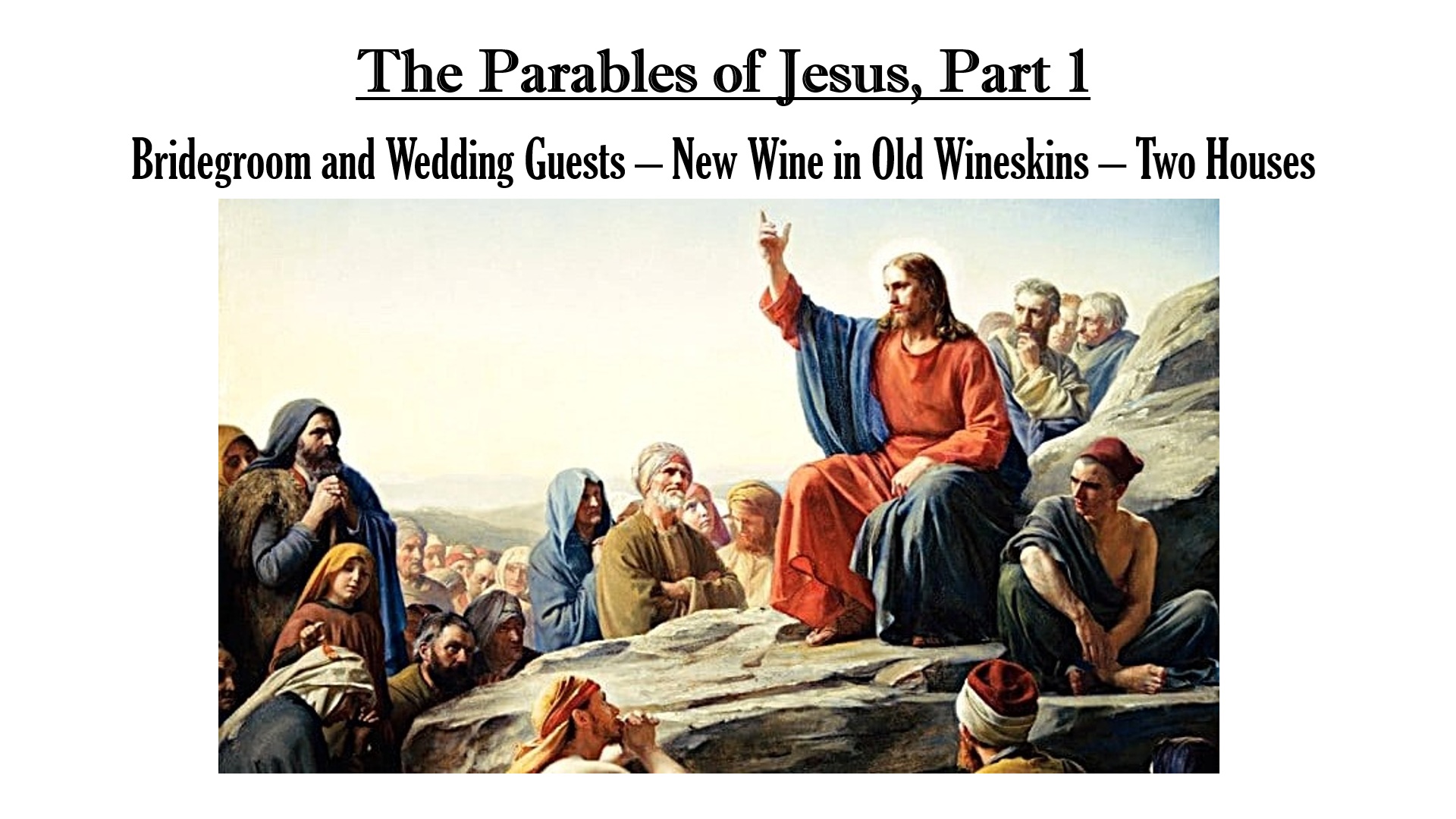
Parables of Jesus - Part 1
I love teaching the Bible and my favorite part of the Bible to teach is the life of Jesus, the Gospels. And then, my favorite part of the Gospels are the words of Jesus.
Introduction – Bridegroom and Wedding Guests – New Wine in Old Wineskins – Two Houses
I love teaching the Bible and my favorite part of the Bible to teach is the life of Jesus, the Gospels. And then, my favorite part of the Gospels are the words of Jesus. Jesus was God and IS God, and so, His words, which have been preserved for us in Scripture, are, in fact, direct quotes from God Himself. The study that we are going to begin this morning will examine the parables of Jesus that are recorded in the Gospels, chronologically, in the order that Jesus taught them. As we look at each one of these parables, I will be providing some context, the reason behind Jesus teaching that particular parable.
An Introduction to the Parables
Whenever I begin a new study, I like to give a brief introduction. So, let me do that for you now.
Parables. What are they? Q1, what does the word parable mean?” Are parables nothing more than fables that contain a moral?
No. Are they merely tall tales that are meant to entertain? No. And they have no connection to historical or real events. The word “parable” (if you look it up in the dictionary) comes from the Greek word “parabole,” which means “a fictitious narrative of common life conveying a moral.” Building on that rather general definition, I define Jesus’s parables as “illustrations borrowed from everyday life that convey a spiritual truth.” So then, the best answer to Q1 is that parables are a truth conveyed as a story or illustration.
The next question, Q2, is a bit tricky. True or false?
Every parable Jesus told was a fictional story. How did you answer that?
[Class shares their answers].
OK, no matter how you answered that, whether you answered true or false, you are correct. And I will tell you why. By definition a parable (I just gave you the definition) is “a fictitious narrative of common life conveying a moral.” So then, the answer would be TRUE, it is fictional by definition. But then you also have to consider who is telling the parable. Jesus, being God, could have had real people and real-life situations in mind. It is likely that some of His parables were based on at least elements of reality. So, if you answered FALSE that is OK too.
Jesus drew comparisons and contrasts from ordinary everyday things, from real-life experiences. These are things that all people can relate to.
Q3 asks, what are some practical reasons that Jesus used parables?
[Class shares their answers].
Reasons Why Jesus Taught in Parables
Most of the people that Jesus spoke to were simple, uneducated peasants who could easily understand and relate to His down-to-earth illustrations. So, there is that. And Jesus did use them to clarify deeper spiritual truth that otherwise the people listening to Him might not have fully understood. So, there is that aspect. By using parables, those who were willing and eager to hear the truth of Jesus’s message would find it, while those who were indifferent to the truth would not (it would be hidden from them). So, there is that aspect as well. The stories certainly made His teachings more interesting. By using parables, Jesus’s audiences were more apt to pay attention to His teaching than if they had to listen to some deep and heavy-handed sermon. I was thinking about preachers in the pulpit and how whenever they give an illustration or tell a story, you perk up and you pay a little more attention. So, there is that aspect of it as well. Finally, His stories could be remembered easier than if He preached deep theology. So, everything that is listed are practical reasons that Jesus taught using parables. I said check all that apply, so really all of them apply. I just wanted to get you to think a little bit. There are a lot of reasons Jesus used parables. It was not merely to entertain. He had a purpose.
[One class member pushed back against one of the reasons given, so there was a brief discussion about that.]
The first several parables that Jesus taught were relatively short and not as familiar to us as some of His other parables. This morning, we are going to look at a few of His earliest parables from His Galilean Ministry. Remember I said we were going to be looking at the parables in chronological order. So, these are the early one. Let me set the stage for the first two parables that Jesus told back-to-back.
Jesus Eating with Tax Collectors and Sinners
Jesus is walking in Capernaum and He sees a tax collector named Matthew (also known as Levi). He is sitting at his tax booth. Now, you need to understand that tax collectors collected taxes for the Roman government. So, needless to say, as a group they were not very popular with the Jews. In fact, they were considered among the worst of the worst. Jesus tells Matthew, “Follow Me.” What does Matthew do? He gets up, leaves everything behind (including his sharpened pencils), and follows Jesus. That is characteristic that you see in all twelve of Jesus’s disciples. When Jesus calls them, they follow Him. They do not hesitate to follow Jesus when He says, “Follow Me.” They do it immediately.
Well, not long afterward, Matthew throws a party in Jesus’s honor at his house. He invites many of his tax collector friends over. That’s when the Pharisees voice their first criticism of Jesus and His disciples. This is from Luke’s account, Luke Chapter 5 beginning in v 29…
And Levi [Matthew] made Him [Jesus] a great feast in his house, and there was a large company of tax collectors and others reclining at table with them. And the Pharisees and their scribes grumbled at His disciples, saying, “Why do you eat and drink with tax collectors and sinners?” And Jesus answered them, “Those who are well have no need of a physician, but those who are sick. I have not come to call the righteous but sinners to repentance.” And they said to Him, “The disciples of John [the Baptist] fast often and offer prayers, and so do the disciples of the Pharisees, but yours eat and drink” (Luke 5:29-33).
Grumble, grumble, grumble, right? This leads to Jesus’s first parable. A lot of Jesus’s teachings were “interactive.” Someone would ask Jesus a question or make some sort of comment and that would prompt Jesus to answer them. And that is what happens here.
So, Q4 asks, who is Jesus responding to in this passage when he tells this parable?
The Pharisees. Jesus had apparently ruffled their feathers by having the audacity to eat with tax collectors and sinners. How dare He? So, these pious religious snobs who had been scrutinizing every little thing that Jesus, this up-and-coming rabbi, did, ask His disciples “Why do you eat and drink with tax collectors and sinners?”
You need to understand that the Law only required that the Jews fast once a year. But these ultra-religious Pharisees are so pious and so legalistic that they fasted twice a week (100 times a year). Wow! They are very devout, very religious! By contrast, Jesus’s disciples are eating and drinking and enjoying life. They are outwardly happy and expressing joy. They are enjoying the company of their Master. All this happiness seems to have embittered these Pharisees. Joyless people, they do not like being around people who have lots of joy (who are happy). It bugs them. So, that is what is going on here. They just do not like it.
The Bridegroom and the Wedding Guests
And Jesus said to them [the Pharisees], “Can you make wedding guests fast while the bridegroom is with them? The days will come when the bridegroom is taken away from them, and then they will fast in those days” (Luke 5:34-35).
Q5, in this parable who does the bridegroom represent?”
Jesus. That was easy.
Now, Q6 asks, who do the wedding guests represent?
The followers of Jesus, the disciples. That would include us as well, right?
In this illustration, which was common (everybody had been to a wedding before) you have the bridegroom (we call him “the groom” nowadays), and he is at this [wedding] and everybody is happy and they are celebrating because he is there. The wedding guests are not fasting. They are celebrating. It is a wedding. It is a happy time. That is His illustration.
Now He says when the bridegroom is taken away, then they will fast. Jesus is alluding to (since He is the bridegroom) when He goes away, at the end of the Gospels, then they will be sad. But now they are happy because they are with Jesus. The wedding guests are with the bridegroom. Everybody is happy. At a wedding feast, when the bridegroom is present it is a time for celebration. Later on, when Jesus is taken away, then they will fast. They will be sad. This is basically what Jesus is saying: “While I am present in their lives, while I am actively involved with them, is not a solemn time. It is a time of joy.”
New Wine in Old Wineskins
Jesus gives another illustration to drive His point home. Here we actually have two parables wrapped up into one. The lesson that is being taught in both illustrations is the same.
You have new material being sewn onto an old garment and then you have new wine being place into old wineskins. What is emphasized is this: that which is new is incompatible with the old. Let’s take a look at what Jesus teaches. Again, Luke Chapter 5…
He also told them a parable: “No one tears a piece from a new garment and puts it on an old garment. If he does, he will tear the new, and the piece from the new will not match the old. And no one puts new wine into old wineskins. If he does, the new wine will burst the skins and it will be spilled, and the skins will be destroyed. But new wine must be put into fresh wineskins. And no one after drinking old wine desires new, for he says, ‘The old is good’” (Luke 5:36-39).
Q7 asks, according to Jesus, why does nobody put new wine into old wineskins?
It will burst. When the new wine is placed in wineskins the fermentation process causes the gases to expand. The old wineskins do not have the ability to stretch very far and, as a result, they end up bursting from the pressure that builds up inside. So, that is what is going on.
Jesus’s point is this: “I came to bring something completely new. I came to bring you a new relationship with God, a salvation based on grace through faith in Christ. You cannot fit this new experience into the old Jewish legalistic system.” Old wineskins over time, like many people, have a tendency to become rigid and unyielding. We would say that people are “set in their ways.” You do not know anybody like that, do you?
To tie all this together we have Q8, new wine is incompatible with old wineskins in the same way as our new faith in Christ is incompatible with old WHAT?
Works-based religions.
I gave you several choices. Our new faith in Christ IS compatible with the Old Testament teachings. You see Jesus all throughout the Old Testament. Our faith in Christ IS compatible with God’s old covenant promises. God will keep His promises to Israel based on His promises to Abraham and David. Our faith in Christ IS compatible with old church doctrines. Some of them come right from the First Century. The correct answer is that our new faith in Christ which is based on grace is incompatible with any religious system that is based on works.
That is what Jesus wants to do to our old dead religion. He wants to break through and bring us His joy, celebration and new life. He wants to break our monotonous routine and produce spontaneity and excitement in our life. Religion brings a burden. But a relationship with Jesus Christ brings a blessing! As Christians who have been saved from a devil’s hell, set apart, sanctified saints of God who have been given a second chance, we should be overjoyed about our new life in Christ. It should never get old. Jesus came to bring freedom and joy. Christians ought to be the happiest people because of what Christ has done for us.
Q9 (you really had to look at this one and read the verse) is based on v 39: “And no one after drinking old wine desires new, for he says, ‘The old is good.’” So then, based on this verse why do you think the Jews rejected Jesus’s teachings? [Class responses]
We Like the Old, Why Change?
They [the Jews of Jesus’s day] are saying, “We like the old. We have no reason to change. We are content with [the way things are]. It has worked for us for centuries. Why would we change? We like the old. Why would we want the new?” They felt comfortable with [the old ways]. Why change?
Their perception is that [the new] is not as good as what we already have. Well, their perception was wrong. Obviously, [the new] is better. But in their minds, because they like the old so much, they do not want to change.
Despite getting cross ways with the Jewish religious leaders, Jesus’s popularity with the people increased. He was very popular. The people followed Him out in the middle of nowhere [sometimes] to hear Him teach. They also wanted to see His latest miracle. And it is during this period, at the height of His popularity, early on in His ministry, that Jesus delivers His Sermon on the Mount.
Jesus rejects the charge by His critics that His teachings run contrary to their Jewish scriptures. He says, “Do not think that I have come to abolish the Law or the Prophets; I have not come to abolish them but to fulfill them” (Matthew 5:17). And Jesus did this by displaying the very character of God by what He said and what He did. In the Sermon on the Mount Jesus taught, among other things, that righteousness is not merely acting right. It is possessing and imitating the very character of God. And He gives all kinds of illustrations on specifics in the Sermon on the Mount.
The Two Houses
So, that brings us to His next parable which I call “The Two Houses.” As Jesus wraps up His sermon, He gives the following illustration. It is a contrast between a wise man and a foolish man. This parable is actually a lot like what you see in the book of Proverbs, this contrast between the wise and the fool. A wise man is one who does things God’s way. A fool rejects God and does what he pleases. So, let’s pick it up the teaching Jesus is presenting in Matthew Chapter 7…
“Everyone then who hears these words of Mine and does them will
be like a wise man who built his house on the rock. And the rain fell, and the floods came, and the winds blew and beat on that house, but it did not fall, because it had been founded on the rock (Matthew 7:24-25).
Q10 asks “Who is like a wise man who built his house on the rock?”
Those who hear and obey, right? There are two things going on here. You hear [Jesus’s message] and then you obey. The other two choices I gave are not part of this parable. It is this deep foundation that gives a structure its stability. When the storms of life come, and they WILL come for all of us sooner or later, those who have built their house, their faith and hope, on the rock of Jesus Christ will be able to stand firm without wavering. They know that God will not let them down. As the Bible says, “Greater is He that is in you than he that is in the world” (1 John 4:4).
And now for the contrast…
And everyone who hears these words of Mine and does not do them will be like a foolish man who built his house on the sand. And the rain fell, and the floods came, and the winds blew and beat against that house, and it fell, and great was the fall of it” (Matthew 7:26-27).
Like a house of cards, the fool’s house crumbles.
Q11 asks, why did one house stand while the other fell?
They had different types of foundations. Foolish people’s lives are built on weak foundations – sand which is constantly moving and shifting. These people have no purpose. In many cases it’s not that they are stubborn and resisting God, although it could be. But they just do not give Him any thought. When the storms of life hit them full-force (everybody is going to get the storms of life) they are ill-prepared and, as a result, their lives fall apart. Sadly, if they ever turn to God, it is after they have wasted much of their life.
The foundation of a godly life is built on Jesus Christ, the solid Rock. We trusted Him to save us and we trust Him to bring us through the storms of life that will batter us. They will. Rest assured. He will not let us down! “On Christ the solid Rock I stand; all other ground is sinking sand.”
Q12 asks, true or false? Both the wise man and foolish man heard the same message.
TRUE. Both men heard “these words of Mine,” Jesus’s teachings. They both did. The difference is how they responded to them.
The Crowds’ Reaction to Jesus
There is this little addendum here at the end, v 28 and 29…
And when Jesus finished these sayings, the crowds were astonished
at His teaching, for He was teaching them as one who had authority, and not as their scribes (Matthew 7:28-29).
Q13 asks, according to these verses, why were people astonished at Jesus’s teaching?
He taught like one who had authority.
So, there we have the first three of Jesus’s parables. As you can see, the illustrations provided in these parables really help us to picture the deeper spiritual points that Jesus was making.
Application
What can we take away from these three parables?
Wedding Feast: As believers, indwelt by the Holy Spirit and aware of our ever-present Lord, this should produce joy in our lives, a joy that is evident to those around us. Here is a great verse for you… Psalm 16:11: “You make known to me the path of life; in Your presence there is fullness of joy; at Your right hand are pleasures forevermore.” If that was true in the life of an Old Testament psalmist, how much more so in our lives as today as New Testament Christians?
Wineskins: It is important, especially as we get older and become more set in our ways, that we remain teachable. Proverbs 9:9: “Give instruction to a wise man, and he will be still wiser; teach a righteous man, and he will increase in learning.” It is important also that we be flexible and allow the Holy Spirit to guide us.
Two Houses: Our lives need to be built on the solid foundation of God’s word. And then I have a great passage for you… 2 Timothy 3:16-17: “All Scripture is breathed out [that is where we get the idea of inspiration] by God and profitable for teaching, for reproof, for correction, and for training in righteousness, that the man [or woman] of God may be complete, equipped for every good work.”
Questions
Note: To better help you to answer these questions you are encouraged to use the English Standard Version translation of the Bible.
Parables of Jesus - Part 1
Parables of Jesus Questions - Part 1
Introduction
1. What does the word "parable" mean? (Check the best answer)
___ a fable containing a moral ___ a truth conveyed as a story
___ a tall tale meant to entertain ___ a historical relation of real events
2. True or false? Every parable Jesus told was a fictional story. T F
3. What are some practical reasons that Jesus used parables? (Check all that apply)
___ to make it easier for the uneducated to understand His teachings
___ to hide the meaning from those people indifferent to the truth
___ to make His teachings more interesting
___ to keep the attention of His audience
___ to make the truths He taught easier to remember
The Bridegroom and the Wedding Guests (Luke 5:34-35)
4. Who is Jesus responding to in this passage? (Circle one)
CROWDS DISCIPLES LEVI PHARISEES
5. In this parable who does the bridegroom represent? __________________
6. In this parable who do the wedding guests represent? __________________
New Wine in Old Wineskins (Luke 5:36-39)
7. According to Jesus, why does nobody put new wine into old wineskins? (Check one)
___ It was not the socially accepted practice ___ It would ruin the taste of the wine
___ It would cause the wineskins to burst ___ It would cause the wineskins to shrink
8. New wine is incompatible with old wineskins in the same way as our new faith in Christ is incompatible with old ________________. (Check the best answer)
___ works-based religions ___ covenant promises
___ church doctrines ___ testament teachings
9. Based on verse 39, why did the Pharisees reject Jesus’s teachings? (Check the best answer)
___ they were close-minded to new ideas
___ they did not understand what Jesus was saying
___ they did not want to give up their status
___ they felt comfortable with their old traditions
The Two Houses (Matthew 7:24-29)
10. Who is like a wise man who built his house on the rock, v 24? (Check all that apply)
___ religious people ___ those who hear Jesus’s message
___ those who obey Jesus ___ those who refrain from sin
11. Why did one house stand while one house fell? What made the difference? (Circle one)
LOCATION EXPOSURE TO THE ELEMENTS BUILDING MATERIALS USED
QUALITY OF THE BUILDERS TYPE OF FOUNDATION
12. True or false? Both the wise man and foolish man heard the same message.
T F
13. According to v 28, why were people astonished at Jesus’s teaching? (Check best answer)
___ He taught like nobody else ___ He taught like one who had authority
___ His words were very eloquent ___ He taught using meaningful illustrations