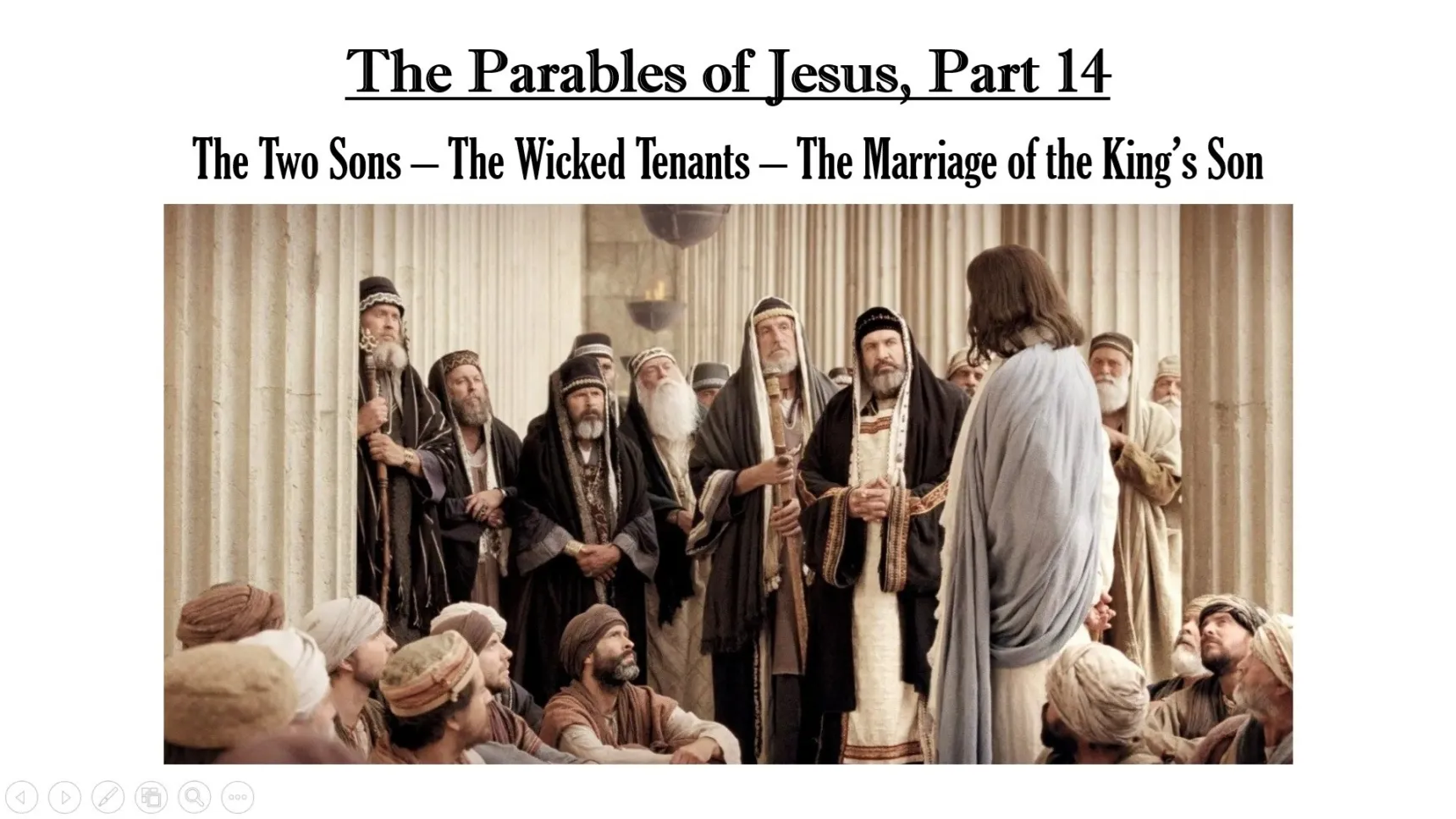
Parables of Jesus - Part 14
The Two Sons – The Wicked Tenants – The Marriage of the King’s Son
The Two Sons – The Wicked Tenants – The Marriage of the King’s Son
I have been telling the parables in chronological order. Since our last lesson, Jesus has (chronologically) made His triumphal entry into Jerusalem. He is in His final week before going to the cross. So, this is the setting for the last five parables that we are going to study. We are going to look at three today and two next week. Jesus enters the Temple and is confronted, it says in the scriptures, by the “chief priests and elders of the people,” by the religious leaders. And they ask Him by what authority He teaches and heals. Who does Jesus think He is anyway? This leads to Jesus telling three parables back-to-back-to-back. The first one we are going to look at is the Parable of the Two Sons.
The Two Sons
As Jesus is talking to these religious leaders, He recalls John the Baptist and how he had been treated by these very same men.
Q1, how does Jesus answer the Jewish religious leaders when they question His authority?
He answers their question with a question. He says, “I’ll tell you by what authority I do these things IF you can answer one question. And here it is: Did John’s authority [speaking of John the Baptist] – did his authority to baptize come from heaven, or was it merely human?” So, they are trapped because no matter how they answer, they have got a problem. If they say that it was from heaven, then Jesus will ask them why they did not believe John – because they did NOT believe John, did they? Just like they do not believe Jesus. On the other hand, if they say that it was merely human, the people will turn on them because they revere John as a prophet of God, which he was. So, they reply, “We don’t know.” To which Jesus says, “Then I won’t tell you by what authority I do these things.” And He proceeds from that point to tell them the following parable. This is Matthew Chapter 21 and v 28…
“What do you think? A man had two sons. And he went to the first and said, ‘Son, go and work in the vineyard today.’ And he [the son] answered, ‘I will not,’ but afterward he changed his mind and went. And he went to the other son and said the same. And he answered, ‘I will, sir,’ but did not go. Which of the two did the will of his father?” They [the religious leaders] said, “The first.” Jesus said to them, “Truly, I say to you, the tax collectors and the prostitutes go into the kingdom of God before you. For John came to you in the way of righteousness, and you did not believe him, but the tax collectors and the prostitutes believed him. And even when you saw it [you saw repentance of sins and how it changed lives], you did not afterward change your minds and believe him. (Matthew 21:28-32).
So, in this parable the first son initially tells his father that he will not obey, but then he changes his mind and goes to work.
Q2, who does Jesus say the first son represents?
Prostitutes -- and tax collectors also. In other words, what Jesus is saying, the worst of the worst sinners. Those people, those terrible sinners initially rejected God but then repented and turned to Him.
Now, the second son is the opposite of the first son. He initially says that he will obey his father and go to work in the vineyard, but then he changes his mind and does not go.
Q3, who does Jesus say the second son represents?
The nation of Israel (in Jesus’s day). Now, as often is the case, as the leaders go, so goes the nation. So, while the religious leaders have turned away from God by their rejection of God’s Messiah, Jesus, their influence leads the entire nation, the people of Israel, the Jews, to turn away also. They had a great influence on the nation.
So, just like their ancestors in the Old Testament, they verbally say all the right things, act all religious, but then they disobey God. In the temple they praise God with their lips. They say they desire to do God’s will. They desire God. They desire to be in His presence. They say it, but then they do not obey Him. So, with that, I want to flash back to the Old Testament.
This is out of the book of Joshua. It is the very end of Joshua, Chapter 24. It is a famous scene where Joshua is nearing the end of his life and he challenges the people of Israel and here is what he says…
But Joshua said to the people, “You are NOT able to serve the LORD, for He is a holy God. He is a jealous God; He will not forgive your transgressions or your sins. If you forsake the LORD and serve foreign gods, then He will turn and do you harm and consume you, after having done you good.” [That is a tough message, isn’t it?] And the people said to Joshua, “No, but we will serve the LORD.” Then Joshua said to the people, “You are witnesses against yourselves that you have chosen the LORD, to serve Him.” And they said, “We are witnesses.” Joshua said, “Then put away the foreign gods that are among you, and incline your heart to the LORD, the God of Israel.” And the people said to Joshua, “The LORD our God we will serve, and His voice we will obey” (Joshua 24:19-24).
Q4, from your knowledge of Old Testament history, did the people of God obey God?
No, they did not. You read on a little further, just two pages over in my Bible, and you come to the book of Judges and you read this passage here. Judges Chapter 2, v 11…
And the people of Israel did what was evil in the sight of the LORD and served the Baals. And they abandoned the LORD, the God of their fathers, who had brought them out of the land of Egypt. They went after other gods, from among the gods of the peoples who were around them, and bowed down to them. And they provoked the LORD to anger (Judges 2:11-12).
It turns out that Joshua had been right about them all along.
Q5, True or false? The generation of Israel in Jesus’s day was really no different from the generation of Israel in Joshua’s day.
Absolutely True. The reality is that the hearts of the people, as Jesus stands there and talks to them here in Matthew, they are far from God. In fact, so spiritually degenerate are they that they do not even recognize the very Son of God standing right there in front of them. Their long-awaited Messiah is here at last. But, instead of honoring Him and receiving Him, they question His authority. And in just a few more days, you know the story, these same religious leaders are going to stir up the crowds to demand that Jesus be crucified!
Application
True repentance is more than just saying the right things and acting religious. The Jewish religious leaders did that and Jesus called them hypocrites. Just turn over one chapter, Matthew 23:13 and there it is – “you hypocrites!” Real repentance involves a change in direction, sometimes even for us believers, we have to repent; turning away from our old sinful ways and receiving a new heart, letting the Holy Spirit do His work in our lives, right? Have you done that? If not, then today you CAN. There is good news.
The Wicked Tenants
The second parable that Jesus tells is the Parable of the Wicked Tenants. By the way, this parable and the last one are closely related. They both address how the nation of Israel rejected Jesus as their Messiah. Jesus is wanting to drive this point home. This is what you need to understand -- Jesus WANTS the Jewish nation to believe Him, to receive Him as their King. And right to the very end, with the cross looming in the foreground, right to the very end Jesus is reaching out His hand trying to save God’s people. He is now just a few days away from going to the cross. Time is running out. V 33…
“Hear another parable. There was a master of a house who planted a vineyard and put a fence around it and dug a winepress in it and built a tower and leased it to tenants, and went into another country. When the season for fruit drew near, he sent his servants to the tenants to get his fruit. And the tenants took his servants and beat one, killed another, and stoned another. Again, he sent other servants, more than the first. And they did the same to them” (Matt 21:33-36).
The master in this parable represents God and the vineyard represents Israel.
Q6, who do the tenants, the ones who are basically renting this vineyard, who do they represent?
The Jewish religious leaders. They are the ones tending the vineyard. Israel is the vineyard, right? And there is another analogy Jesus uses for these guys in other places in scripture where He talks about them as false shepherds who are tending the flock of Israel. A different analogy, but the same idea. What do these tenants (that represent the religious leaders) in this parable, what do they do? They beat them and killed them, right? They were not very nice at all. They killed the master’s servants!
The servants represent the prophets and priests who for centuries faithfully brought God’s message to the nation. But Israel’s leaders – both their spiritual leaders and their political leaders (their kings) – did not want to hear from God. So, they mistreated and, in some cases, killed God’s prophets.
Finally, he [the master] sent his son to them, saying, ‘They will respect my son.’ But when the tenants saw the son, they said to themselves, ‘This is the heir. Come, let us kill him and have his inheritance.’ And they took him and threw him out of the vineyard and killed him” (Matthew 21:37-39).
So, the master decides to send his own son down to his vineyard.
Q7, True or False? In this parable the master’s son (who they end up killing) represents Jesus.
True. The master reasons that the tenants will respect the son more than they did the servants. But they kill the son also. In this parable Jesus is exposing the murderous plot by the Jewish religious leaders (their plot to kill Him). They have been planning this since very early in His ministry. From very early on they wanted to kill Jesus. They just never had the opportunity to seize Him. He was very popular with the people. So, the events which are about to unfold in the next few days, they do not take Jesus by surprise at all. He knows exactly what is going to happen. He has even told His disciples what was going to happen.
“When therefore the owner of the vineyard comes, what will he do to those tenants?” They said to him, “He will put those wretches to a miserable death and let out the vineyard to other tenants who will give him the fruits in their seasons.”
Jesus said to them, “Have you never read in the Scriptures: “‘The stone that the builders rejected has become the cornerstone; this was the Lord’s doing, and it is marvelous in our eyes’?” (Matthew 21:40-42).
He is quoting here from Psalm 118 and from Isaiah 28. “Haven’t you read that in your Bibles?”
“Therefore, I tell you, the kingdom of God will be taken away from you and given to a people producing its fruits. And the one who falls on this stone will be broken to pieces; and when it falls on anyone, it will crush him” (Matthew 21:43-44).
Q8, the result of the wicked tenants’ rejection of the son is that the master does what?
He does two things. The master judges the wicked tenants and he gets new tenants. The new tenants that he gets represent the Gentiles.
Now, I want to stop right here and clarify my theology because there is a theology out there called “Replacement Theology.” I do not espouse to that. I do not believe that the Gentiles, the church specifically, replaces Israel. There are people that will teach that. I believe that God still has a plan for His people. We are grafted into the tree, so to speak, and we do not replace them. I get that from how I read the prophecies of the Old Testament and how I read Revelation Chapter 7. The new tenants represent a new group of people – US!
Q9 asks, WHO is the stone that the builder’s rejected that has become the cornerstone?
Jesus. Now, the reason we know this is both Paul and Peter quote this same passage about the cornerstone and all that (Isaiah 28) and they apply that it to Jesus (Ephesians 2:20, Acts 4:11 and 1 Peter 2:4-7).
This very same building stone, this cornerstone,
Q10, will do WHAT to those that reject Him?
He will crush them. He will destroy God’s enemies. Read the book of Revelation... judgment when He returns.
Let me ask you a question. Does this parable hit home with the religious leaders? Do you think they understand the point Jesus is making, that He is pointing His finger at them as being the ones [the parable is referring to]? Do you think they get it? I will show you why I say YES. Look at the very next verses…
When the chief priests and the Pharisees heard His parables, they perceived that He was speaking about them [they got it, they KNEW what He was saying]. And although they were seeking to arrest Him, they feared the crowds, because they held Him to be a prophet (Matthew 21:45-46).
Just like they held John the Baptist to be a prophet. And Jesus is this even greater prophet. That is how they,[ the crowds], looked at Jesus. [Blinded by their own hatred, the chief priests and Pharisees do not even see Jesus the way the people see Jesus – as a prophet sent by God.]
Application
How do YOU see Jesus? Do you see Him as a good man? I am just going to go through the list of how average people out there see Jesus –Is He a prophet? Is He a good teacher? Some might even say that Jesus was a fraud who tricked people. Or do you see Jesus as the Bible presents Him? The Bible says that Jesus is “holy” (Hebrews 7:26); He is “pure” (1 John 3:3); He is “righteous” (1 John 2:1); He is “the Messiah” (John 1:41); and He is “the Savior of the world” (John 4:42). So that is the question – how do YOU see Jesus? If you have not done so, today is the day to make Jesus your Master and Lord. Place Him as the Cornerstone of your life.
[Class input about what a cornerstone does. It has a structural purpose. And is not there merely for aesthetics. A brief discussion followed about why the religious leaders opposed Jesus. They had a good system going and they did not want to mess it up].
The Marriage of the King’s Son
Like I said, the religious leaders have been plotting to kill Jesus. They have already decided that He is guilty of blasphemy and must die. They are just looking for the right opportunity to seize Him. Jesus knows this and continues His verbal rebuke of the religious leaders in the next parable, the Parable of the Marriage of the King’s Son. The king in this parable (no surprise) represents God. The king’s son, then, would be WHO? Jesus. Here is the parable, Matthew Chapter 22…
And again, Jesus spoke to them in parables, saying, “The kingdom of heaven may be compared to a king who gave a wedding feast for his son” (Matthew 22:1-2).
The wedding feast was a major part of a Jewish marriage. In this parable it represents the kingdom of God or as Matthew calls it, “the kingdom of heaven.” The kingdom includes all of God’s children, all who have accepted God’s invitation (we saw this in previous parables) to follow His Son, Jesus. V 3…
“And sent his servants to call those who were invited to the wedding feast, but they would not come” (Matthew 22:3).
Q11, how did the people respond to the king’s invitation in these verses?
Rejection -- “they would not come.” That is rejection. This invitation represents God’s call to come to Christ. The servants represent God’s prophets, His messengers, His preachers. The king’s invitations here are sent out to a select few. They represent God’s chosen people, the nation of Israel. That is who the Gospel first went to. BUT they reject the king’s invitation. They do not want to come to the feast -- just like the Jews, chosen by God to be a covenant people, a people unlike any other people, a unique people, they rejected God. And, by and large, they rejected their own Messiah. But God does not stop there. He is so gracious. He gives them another chance! Look at V 4…
“Again, he sent other servants [out to the same group], saying, ‘Tell those who are invited, “See, I have prepared my dinner, my oxen and my fat calves have been slaughtered, and everything is ready. Come to the wedding feast.”’ (Matthew 22:4).
[This time] the king is making [the wedding feast] sound even better. He makes it sound fantastic, painting a picture of this great celebration and even saying, “We are going to have steak!”
[One class member pointed out that this was not only a wealthy Jewish wedding, which was a big deal. It was a royal wedding. It doesn’t get any better than that].
How could anyone refuse such an invitation from the king? This is the opportunity of a lifetime! Well, look at their response…
“But they paid no attention and went off, one to his farm, another to his business [look at this --], while the rest seized his servants, treated them shamefully, and killed them” (Matthew 22:5-6).
Q12, how did some of those receiving an invitation respond to the king’s servants?
You can check three of the four. Some were completely indifferent. Some treated the servants shamefully. And others went so far as to kill the servants. Just like those invited to God’s kingdom killed many of God’s prophet in the Old Testament and, as we see later, they kill some of God’s preachers in the New Testament. God offered His people the wonderful gift of salvation. It does not get any better than that. And their reaction to His love is difficult to comprehend. It is an intense hatred and rejection of both God and His gift. Look at V 7…
“The king was angry [well I guess so], and he sent his troops and destroyed those murderers and burned their city” (Matthew 22:7).
Now, many scholars believe that v 7 prophesies the destruction of Jerusalem in 70 A.D. by the Romans, by [Emperor] Titus. Because of the way his messengers were mistreated, the king becomes angry and pronounces judgment on those who rejected his invitation and killed his servants. But that is not the end of the parable. The king doesn’t give up. Look at v 8…
“Then he said to his servants, ‘The wedding feast is ready, but those invited were not worthy. Go therefore to the main roads and invite to the wedding feast as many as you find.’ And those servants went out into the roads and gathered all whom they found, both bad and good [they did not have to be good]. So, the wedding hall was filled with guests” (Matt 22:8-10).
Q13, after the initial setback, what did the king do in these verses?
He opened the invitation to everybody, to all. The king is determined to fill his banquet hall. So, he sends his messengers out to the highways and beyond. This represents the Gospel being preached to the nations, to the Gentiles. “In Jerusalem and in all Judea [and Samaria], and to the end of the earth” (Acts 1:8). That is the mandate, right? We see this carried out in the book of Acts. The result of the king’s strategy is that many people come to the wedding feast.
Wouldn’t it be great just to leave it right there? Wow! That is so great. I just feel so good! Oh, but there is a twist in the story (and it is there for a reason).
“But when the king came in [all the guests are there] to look at the guests, he saw there a man who had no wedding garment” (Matthew 22:11).
Now, I want to just explain before I go on that a typical wealthy Jewish wedding of that day, when you arrived at the wedding you were required to wear certain wedding clothes. And in this case, the king being wealthy, the wedding garments are furnished at the door by the king. As the people arrive, they hand them out.
Q14, what did the king provide to those who attended the wedding of his son?
Garments.
And he said to him, ‘Friend, how did you get in here without a wedding garment?’ And he was speechless. Then the king said to the attendants, ‘Bind him hand and foot and cast him into the outer darkness. In that place there will be weeping and gnashing of teeth.’ For many are called, but few are chosen” (Matthew 22:11-14).
These wedding clothes in this parable represent the righteousness of God, the robe of God’s imputed righteousness. God provides this for us. We do not provide it ourselves. Isaiah says this: “All our righteousnesses [plural] are as filthy rags” (Isaiah 64:6 KJV). Instead, we must clothe ourselves with Christ. The Bible says in Galatians, “For as many of you as were baptized into Christ have put on Christ” (Galatians 3:27). That is the picture.
However, one of the invited guests chooses not to wear the proper wedding garment. Q15, True or False? When the king confronts this guest, the king is given a ridiculous excuse for not meeting the king’s requirements. “Well, it is like this, you see…” Is that what he says? What does he say? Nothing. The answer is false. “He was speechless.” He did not know what to say. He offers no explanation to the king. Because of his failure to meet the king’s requirement, he is cast out. It makes no difference what he is wearing. [The point is that] he is not wearing the right clothes. He is not wearing the required wedding garment, the one that was furnished by the king. He is without excuse and, as a result, he is held personally responsible. Ultimately, he pays the price for being clothed in his own self-righteousness rather than with the righteousness of the King.
Jesus closes with that statement that you have all heard – “For many are called, but few are chosen.” So, I love Q16, which gets us out of our comfort zone a little bit. “For many are called, but few are chosen.”
Q16 asks, if you are saved (and I am assuming as I look around this room at all of you, that everyone here is saved), so if you ARE saved, why did God “choose” you?
[Class answers included both “grace” and “mercy.” One class member commented that God has been covering man ever since the Garden of Eden. Just like the king in the parable provides a covering. Another class member mentioned that we all be getting white robes, another covering.]
I do like that Paul talks about putting on Christ. I think that is a great picture. The imputed righteousness of Jesus that we put on. It is like putting on that wedding garment. We have these old filthy rags, if you will, and we put on the righteousness of Christ. It is a beautiful picture.
We come face-to-face here with that very “popular” Doctrine of Election that we all like to avoid; that gets everybody riled up when they study [the book of] Romans. But it is in the Bible and we have a hard time resolving how is it that we have choice but that God chooses us. And how is it that we have free will but yet God has “chosen us from the foundation of the world” (Ephesians 1:4). And we don’t quite get all that.
But here is how I resolve this passage to help you out a little bit. Ephesians Chapter 2, v 8 and 9: “For by grace you have been saved through faith…” Now, GRACE, that is what God does. That is the work of God through the convicting work of the Holy Spirit and through experiences that He puts us through in our lives. “For by grace you have been saved through FAITH” and that is our part. So, we both play a part in the salvation process. God initiates it.
“And this is not your own doing; it is the gift of God.” So, don’t be so smug and proud of yourself. It is the Holy Spirit that convicted you. “Not a result of works, so that no one may boast.” By the way, just in case you think works are not important, the next verse (Ephesians 2:10) talks about how we were “created in Christ Jesus for good works.” So, don’t think that works are not important. They just do not save you.
God’s invitation to salvation is like this – He extends grace to many, but few respond to it by faith, relatively speaking. People reject God’s invitation for any number of reasons. We saw this in the parable. They are too busy. They do not think it is important. They don’t care. They don’t think they need it (that is a big one). They might even accept God’s invitation, but it is going to be on their own terms, not God’s. Well, it does not work that way. He is the King. You have to accept salvation on HIS terms. And those who have the mindset that “OK, I’ll come to God, but I am going to do things my way, not God’s way,” that mindset yields the same result as outright rejection. You end up in the same place – place of weeping and gnashing of teeth, darkness, hell. That is where you end up. So, that is not the right attitude.
Application
God is the One who initiates salvation. He invites many to come, but we must come on HIS terms.
Second Peter 3:9 – this is the heart of God: “The Lord is not slow to fulfill His promise as some count slowness, but is patient toward you, not wishing that any should perish, but that all should reach repentance.” That is His desire. That is what He wants for everybody.
For those of us who have accepted His invitation (we have received Him by faith), it is our responsibility as God’s servants to take the King’s invitation to our neighbors, to our families, friends, and work places. Let’s do our part to be sure that heaven is filled when the wedding feast is served.
In closing, after telling these three heart-piercing parables, do you think that the Jewish religious leaders repented? What do you think? Well, some did. By and large, NO. Yes, we know that some Pharisees were saved. We see them at the Jerusalem Council, right? (Acts 15). But the religious leaders as a whole rejected Jesus as their Messiah. As did the whole nation. [While] there were some that did come to Jesus, they were a minority.
[One of the reasons I mentioned before why people reject the King’s invitation (the Gospel) is they don’t need it. “I am good enough!” That was precisely the attitude of the Pharisees in Jesus’s day].
Well, the answer is NO. By and large they did not repent (some did). But there is no evidence of this mass repentance by the Jewish religious leaders at all. And as we read on in Matthew’s gospel, we see that they continued to plot against Jesus. Nothing has changed. They are still trying to have Jesus killed. By the end of the week, they will successfully have Him crucified. In the very next chapter, Matthew 23, Jesus pronounces seven “woes” (these are judgments) on the scribes and the Pharisees. This is a stern rebuke of the religious leaders of that day. Jesus highlights their hypocrisy, their legalism, and their spiritual blindness. What I want you to see is that right to the very end, Jesus tries to get their attention. He is trying to get the nation’s attention through their leaders, but to no avail.
Next time we will finish up our study with the last two of His parables.
Questions
Note: To better help you to answer these questions you are encouraged to use the English Standard Version translation of the Bible.
Parables of Jesus - Part 14
Part 14 Questions
The Two Sons (Matthew 21:23-32)
1. How does Jesus answer the Jewish religious leaders when they question His authority in verses 23-27? (Check the BEST answer)
___ He told them He was from God ___ He answered their question with a question
___ He remained silent ___ He asked them what they thought
2. In this parable, the first son initially tells his father that he will not obey, then changes his mind and goes to work. Who does Jesus say he represents? (Circle the BEST answer)
THE GENTILES PROSTITUTES NATION OF ISRAEL THE DISCIPLES
3. In this parable, the second son initially says that he will obey his father, but then he decides not to and turns away. Who does Jesus say he represents? (Circle the BEST answer)
THE GENTILES PROSTITUTES NATION OF ISRAEL THE DISCIPLES
4. In Joshua 24:24 the people of Israel declared to Joshua, “The LORD our God we will serve, and His voice we will obey.” From your knowledge of Old Testament history, did the people obey God? (Circle ONE)
YES, THEY DID NO, THEY DID NOT THE BIBLE DOES NOT SAY
5. True or false? The generation of Israel in Jesus’s day was really no different from the generation of Israel in Joshua’s day.
T F
The Wicked Tenants (Matthew 21:33-46)
6. The master in this parable represents God and the vineyard represents Israel. Who then do the tenants, the ones renting the vineyard, represent? (Check the BEST answer)
___ The Jewish religious leaders ___ The Roman government
___ The Twelve Disciples ___ The Gentile nations
7. True or False? In this parable the master’s son (who is killed) represents Jesus.
T F
8. The result of the wicked tenants’ rejection of the son is that the master does what? (Check ALL that apply)
___ The master judges the wicked tenants ___ The master sends another son
___ The master negotiates with the wicked tenants ___ The master gets new tenants
9. WHO is the stone that the builder’s rejected that has become the cornerstone? __________
10. WHAT will this same cornerstone do to those who reject it? __________________________
The Marriage of the King’s Son (Matthew 22:1-14)
11. How did the people respond to the king’s invitation in verses 1-3? (Circle ONE)
ANGER CURIOSITY ENTHUSIASM REJECTION THANKFULNESS
12. How did some of those receiving an invitation in verse 4-6 respond to the king’s servants? (Check ALL that apply) They…
___ were completely indifferent ___ treated them shamefully
___ eagerly accepted the invitation ___ killed them
13. After the initial setback, what did the king do in verses 8-10? (Check the BEST answer)
___ He established a new kingdom ___ He cancelled the wedding feast
___ He invited the best of the rest to come ___ He opened his invitation to all
14. What did the king provide to those who attended the wedding of his son? (Circle ONE)
CANDLES CONFETTI GARMENTS MONEY WELCOME BAGS
15. True or False? When the king confronts one of his wedding guests, he is given a ridiculous excuse for the person’s failure to meet the king’s requirements.
T F
16. Read Matthew 22:14. If you are saved, WHY did God “choose” you? ___________________
(Hint: Ephesians 2:8-9)