PSALM 42
“WHY ARE YOU CAST DOWN, O MY SOUL?”
That question gets asked twice in this psalm, once in v 5 and once in v 11. Clearly, as you read through this psalm, the psalmist is depressed. Now, normally when I teach a lesson, I spend a little time up front introducing the passage – what is going on, maybe give some context, the setting and all that. I am not going to do that with Psalm 42. What I am going to do this morning is I am going to begin by reading this psalm all the way through. Then as we examine it verse by verse, we will make observations and applications. But what I want you to notice as we go through this psalm are all the highs and lows that this unnamed psalmist is experiencing.
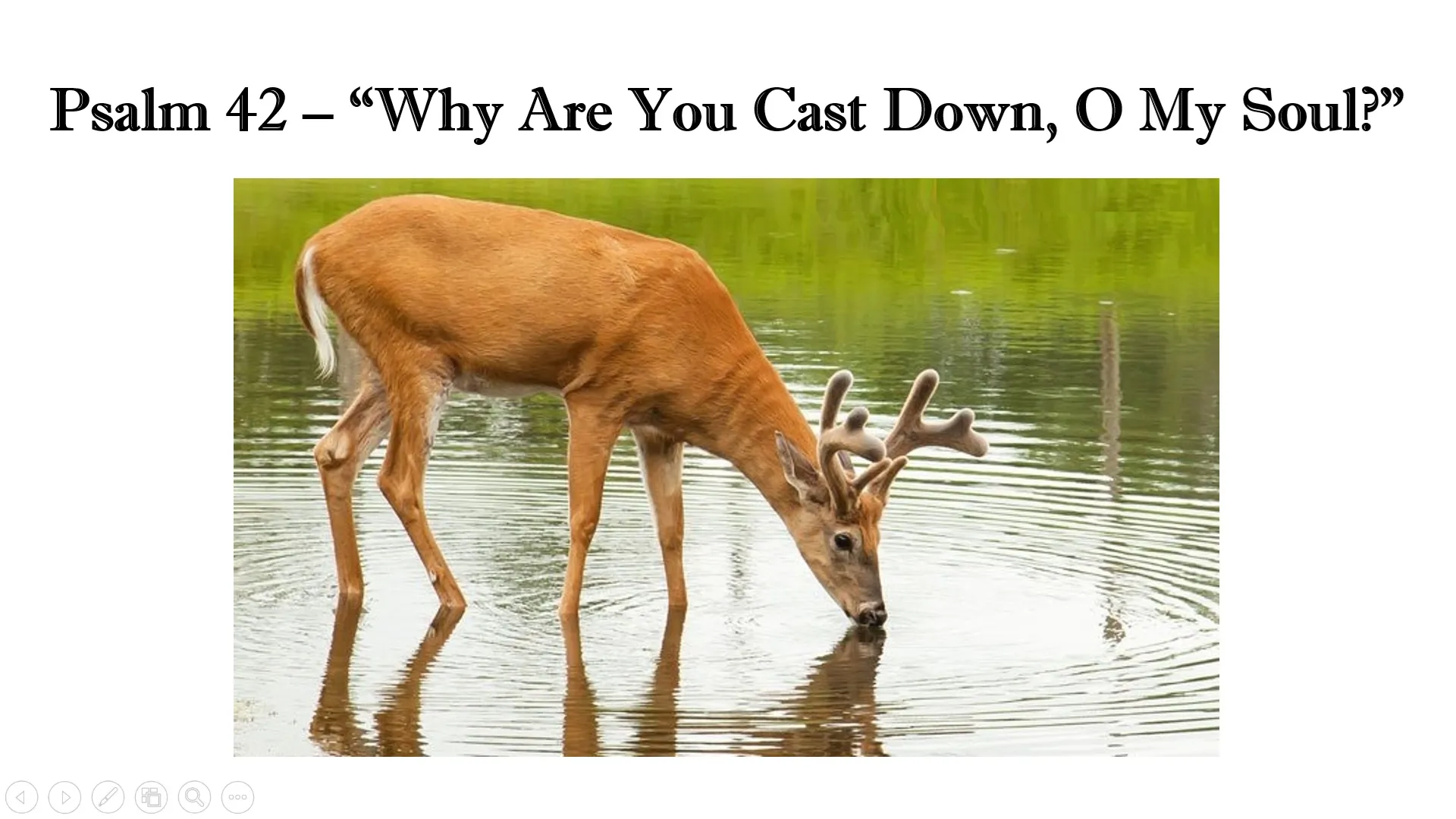
“As a deer pants for flowing streams,
so pants my soul for You, O God.
My soul thirsts for God, for the living God.
When shall I come and appear before God?
My tears have been my food day and night,
while they say to me all the day long,
‘Where is your God?’
These things I remember, as I pour out my soul:
how I would go with the throng
and lead them in procession to the house of God
with glad shouts and songs of praise,
a multitude keeping festival.
Why are you cast down, O my soul,
and why are you in turmoil within me?
Hope in God; for I shall again praise Him,
my salvation and my God.
My soul is cast down within me;
therefore, I remember You
from the land of Jordan and of Hermon,
from Mount Mizar.
Deep calls to deep
at the roar of your waterfalls;
all Your breakers and Your waves
have gone over me.
By day the LORD commands His steadfast love,
and at night His song is with me,
a prayer to the God of my life.
I say to God, my rock:
‘Why have you forgotten me?
Why do I go mourning
because of the oppression of the enemy?’
As with a deadly wound in my bones,
my adversaries taunt me,
while they say to me all the day long,
‘Where is your God?’
Why are you cast down, O my soul,
and why are you in turmoil within me?
Hope in God; for I shall again praise Him,
my salvation and my God.”
This is a roller coaster ride emotionally. Now, on one hand he’s downcast. He is in despair. But on the other hand, he won’t let go of God. The psalmist is a believer and he (or she) is expressing what’s going on the inside of them – an honest expression to God about his feelings – and they are all over the place! Spiritual highs and lows. How about you? Can you relate? Have you ever felt this way? Maybe you’re there right now, I don’t know. The fact is that, even for a born-again believer in Jesus Christ, life is hard.
Martin Lloyd Jones wrote a book based on Psalm 42 and its title was “Spiritual Depression.” It’s something that we all battle at one time or another. Remember last week we closed with a hymn: “Are we weak and heavy-laden, cumbered with a load of care? Precious Savior, still our refuge—Take it to the Lord in prayer.” This is a part of our lives. What we need to do when we are depressed is to do just that – take it to the Lord in prayer. When life gets you down, you go to God. And that is exactly what the psalmist is doing here in Psalm 42.
The psalm begins with a title… “To the choirmaster. A Maskil of the Sons of Korah.” A maskil means an instructive psalm. So, here again the psalmist is instructing us. And then, this is a psalm that was meant to be sung. We know that because of the sons of Korah. They were the song leaders. So, given that this is a song, and it is a sad song, I see it as the Hebrew version of “the blues”! Not all songs are happy songs, are they? Sometimes we cry when we sing. Sometimes we sing the blues. This is the case here. The psalmist begins by expressing the way he feels, his spiritual condition.
READ Psalm 42:1-2
Do you remember the picture I put up at the beginning of that deer that was drinking out of the river? Well, that’s where the psalmist WANTS to be. But he is not there. He’s longing, he’s thirsting for God. In these two verses here, he pictures himself as a deer wandering around the dry, parched land desperately in search of water. In Israel there are times of the year where it is really dry. And so, it would be common to see the deer just looking for a water hole somewhere. He is in a dry place spiritually and he’s longing for God. He is longing for the living God. His tongue is parched, spiritually. Isaiah 41:17 says, “When the poor and needy seek water, and there is none, and their tongue is parched with thirst, I the LORD will answer them; I the God of Israel will not forsake them.” And that is precisely the psalmist’s condition here in Psalm 42.
Now, this picture of God as being living water and satisfying our spiritual thirst is repeated by Jesus, isn’t it? And we studied that. Do you remember the woman at the well (John Chapter 4)? Jesus promises to give her “living water” (John 4:10). He tells her, “Whoever drinks of the water that I will give him will never be thirsty again. The water that I will give him will become in him a spring of water welling up to eternal life” (John 6:14). Then later in John Chapter 6 He says, “Whoever believes in Me shall never thirst” (John 6:35). Now, the psalmist realizes that God is his source of spiritual life, the refreshment for his parched soul. It is in God’s presence that he longs to be. He says, “When shall I come and appear before God?” in v 2. It is the longing of his heart to be back in the presence of God, to be revived spiritually. For whatever reason he feels distant from God. That happens in life. So, this is his condition. These two verses establish where he is at spiritually. And he is just being honest about it.
READ Psalm 42:3
“My tears…” He is literally crying. He is deeply saddened. And it is a sadness that will not go away. And then there are these people in his life, maybe even some of that might call themselves his friends, who question him. Basically, they are taunting him, “Where is your God?” Obviously, whatever situation this guy is in, to the people out there that are around him, it does not look good. They know the man is a believer and yet he is experiencing all of this turmoil in his life. So, they are basically saying, “Yeah, old boy, where is your God now? I thought that your God was a loving God. I thought He was a good God.” So, not only is he going through this terrible experience, but the people around him are not really being very nice.
By the way, we hear these same voices today whenever there is a tragedy like 9-11 or Sandy Hook or any major tragedy; people will question the very existence and the goodness of God. “Why would a loving God allow this to happen?” Those are the kinds of voices that the psalmist is hearing. And if we listen to those kinds of voices long enough, we can become discouraged. We can begin to have doubts of our own, a crisis of faith. So, we cannot listen to those voices.
[Class discussion about dealing honestly with our feelings, the struggles and the stresses of life; and the importance of having a community of Christian brothers and sisters that we can share those concerns with]
READ Psalm 42:4
That is a happy place! He is remembering a happy time in his life. He wants to go back there. He is pouring out his heart to the Lord and this is the memory that is brought back to him of better times when he was going with other believers on the way to Jerusalem for one of their festivals. This was a highlight of his life. Those were happy times! Here is the application: when we get distressed, we get discouraged, it is good to remember, to recall those times of spiritual blessing, spiritual high points in our lives.
So, he is remembering his happy times, but then he goes right back into despair in v 5. He is talking to himself…
READ Psalm 42:5
Whatever it is that is causing this man’s depression, it has not gone away. It is still there. It has not been resolved. And he is still going to be dealing with it. The circumstance that he is in, whatever it is, even after he has prayed, it is still there for a while. That is reality. This man is being honest with his feelings. He does not want to feel that way. But he is being real. We come to church and, yes, we as New Testament saints, we have the whole canon of scripture. And we have the book of Revelation. We can read about how it all ends. We should be the most hopeful of all. And yet you lose a love one, you lose a spouse, a child; people have a breakup of relationships. I am sorry, but you are going to feel sad.
So, these feelings are still there. The question is how are we going to deal with them?
Now, I want you to notice, he is talking to himself. That is OK. It does not mean he is crazy. He even answers himself. One commentary I read said that he gave himself a good talking to. He asks himself, “Self, why are you cast down, O my soul, why are you in turmoil within me?” And his response is not, “Get over it!” “Move on!” “Come on!” That is not what he says. What IS his response to himself (at the end of v 5)? “Hope in God.” He is reminding himself, “Yeah, I’m feeling blue, but I’ve got hope. I’ve got hope in the Lord. Self, you know, you are not going to be able to resolve this by yourself. You are going to need God’s help. Hope in Him.”
In v 6 he is still downcast – “My soul is cast down within me.” But then he remembers something else which encourages him to some degree. We do not even know what the significance of these things are. But he knows.
READ Psalm 42:6-8
So, he remembers three specific geographical places that he names, three specific locations that have a special place in his heart. At these places, at some point in his life, God was very real to him. Have you ever had those “mountaintop” experiences (literally) like in Colorado or wherever you went; some special place in your life? I call it a “spiritual marker,” where you can remember something of spiritual significance happened there with fond memories. This is what the psalmist is remembering here. We do not know what the significance of these places are, but he knows. And God knows.
I find it very interesting that the psalmist even recalls how he could see God in the roar of the waterfalls. But then, we see that despair takes over and right in the middle of the sentence about the waterfalls (v 7) he says, “your breakers and your waves have gone over me.” So, he is right back to his deep despair. And that is why I called it a rollercoaster. He is overwhelmed by his circumstances. And yet, he can affirm God’s “steadfast love” in v 8.
[One person in class saw this passage differently and observed the following: “I am going to go with this from a different direction. But this, ‘Deep calls to deep at the roar of your waterfalls; all your breakers and your waves have gone over me’ – that is a very positive thing. That is not a negative thing, because it says to me that we do not always hear clearly God’s voice but we always hear God’s voice. And sometimes it is like the roaring sound of the waterfalls that comes. And here he says, “I am getting overwhelmed by God’s presence. I don’t understand everything that is going on in my life. I do not understand everything You are doing in my life, but I trust in You.” So, in other words, the psalmist is not necessarily overwhelmed by his circumstances, rather, he is overwhelmed by God.]
Then in v 9 he is done talking to himself for a moment and now he is going to talk to God. So here he goes…
READ Psalm 42:9-11
“Why have You forgotten me?” he asks God. Now, has God really forgotten him? No. And we know that from v 8. He just affirmed that God has not forgotten him. He is just feeling overwhelmed. Let’s don’t hold that against him because I want to go somewhere with this. Do you remember the story of Job? And how his companions chided him and just gave him grief? Like his problems were not bad enough, then he had these so-called “friends.” I don’t really think they were friends. They criticized Job for the things that he was saying about God. Job was in this painful place in his life and Job responds to them in Job 6:26. He says, “Do you think that you can reprove words, when the speech of a despairing man is wind?” What Job was saying is, “Don’t judge me by what I saying while I am in pain. It’s just wind. It doesn’t mean anything.” People are going to say things when they are hurting. He knows God has not forgotten him.
[Class comments about God’s grace in the midst of our suffering]
The psalmist, as we can see in Psalm 42, is in obvious pain. Maybe it is physical (we don’t know). Certainly, it is emotional. And it is probably spiritually related to some degree. He’s hurting, whatever. Life is beating him up. He is not happy. He is drowning in sorrow. That is his reality. And he is not exactly surrounded by encouraging people. He closes in verse 11 the same way as he said before, “Why are you cast down, O my soul, and why are you in turmoil within me?” That’s his present reality. That is how he feels. Then he says, “Hope in God; for I shall again praise Him, my salvation and my God.” And that is his hope for the future.
We Christians, likewise, are hopeful for our future. Despairing as we might be at the time, we have a hope. That is what I want us to see.
OK, we are going to sing. Last week we sang my wife’s favorite hymn and so this week (when she is not here), we are going to close by singing my favorite hymn; which is appropriate for this lesson as believers; many of us experiencing some form of depression, going through different things. How many of you know the story behind “It is Well with My Soul”? It was written in 1873 by Horatio Spafford. He wrote the words to this hymn after the tragic death of his four daughters. The ship that they had been sailing in, along with his wife, collided with another vessel and sank. Miraculously his wife Anna survived. He is on his way across the Atlantic to meet up with her. As they sail near the very spot where the ship sank and his daughters had perished, he wrote this hymn. I think sometimes it is good to know the stories behind the hymns. This is one that has meant a lot to me.
[Instructions given on how we are going to sing this hymn]
When peace, like a river, attendeth my way,
When sorrows like sea billows roll;
Whatever my lot, Thou hast taught me to say,
It is well, it is well with my soul.
Though Satan should buffet, though trials should come,
Let this blest assurance control,
That Christ hath regarded my helpless estate,
And hath shed His own blood for my soul.
My sin—oh, the bliss of this glorious thought! —
My sin, not in part but the whole,
Is nailed to the cross, and I bear it no more,
Praise the Lord, praise the Lord, O my soul!
It is well (it is well)
with my soul (with my soul),
It is well, it is well with my soul!