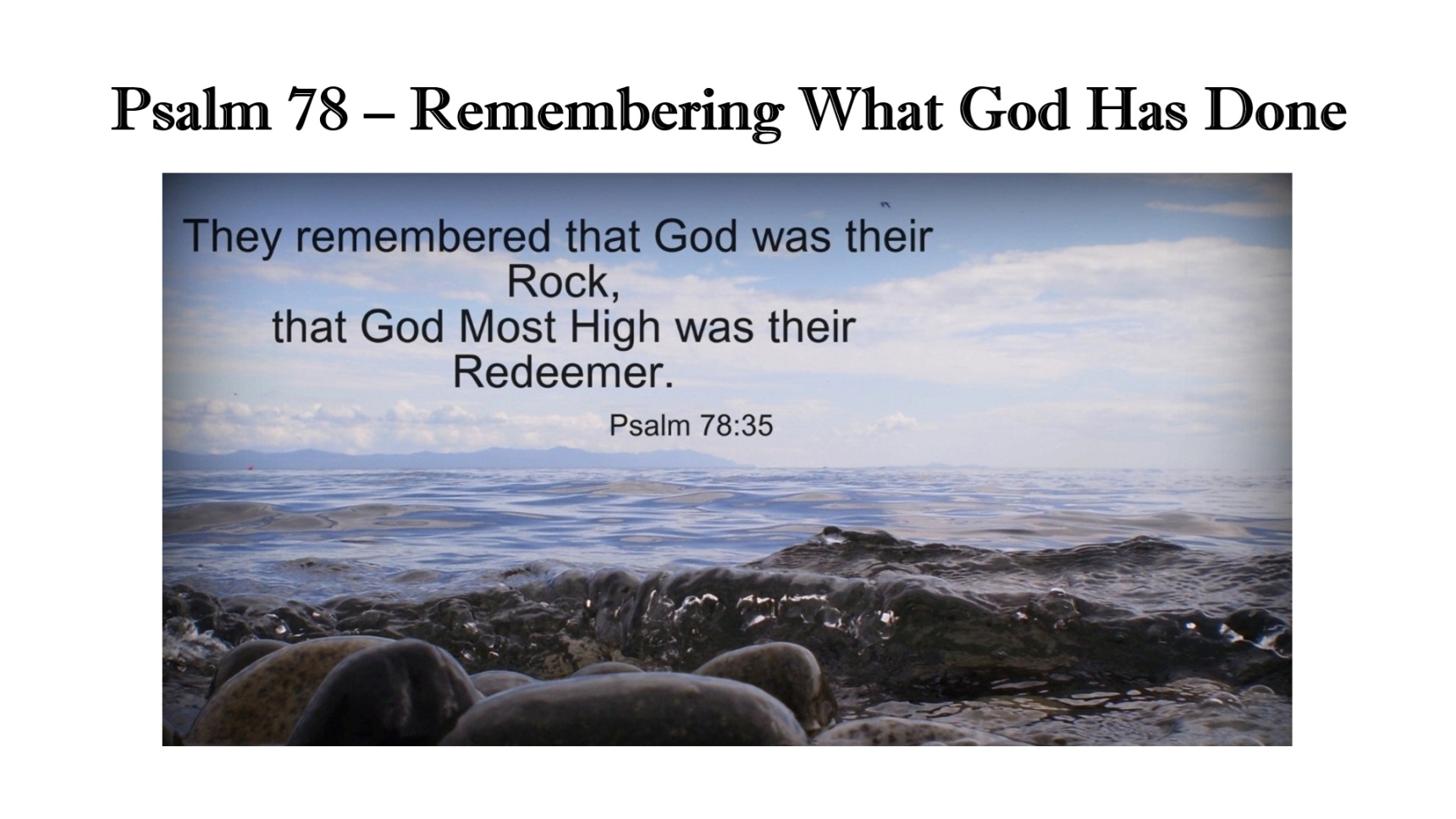
PSALM 78
REMEMBERING WHAT GOD HAS DONE
[In the original lesson, this psalm began a new study in the book of Psalms. I gave an introduction then which is not included here. For an introduction to the book of Psalms, see the Psalm 110 lesson]
We are going to be in Psalm 78 today. It starts off with the title, “A Maskil of Asaph.” Asaph was what we would call the minister of music today – in the tabernacle worship during David’s time. Remember, the temple had not been built yet. So, they were in the tabernacle there in Jerusalem. A maskil is a technical term, but it is simply a poem that is intended to instruct or to guide. There are 13 of these that are specifically identified in the Psalms. The idea is that, as you hear these words, you reflect on them and you consider, “what is it that God wants me to do with this instruction?” And really think about what God is telling you.
READ Psalm 78:1-4
God addresses His covenant people through Asaph. Under the inspiration of the Holy Spirit, Asaph writes these words to God’s people living in King David’s time. Asaph calls his readers to pay attention – “Give ear, O my people.” Listen up! He is not going to tell them anything new. These are things that they have heard before from their fathers and their mothers and their grandparents. They have heard these before. What he is about to say is so important that they need to hear them again. And what is it they need to hear? He says it there in v 4, “the glorious deeds of the LORD, and His might, and the wonders that He has done.” So, that is what Psalm 78 is going to be recounting for the people.
READ Psalm 78:5-8
So, God’s intent for His people is for them to experience His wonderful works, to learn His law, His testimony, His will, His love for them and then to trust Him and obey Him; so that, in turn, He can bless them. But not only that, God wants them to then – all that they have learned about Him through their experience and through the word – pass that on to their children. And then for their children to pass it on to their children and so on, and so on, and so on. Training children to follow the Lord was the responsibility, in the Old Testament, of the parents. By the way, it still is today.
Now, there are many parents out there, and I know of some, who take the attitude, “Well, I will just let my kids decide for themselves what they want to believe.” And if you take that approach then what is going to happen is that those children will probably end up going down what we call “the broad path of destruction” that the world follows. Because the world will teach them, won’t they? It will not be the ways of God more than likely and they will move away from God. So, it is imperative for us as Christian parents and grandparents and uncles and aunts – whoever we might be – that we, as much as we can, teach them the truth about God; teach them to know and to fear God.
Ephesians 6:4 (ESV): “Fathers [parents], do not provoke your children to anger, but bring them up in the discipline and instruction of the Lord.” I like how the King James Version says that – “in the nurture and the admonition of the Lord.” That is what we are to do.
We are going to get into a little history here. We all know the history of Israel. We have studied the Bible. They were not a faithful and obedient people. In fact, Asaph characterizes the people that we are going to be reading about in this psalm as, v 8, “a stubborn and rebellious generation, a generation whose heart was NOT steadfast, whose spirit was NOT faithful to God.” Does that pretty well summarize what you learned about the history of Israel in the Old Testament? So, Asaph is going to recount some of this history. And basically, he is saying, “Don’t be like them!”
Learn from the mistakes of the past. There is an old saying that goes, “Those who cannot remember the past are condemned to repeat it.” There is a lot of truth to that. We can learn from the past whether it was positives or negatives. And history is important as we do that.
Now right off the bat Asaph provides an example of what happens if we don’t pass the truth about God on to our children. I don’t want you to miss this.
READ Psalm 78:9-11
Who were the Ephraimites? The children (descendants) of Ephraim. Now, who was Ephraim? One of the two sons of Joseph – Ephraim and Manasseh. Joseph was spiritually a very strong man. There is not a whole lot spoken about the sons. But I can almost guarantee you that both Ephraim and Manasseh were a step down spiritually. Then they had descendants. There are a lot of generations that pass between the time that they are in Egypt and the time that is spoken about here. I believe that Asaph is speaking about the failure of the Ephraimites to trust God and keep His covenant.
In 1 Samuel Chapter 4 there is a story told about the Ark being captured by the Philistines at the battle of Aphek. The Israelite army was routed and the Ark was taken. The Israelite army was having a difficult time against the Philistines and they were being “whooped” pretty good. So, they said, “Hey, let’s go get the Ark out of Shiloh and let’s bring it up here and then we will have victory. God will fight for us.” And so, they went and got the Ark and that is when it was taken by the Philistines. Well, the Ark was housed at Shiloh which was in Ephraimite territory. So, the Ephraimites were the ones that had the responsibility to protect it. What had happened over the course of time, many generations, their religion had become so shallow that they actually trusted in the Ark to save them rather than to trust in God. So, they were routed by the Philistines.
It was a slow steady decline over many years from a complete trust in God (Joseph) to an empty form of religion – “Let’s rely on the Ark, let’s rely on this box.” And not relying on God Himself. They began to trust in their own might, their own religious façade rather than depending totally on God. That happened over time. Asaph simply provides a case in point about what can happen over several generations if the children are not reminded again and again and again, generation after generation, about the goodness and the greatness and the faithfulness of God.
SUMMARIZE Psalm 78:12-31
Now, v 12-31, for the sake of time I am just going to summarize for you. God delivers the children of Israel out of Egypt. He brings them safely through the Red Sea, splits the waters. They walk on dry land, which allows them to escape the Egyptian army. He leads them by a pillar of cloud by day and a pillar of fire by night. He provided water out of the rocks for the people. He actually did that twice. He did it once on the way to the Promised Land (Exodus 17). He did it again during the wilderness wandering (Numbers 20). And then He provided manna, which in this psalm Asaph calls it “bread of the angels.” He provided meat, gives them quail. And it wasn’t just enough food to satisfy their hunger pangs. The people were filled. They had an abundance. God does all of this for them on the way to the Promised Land and how did the people react? They murmured, they complained – negative, negative, negative. Remember the scene when they were out there by the Red Sea – “You brought us out here in the wilderness to die! We were better off in Egypt”
[Class discussion about why we should study the Old Testament and remember all the stories about what God did for His people in the past]
Is the God of the Old Testament different from the God of today? He is the same God. So, if we see the goodness and grace for His people for that time (in the Old Testament), what does that say about the God of today? He is faithful. There you have application for us today because GOD HAS NOT CHANGED.
Under the inspiration of the Holy Spirit, Asaph writes these words to the people of David’s time…
READ Psalm 78:32
In spite of God’s goodness, in spite of all that God did for them, they still sinned. This is God’s people!
READ Psalm 78:33
That does not sound very good, does it?
READ Psalm 78:34-35
There is a response. The people repented, which was good. But then you have v 36…
READ Psalm 78:36-37
Again, this is God’s people doing all this!
READ Psalm 78:38a
There is a scene (Exodus 32) when Moses is on top of the mountain and the people have just worshipped the golden calf. And God tells Moses, “I am going to wipe them out! And I am going to start over with you, Moses. They have been a stiff-necked people. They are rebellious.” But you know what – God did NOT destroy the people. Do you know why He didn’t? We know the story. We know that they went on to the Promised Land, so God did not wipe them out. Why didn’t He? Because Moses interceded for them. And God said, “OK.” By the way, we can learn from that story that there is something meaningful about prayer.
READ Psalm 78:38b
That is a gracious God because we deserve His wrath.
READ Psalm 78:39-40
Here is what I want you to take away from all this – God’s people had a serious spiritual problem. But eventually, despite that spiritual problem, despite all their failings, they made it. The vast majority of the people (they lost some along the way due to God’s judgment), made it to Kadesh Barnea, to the doorway of the Promised Land. God brought them there.
God’s plan was for His people to go in and take possession of the land. “It is yours. I promised it to you.” What happened instead? They formed a committee. What did the committee conclude? Now Caleb and Joshua gave a good report. They knew God had promised the land to them and were prepared to go in and take it. But what about the rest of them, the other 10? They said, “Giants are in the land. We are like grasshoppers. We are going to die!” They did not have any faith in God. Think about it. God had just parted the Red Sea. He had defeated their enemies along the way. He provided food and water for them. But they failed to see all that. And so, they…
READ Psalm 78:41-42
The “foe” here refers to Egypt.
The committee came to a most erroneous conclusion because they forgot who their God was. This is what Caleb said – I like what Caleb said because he had the right report – he said, “Let us go up at once and occupy it, for we are well able to overcome it” (Numbers 13:30). Why was Caleb so confident while the rest of the committee was not? He believed God. He trusted God. He knew that God keeps His promises.
Well, you know what happened next. God judged them for their unbelief. The judgment of God on that faithless generation was that all the people of that generation (except for Joshua and Caleb), everyone 20 years of age and older, would die off over the next 40 years. So, they wander around in the wilderness for 40 years and 600,000 corpses fall along by the wayside during that time. And if you have ever been out in the wilderness of Israel, that is a very austere and harsh environment. The wind blows all the time. The sand is in your face. It is hot in the daytime. It is cold at night. The ground is hard. It is not a very nice place to be. And that was never God’s intent for the people. His intent was for them to go to a land flowing with milk and honey and take the land – “I have given it to you.”
SUMMARIZE Psalm 78:43-51
What Asaph does next is he reminds them of what happened while they were still in Egypt. Well, while they were in Egypt what happened? They had this Pharaoh that came to power who did not know Joseph. He enslaved the people, put harsh taskmasters over them. The people cried out to God and God heard their cry. He raises up a national deliverer – Moses, right? And Moses along with his brother Aaron go to Pharaoh and they say, “Thus says the Lord, let My people go!” Pharaoh responds, “Get out of here. No way, I will not let the people go.” And this happens time and time again. And what happens? What does God finally start doing to Egypt, to Pharaoh? He starts sending plagues. What is interesting, if you read Exodus Chapters 7 thru 12, which describe the plagues, is that every one of those plagues that happened in the land of Egypt, God’s hand was over the land of Goshen where the people of Israel lived. When they had the frogs, the people in the land of Goshen did not have frogs. When they had the darkness, God was the light in the land of Goshen. God’s hand protects where the Israelite people were. And they knew it. They could see that.
So, not only did they have everything God did for them in the wilderness, but going all the way back to the plagues in Egypt they could see where God protected His people. The same group of people who were faithless, that did not go and take the land, they had seen all that too.
And then the very last plague – death of the firstborn – that was what finally got Pharoah’s attention and he let the people go. Even on that one, God gave the people grace. He says, “Look, this is what you do, kill the lamb, blood over the doorposts and when I see the blood I am going to pass over you.” And He did, right? He spared all of the people the death of their firstborn. He spared them that because they were obedient and did what He told them to do. From that point on they had the Passover celebration to remember what God did in Egypt, how He “passed over” and spared their firstborn.
The focus here, even though it is heavy on history is not on how awful the people were (and they were). Rather, it was on how good God is and was. That is the focus of Asaph. “Well, we wouldn’t be like THEM!” Well, maybe we would, maybe we wouldn’t. But God is the same. He is still gracious. He is still good. He still provides. And we still do not deserve it.
[Group discussion brought out an important point: the closer we get to God and we see His goodness and holiness in scripture, the more we are aware of our own sinfulness. The Holy Spirit and studying the word helps us to see that.]
SUMMARIZE Psalm 78:52-72
Let me fast-forward. This psalm goes on to say the people take the possession of the land. Then God tells them to wipe out all the inhabitants of the land because He knew that they would be caught up in idolatry if they did not. Well, they did not listen to God. They did what they wanted to do. They let the Canaanites stay there… idolatry, right? And Asaph is reminding the people of that failure. Despite that, God was still good to them and had grace and loved them. He was still faithful to them.
But that was the people of God and how they were. They had become so involved in idolatry and they had fallen so far away from God. Then they would then cry out to God whenever these oppressors would come. God would send a deliverer. There would be a time of peace and revival. Then they would go right back to their same old ways, over and over again. By the time you get to First Samuel, Eli and the priesthood was corrupt. And God had to get rid of Eli and kill his sons and raise up Samuel. And then there was a time of revival.
Asaph is recounting all of this, but when is Asaph living? He is living during the time of King David. So, even when we get to the end of Psalm 78, it certainly is not the end of the story, is it? No. Not by any stretch. Because this is Asaph writing from his time looking back – 450 years of Israel’s history he covers. We have the whole canon of Scripture to look to, reflect on, the goodness of God, don’t we? What is it that we see that maybe Asaph did not see? Well, Asaph did not see David’s sin coming. David murdered and committed adultery. Then he repented and God forgave him, but there was a punishment, there was a result for David’s sin. His baby son died and then later Absalom rebelled, took the kingdom away from David for a time. But God was faithful to David, wasn’t He? And He restored the kingdom back to David. Asaph did not see that coming.
And then Solomon began to reign and God gave Solomon great wisdom and riches. And despite Solomon’s heart being turned away from the Lord by the women that were in his life, his love of women, God remained faithful to Solomon. All during his reign there was peace in the land and unity.
And then the kingdom was divided. You had the northern kingdom and they completely rebelled against God. They slipped into idolatry big time. They did not have one good king. Ten of the tribes made up that northern kingdom and God sent prophets and they would not listen to them. Finally, God had enough and the Assyrians came and wiped them out. And then the southern kingdom (Judah and Benjamin made up that kingdom), which should have learned from the sins of their brothers to the north, they had some good kings like Hezekiah, but for the most part they were on again, hot and cold; and God sent prophets like Isaiah and Jeremiah to them. And they would not listen to them. Eventually God sent them away into captivity (to Babylon). But God promised through Jeremiah that after 70 years I will bring you out. And God kept His promise, didn’t He? After 70 years of captivity a remnant came back to live in the land.
And then God’s prophets announced over and over again about the coming Messiah and this one that would come and that would restore Israel and bring hope for the nation, would bring salvation. And in the fullness of time, God sends His only begotten Son to live with us – Immanuel, God with us. A baby is born, Jesus, right? And heaven cannot contain itself. Remember the shepherds are on the hillside and there are these angels telling them about Jesus and about Him being born in Bethlehem. All of a sudden there is the sky filled with the host of heavenly angels singing, “Glory to God!”
And then Jesus grows up and He lives among us. He displays the loving character of God for us to see. He makes the lame to walk. He makes the blind to see. He makes the deaf to hear. He raises the dead. He does all these wonderful things. He proclaims salvation. And it says in John that “We beheld His glory, the glory as of the only begotten of the Father, full of grace and truth” (John 1:14). “We saw that with our own eyes,” John says.
And the ultimate act of God’s love was Jesus dying on a Roman cross and paying our sin debt. “By His wounds we are healed” (Isaiah 53:5). We were saved. We were redeemed because of what Jesus did. But He did not stay dead, did He? No, just as promised, on the third day He rose from the grave. He defeated death. He appeared to His disciples and eventually ascended back to heaven. But before He did, He promised He was going to send a Comforter to us. And what happened on Pentecost? He fulfilled His promise. The Holy Spirit came. You had God in us.
Then you have the epistles that talk about what it means now in this new covenant that we have. What it means to live the Christian life. The struggles that we are going to go through and the fact that we have the indwelling Holy Spirit and the epistles tell us that we have victory over sin.
And then if that is not enough there is the book of Revelation. And we get to read ahead of us even now to see how it will all end! And right up to the very end people are being saved and brought to Him. And eventually Jesus does return as He promised with His church. He reigns for 1000 years, fulfills His promise to Israel, destroys sin and Satan. And then God makes a new heaven and earth, where we get to live for an eternity with Him. Asaph did not see any of that! And we do.
So, you want to be hard on the children of Israel for what they failed to see and understand. How much more us, with all that additional revelation about God. I just covered a small part of it for the sake of time. But that is my point. Asaph is trying to get them to remember their past. Look at our past – our own experience, the insights we have from the word of God. How much more are we without excuse today?
The goodness of God. You know what? God has been faithful all through the Bible. He will be faithful all to the end of time. I want us to focus on the faithfulness of God because God has not changed, has He? And God will not change. Long after we are gone, God will be God. He will be faithful to the coming generations.
Class, what I want you to focus on today is not history. Not even what Israel did wrong. I want us to focus on how good, how great God is. I want us to focus on His faithfulness to us personally, corporately, and throughout the ages. That is what we are going to sing about…
Great is Thy faithfulness, O God my Father;
there is no shadow of turning with Thee;
Thou changest not; Thy compassions, they fail not.
as Thou hast been Thou forever wilt be.
Great is Thy faithfulness!
Great is Thy faithfulness!
Morning by morning new mercies I see;
all I have needed Thy hand hath provided.
Great is Thy faithfulness, Lord unto me!
He is faithful. He has not changed and He never will.