PSALM 95
“OH COME, LET US WORSHIP”
This morning, we are going to be in Psalm 95. We are continuing our theme of worship. Last week in Psalm 84, we focused on our own hearts being ready to worship God. That was the essence of Psalm 84. Basically, what we said was that our worship should be a heartfelt response to God because of our love for Him and not merely done out of a sense of duty. Today, again, we are going to talk about worship, but this time we’re going to look at it from God’s perspective – what HE desires from those of us who come before His presence to worship Him.
When Psalm 95 was compiled, the writer was anonymous. They did not really know who it was. However, Hebrews 4:7-8 actually quotes from Psalm 95 and the writer of Hebrews attributes that psalm to David. So, if you believe as I do that all scripture is inspired by the Holy Spirit, then we can say with a great deal of certainty that Psalm 95 is a psalm of David (even though it doesn’t say so in the title).
Let me start with a question to get us thinking a little bit. Why is it that we come every week (or most every week) here to First Baptist Church Rockwall to worship God?
[Class answers included that we are instructed by God’s word to do that; to hear about and learn more about the Lord; we have a need to worship; good things happen in church including Christian fellowship]
Last week I used the marriage analogy and I made the point that even though coming to worship (corporately) is expected of us as believers (the Bible tells us to do that), what primarily motivates us is that we have a love for the Lord.
OK, this is just my observation… Far too often there is a tendency to view things from our own perspective (how I feel, how it makes me feel, does it apply to me, what’s in it for me, and so forth) and we forget that there is a much more significant heavenly perspective (other than our own). That applies to the whole concept of worship. From God’s perspective, why is it that HE wants us to worship Him? That really is what Psalm 95 is about.
The answer to that question is, biblically, because He alone is worthy! Consider the following verses… Second Samuel 7:22: “How great You are, Sovereign Lord! There is no one like You, and there is no God but You, as we have heard with our own ears.” First Chronicles 29:11: “Yours, Lord, is the greatness and the power and the glory and the majesty and the splendor, for everything in heaven and earth is Yours. Yours, Lord, is the kingdom; You are exalted as head over all.” Ephesians 3:20-21: “Now to Him who is able to do immeasurably more than all we ask or imagine, according to His power that is at work within us, to Him be glory in the church and in Christ Jesus throughout all generations, for ever and ever! Amen.” And there is that great passage when John gets a glimpse of heaven, Revelation 5:13: “Then I heard every creature in heaven and on earth and under the earth and on the sea, and all that is in them, saying: ‘To Him who sits on the throne and to the Lamb be praise and honor and glory and power, for ever and ever!’”
He is worthy of our worship. He alone – Father, Son and Holy Spirit, the Trinity, three in one. It is all about God! And it is our joy and our honor to praise and worship Him. That is the perspective I want you to look at.
Keep in mind last week’s lesson and our heart’s desire to come to Him and to please Him for what He has done and who He is; and then the whole idea that He is worthy of our worship – that is the background for Psalm 95.
READ Psalm 95:1
That is our call here, to come and worship God. From this verse we see that God desires joyful hearts. We sing, right? Now, some of us sing pretty well. And others, like me, not so much. But I do not think that God is concerned so much with how well we carry a tune (thank you, Lord). He knows our hearts.
I think it is interesting that the psalmist here, David, refers to God as the “rock of our salvation.” He, by His grace, through my faith, saved my soul! And that is something to just focus on, that God saved me. He is the rock of our salvation. That is foremost in the psalmist mind as he comes to worship God. So, we worship God with joy and singing. But that’s not all. Look at the next verse…
READ Psalm 95:2
What is thanksgiving? We praise God for what He has done for us, His blessings. So, we come to God with a deep sense of gratitude. Look at all He has done for us. Not only did He save our souls – that would be enough – but He doesn’t just stop there. He showers us with grace like rain. Blessings all around us, none of which we deserve. All I am and all that I have I owe to Him! When we worship God, He knows us intimately because He made us, right? He knows what is in our minds and our hearts. And He knows what is in them as we sing our songs to Him. What pleases God is that we have joyful and thankful hearts, even if we do not sing all that well. Our worship is sincere. We mean what we sing. Sometimes I just stand back and look at the words. I take them in. There is no pretense, just an honest, joyful expression of our love for Him and sincere gratitude. Jesus Himself said that “true worshipers will worship the Father in spirit and truth, for the Father is seeking such people to worship Him” (John 4:23).
READ Psalm 95:3
Simply put, just to summarize this, there is no one like our God. He is a great God. He is the sovereign Ruler of the universe. He is above all. And here the psalmist, David, reminds us that He is the Creator of all things. Look at v 4 and 5…
READ Psalm 95:4-5
From the deepest deep, from the bottom of the Mariana Trench more than 36,000 feet deep below the Pacific Ocean. All the way to the highest height, to the peak of Mount Everest, 29,090 feet high. God made it all. He formed it all with His own hands. He made all the seas and oceans and the dry land. It is an amazing thought.
Yes, we can view God from our own personal perspective, for what He has done in our lives. And that’s important. But let us never forget who God is. He is the Creator of the world. He is all powerful, all knowing, all present, eternal, sovereign, GOD! And He alone is worthy of our worship and praise! So, that is the gist of Psalm 95. We are going to transition now.
[One class member gave this observation: “From an outsider looking in (an unbeliever), it may seem that God is this all-demanding Presence that demands our praise. But the truth is that, when we know Him and love Him (because He first loved us), the praise is a natural byproduct just like breathing. To say that praise is a demand of God is to completely misunderstand what the Scriptures are saying.”]
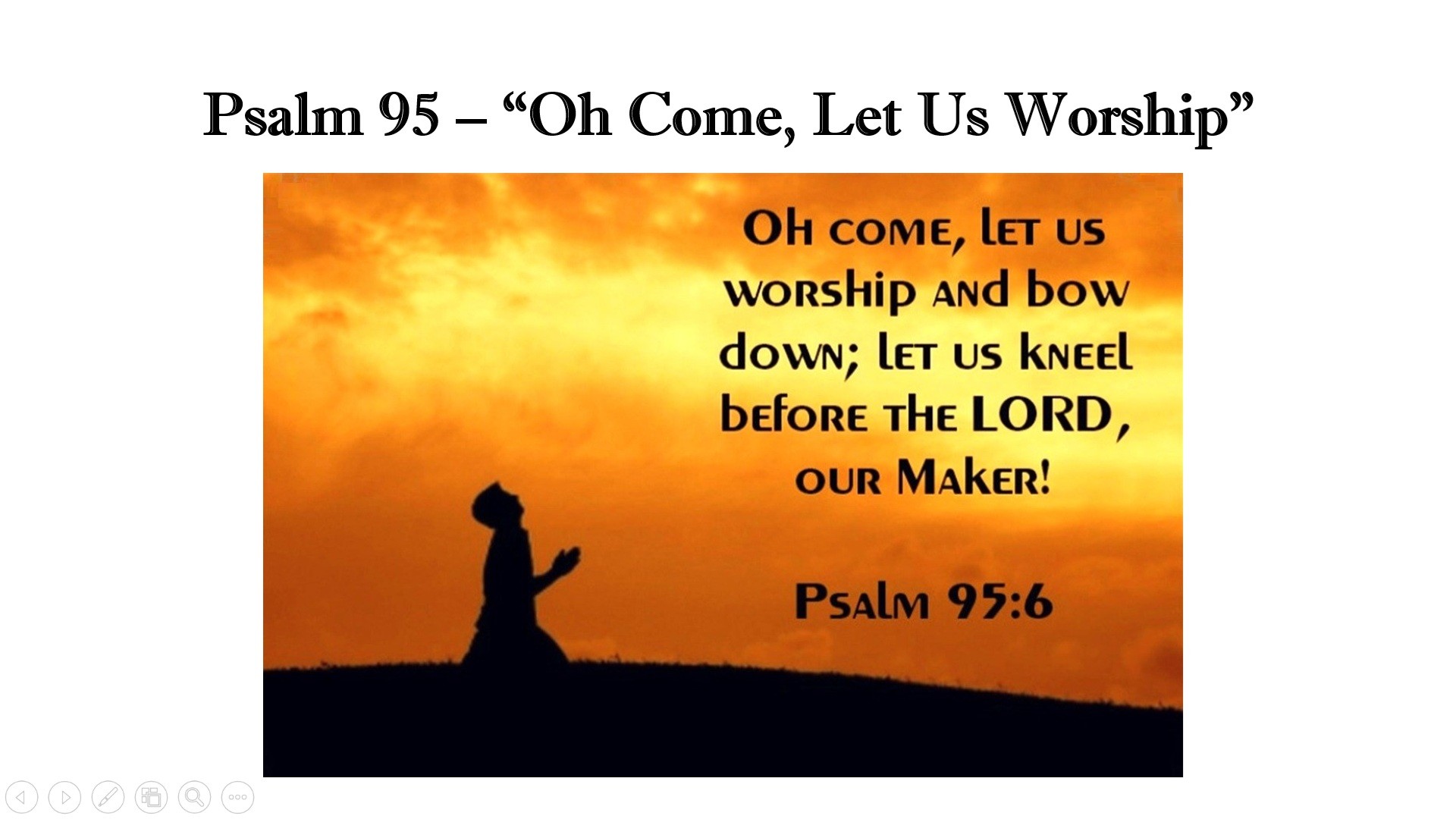
READ Psalm 95:6
This verse is a transition of sorts. The first five verses of this psalm have an upward perspective, exalting God. As we recognize and see how great and awesome God is, we are reminded of our own humble estate. HE is the Creator. We are the created. We were made in HIS image. We humbly come before Him. We submit ourselves to Him. And then, only after that, do we then begin to boldly bring our petitions to Him. And we do that through prayer. You can see some aspects of prayer here in this verse as we come and bow down and submit to Him, humbling ourselves in His presence (kneeling is a humbling posture).
Psalm 24:1 says, “The earth is the LORD’s and the fullness thereof, the world and those who dwell therein.” That verse reminds us that, as created beings, we belong to our Creator, “the LORD, our Maker.”
READ Psalm 95:7
Here again David, the psalmist, uses the same analogy he used in Psalm 23, where we are the sheep and He is the shepherd. But then v 7 stops in the middle of a sentence: “Today, if you hear His voice…” The question is not “Is God speaking?” The question is, “Sheep, are we listening?” Are we hearing what He is saying to us? Do we hear Him? Now, how does God speak to us? In an audible voice from heaven? Sometimes. He has done it before. He could do it again. Through dreams and visions? Again, sometimes. I think He still does. But normally, how does God speak to us? Through Scripture, His word; through the pastor; maybe even the teacher at times; through His messengers (fallible as they might be). I tell my wife all the time, “If God can use a donkey, He can use me.” And I mean that. But then also, God speaks to us through the Holy Spirit. So, worship not only involves our singing and our prayer, but it involves listening to and hearing His word.
I am just going to say this – In all my years of going to church, going to Christian type meetings where we had speakers (like when I was at seminary), and chapel services, revivals, going to Sunday School classes, and so forth, I have never heard a speaker one time stand up in front of the group at the beginning of their presentation and say, “You can all go home because God has nothing to say to you today. Come back next week.” I have never heard that. The truth of the matter is, God has something He wants His people to hear. And no matter how boring or how “human” the messenger may be, the truth is God can use them by speaking His word through them and His message to us. He has something He wants us to hear. He has a message for us. God wants His people to hear Him.
So, when God speaks His message through His messenger, through His word, through the Holy Spirit, we have two options and here they are:
Option #1 – We can say, “Yes, Lord, I agree with You, what Your word says. I submit to what You are saying.” I humble myself and say “I am going to work on that area of my life and I am going to do what you are telling me to do.” OR…
Option #2 – We can say, “No, I am not going to do that. That does not apply to me. It is irrelevant. NO!”
[One class member shared their real-life experience of how God spoke His message at a time in her life when she needed to hear it.]
I said that to say this: That Option #2, which I just mentioned, is what happens in v 8. “Today, if you hear His voice, do NOT do this (this is what you do NOT want to do) ---
READ Psalm 95:8-9
What is the psalmist talking about? He is talking about what happens in Exodus Chapter 17. Now, what is interesting about Exodus Chapter 17, did you know this? That it follows Exodus Chapter 14. Did you know that? Do you know what happens in Exodus Chapter 14? Probably the greatest miracle in the Bible – the parting of the Red Sea! Wow! Can you imagine seeing that? Can you imagine witnessing the sea part and you don’t walk through on mud, but you walk through on dry land? There is this wall of water on both sides of you. You go through this, a million-plus people, walk through this path to the other side of the sea; then they get to the other side, Moses stretches out his staff and here comes Pharaoh’s army and the sea just closes in on them. Then, the next thing you know, there are all these dead horses and soldiers lying dead on the beach! Can you imagine seeing that? Oh, the other thing about Exodus Chapter 17, is that it follows Exodus Chapter 16. Do you know what happens in Exodus Chapter 16? That is when the people are hungry and crying out to God for food. And what does God send? A miracle, manna, right? And then not only that, they get tired of manna and they ask for quail. So, God sends them meat. All these quail miraculously come in and the people eat and are satisfied. Then comes Exodus Chapter 17…
“All the congregation of the people of Israel moved on from the wilderness of Sin by stages, according to the commandment of the LORD, and camped at Rephidim, but there was no water for the people to drink. Therefore, the people quarreled with Moses and said, ‘Give us water to drink.’ And Moses said to them, ‘Why do you quarrel with me? Why do you test the LORD?’ But the people thirsted there for water, and the people grumbled against Moses and said, ‘Why did you bring us up out of Egypt, to kill us and our children and our livestock with thirst?’ So, Moses cried to the LORD, ‘What shall I do with this people? They are almost ready to stone me.’ And the LORD said to Moses, ‘Pass on before the people, taking with you some of the elders of Israel, and take in your hand the staff with which you struck the Nile, and go. Behold, I will stand before you there on the rock at Horeb, and you shall strike the rock, and water shall come out of it, and the people will drink.’ And Moses did so, in the sight of the elders of Israel. And he called the name of the place Massah and Meribah, because of the quarreling of the people of Israel, and because they tested the LORD by saying, ‘Is the LORD among us or not?’” (Exodus 17:1-7).
So, this is the incident that the psalmist is talking about.
Application: Do not come to God like that! With a bad attitude, complaining and murmuring and questioning God’s goodness. V 9, “They had seen My work.” They had seen what God had done and not that long ago. It wasn’t like it had happened generations before. No. This had just happened. And they had forgotten about it, and were just grumbling, and they had this really sorry attitude toward God.
Even Jesus with His own disciples, He had to rebuke them one time. He said, “O you of little faith, why did you doubt?” (Matthew 14:31). So even Jesus’s own disciples were guilty of that, right? So, the psalmist, David, is saying here, “Don’t be like them. Live your life with an expectant faith in God who loves you and cares for you. And He has proved it... time and time again!
[Brief discussion on the difference between being honest with God and complaining to Him. The problem with the people of Israel was their failure to operate on faith based on God’s covenant promise to them. Their hearts were hardened. They had a bad attitude and did not trust God.]
Look, it is not like their concerns were not legitimate. They were fearful. They were hungry. They were thirsty. Whatever. Those are all legitimate concerns. The problem was how they approached God, with unbelief. Even though “they had seen My work,” God says. They should have had faith. They should have believed that God was going to provide for them. They had seen God come through for them many times before. That attitude that the people had was due to the hardness of their hearts. And that made God sick. Look at the next verse…
READ Psalm 95:10
Failure to trust God. Failure to rely on Him was a problem with that generation. You know the whole story about what happened with Joshua and Caleb and sending in the spies to the Promised Land. When all that happened, God did not just strike them dead. He kept providing for them day after day for 40 years. He provided manna, water, and quail, whatever they needed to survive. He was faithful despite their complaining. But God says, “I loathed that generation,” a people who had gone astray in their hearts. They failed to trust Me. They did not have the right hearts. They were not filled with joy and thanksgiving and hope for the future like this psalm began with – that kind of attitude.
The whole point here is that we can learn from their mistakes. We should not be like that. And there were consequences for their attitude…
[At this point in the lesson I had technical problems, so this last part had to be recorded later]
READ Psalm 95:11
You know the story. Joshua and Caleb were the only faithful ones. Everybody else from that generation 20 years of age and older never got to experience living in the land of promise. What God intended them to have, they forfeited.
As I was preparing this lesson I was reminded of that song, “What a Friend We Have In Jesus” (my wife’s favorite hymn). There is a line in the first verse which says, “O what peace we often forfeit, O what needless pain we bear, all because we do not carry everything to God in prayer!” Unfortunately, there are times, if we are not careful, when we could become just like the people of Israel or even Jesus’s disciples. And the result is that we will miss out on some of the blessings that God intends for us to have.
No, we won’t lose our salvation. Praise the Lord, that is secure! But we could lose the joy of our salvation. We could rob ourselves of the peace that passes all understanding. When we get our eyes off Jesus and we start looking around at the prevailing negative circumstances in our life, we could become like Peter out there on the Sea of Galilee and begin to sink.
We have a dog. Tiny is our little Pomeranian. In the mornings when I go into her area in the utility room, she will roll over on her back. This is her way of submitting to my authority over her. She fully expects that I will do all this stuff for her and for the moment she humbly submits to me and says by her actions, “I will do whatever you say to do.” And that is how we are with God. But then later in the day after we put her outside because it is such a nice day and she really needs to be outside and not cooped up in the house all day – that dog will stand outside our patio door and literally for hours will bark. She is letting us know that she is not happy with her circumstance that we have placed her in. She has no regard or thought as to why we did it. She just does not like it. And she lets us know that she is not happy one bit. Far too often that is exactly how we are with God.
Let me close with some practical application for Psalm 95. We need to prepare our hearts for worship. Part of this involves leaving our negative thoughts and critical spirit out in the parking lot. We then enter His sanctuary and come before Him with the right attitude for worship: “I want to hear from You, Lord. I want to tell You what is heavy on my heart. But I also want to praise You for Your goodness to me, for saving me, and giving me all those blessings that I don’t deserve. God, I want to meet with You today. Speak to me, Lord.”
Then, as you sing the words to the hymns and the choruses, think about what you are singing. Make those words your personal words of praise. Participate in worship. Don’t just be a spectator at an event. Be a worshipper. Bring to God your highest praise. HE is worthy of our worship. HE deserves our very best.