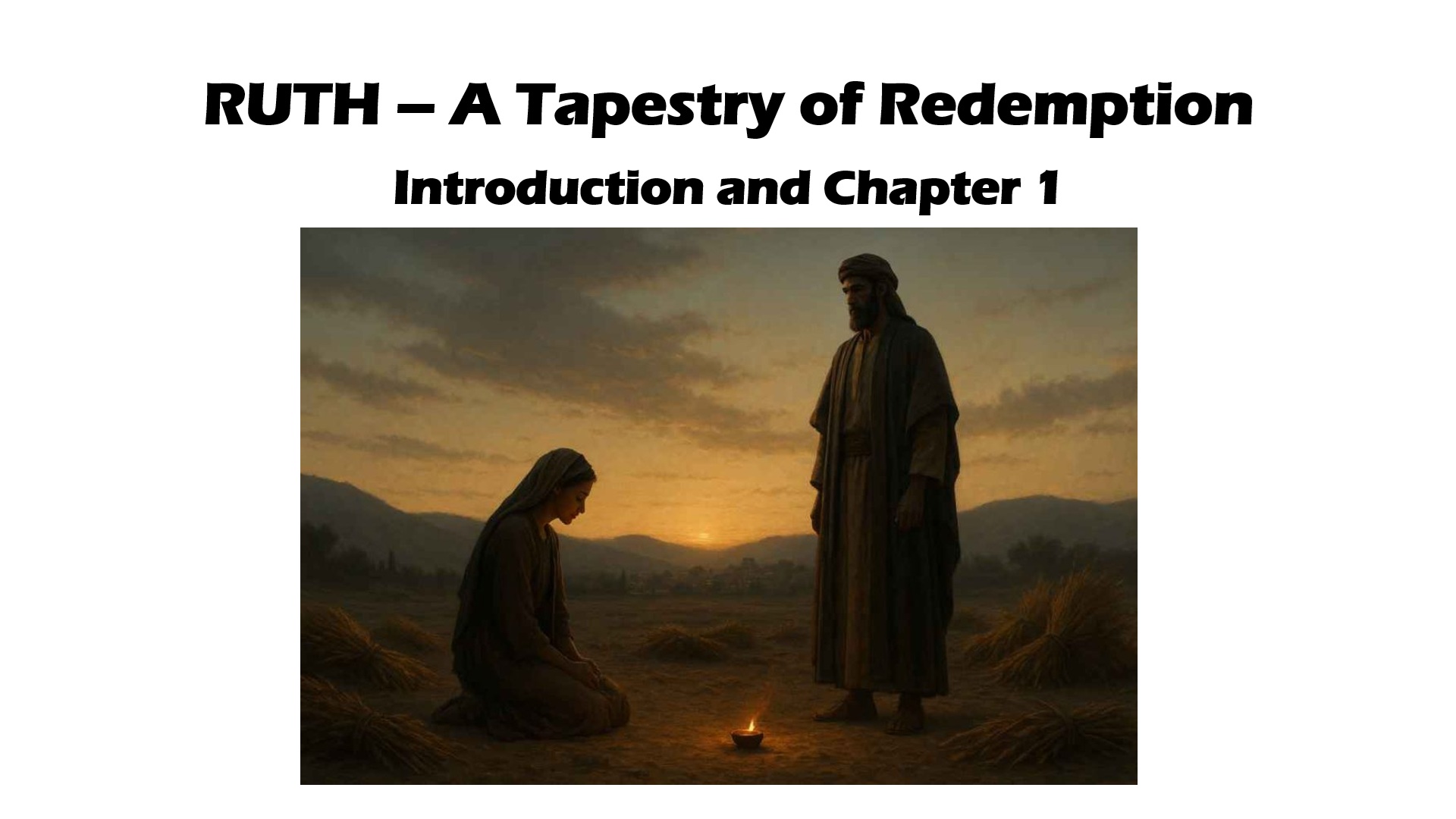
RUTH CHAPTER 2
The book of Ruth. It is much more than a love story, though it is – it certainly is that. When we think of Ruth, that is what normally comes to mind. Fundamentally, however, the book of Ruth is about redemption. The events that unfold in this book take place during a dark and dismal period of Israel’s history. That is the subject of Q1. The events of Ruth take place when? The Period of the Judges. In my commentary that I was looking at it said somewhere between Gideon and Samson is when the events we are about to look at most likely took place.
This feel-good story shines a ray of hope in the midst of turbulent times. The characters in the book of Ruth are ordinary everyday people. The title character Ruth is obviously a woman. In fact, she is a poor widow. We find out later that she is an ancestor of Jesus. But she is NOT an Israelite. There you have the answer to Q2. While Ruth may be the title character, she is not the main character. The main character in this story is One who remains invisible throughout, but is actively at work weaving a beautiful tapestry of redemption. That is why I call this study “A Tapestry of Redemption.” [We see] God’s hand at work throughout this book.
Life often resembles the backside of a tapestry, appearing to make no sense at all. Just a whole bunch of random events and loose ends; a tangled mess, at least from our perspective. As in the story of Ruth, we sometimes experience pain and suffering and sadness. Things do not always seem to make sense. The world around us can be very depressing at times. The situations may appear hopeless. But all along, God is weaving a beautiful tapestry. And if we could see the finished image on the other side of God’s design, we would realize that He has a plan, and that the end result will be something perfect. The book of Ruth offers us a snapshot from the Old Testament of the Master Craftsman at work. He is up to something even if what He is doing at the time may not make sense to us.
So, that is my little introduction into the book of Ruth. Let’s get started, Chapter 1 and v 1…
READ Ruth 1:1-2
In case you were wondering about “Ephrathites,” that is just another [term used] for someone from Bethlehem. Another name for Bethlehem was Ephrathah. So, that is all that means.
Q3 asks, what was it that drove Naomi’s family to leave Israel? A famine, right? Now, there are a lot of things that drive people to immigrate from their homeland. But in this case, it was a famine. We know nothing about this particular famine. It is not mentioned in the book of Judges. All we know is that its occurrence is during the idolatrous and evil period of the judges. So, it may very possibly [have] been God’s judgment on Israel. We don’t know that. The reason I say that is because the book of Deuteronomy warns that, if God’s covenant people are disobedient to Him (and certainly during the period of the judges they were), one of the judgments mentioned is a lack of rain and famine on the land (Deuteronomy 28:15-24). So, I am just saying that this could possibly have been one of God’s judgments. This famine forces Naomi and her family out of Israel, out of the land of Judah (the tribe of Judah’s territory in the nation of Israel). They left Israel and went eastward across the Jordan River and into the land of Moab. And that is where our story begins.
So, I have to make just a brief comment before we move on to v 3 about Moab. Q4 asks, True or false? The Moabites were Israel’s enemies. True. They were one of the primary enemies. They were so disliked that Moses in Deuteronomy 23:3 says, “No Ammonite or Moabite may enter the assembly of the LORD. Even to the tenth generation, none of them may enter the assembly of the LORD forever.” So, this judgment that barred these Moabites from entering Israel’s place of worship was pronounced because, if you remember the book of Numbers, of the terrible sin of Balaam who conspired with the king of Moab against the people of Israel. This was one of the judgments against the Moabites for that. So, if you were living in Israel and you were a Gentile proselyte from Moab, you were not allowed to worship with God’s people.
[At this point one class member pointed out that the Moabites were descendants of Lot (Abraham’s nephew) as a result of an incestuous relationship between Lot and his two daughters.]
So, the Moabites were actually distant relatives of the Israelites. But they were hated. I want you to keep that in mind as we go through the story.
READ Ruth 1:3-5
This is a very sad situation, right? Naomi and her two daughters-in-law are now poor destitute widows. So, what are they going to do? They do not have a whole lot of options.
Now, before we go on, I want us to talk about Q5, which I will admit (it was done on purpose) was a bit tricky. But I felt that it was important to consider at this point in our story. Naomi’s two sons, who were from Bethlehem in Judah, took Moabite wives. Was this permissible under the Law (the Law of Moses). Yes. It WAS permissible. Based on what the Law said, the Moabites were NOT one of the [people groups] that the Israelites were prevented from marrying.
In Q5 I referenced Deuteronomy 7:1-3. Based on this passage the only people groups that the Israelites were commanded NOT to marry were those from these seven nations who originally inhabited the Promised Land at the time of the Conquest (covered in the book of Joshua): “the Hittites, the Girgashites, the Amorites, the Canaanites, the Perizzites, the Hivites, and the Jebusites… You shall not intermarry with them.” As you can see, the Moabites were not on this list. The reason is because the Moabites lived outside the land, to the east of the Promised Land.
I just wanted to point this out because later in the story marrying Ruth is an issue that gets raised because she was not an Israelite. From the Law’s perspective, however, this is not a problem.
There is one caveat to what I just said and that is that no Israelite was to marry a foreigner who worshipped false gods. That [gets emphasized in] the book of Ezra. [The Israelites] were marrying all these [foreign] women who worshipped false gods. They were leading [their Israelite husbands] astray. So, if [a foreigner was an idol worshipper], you were not supposed to marry them either. But we know as we go through the story of Ruth, she was not a worshipper of the Moabite false gods.
[One class member commented that he believed Elimelech, Naomi’s husband, disobeyed God by leaving Israel and going to Moab. A couple of points here. First, there is nothing in the scripture passage that indicates this to be the case. It is only conjecture. Personally, I think it was an act of desperation by Elimelech to save his family from starvation. Second, it doesn’t really matter whether it was an act of disobedience or not. God was able to sovereignly use Elimelech’s decision for a divine good as He does with us whenever we make a move that falls outside of His will.]
Have you ever made a move that was outside of God’s will? We have all done it before. And yet God can turn that around for His good, can’t He? Whether or not it was God’s will does not matter. God was still able to use the events for good. That is the bottom line here.
Back to our passage, v 6…
READ Ruth 1:6
Q6 asks, why did Naomi decide to return home to Bethlehem after 10 years? She heard the famine was over. Naomi sees this as God’s hand of provision for His people. She says, “the LORD (Yahweh) has given them food.” With no husband to provide for her and no reason to remain any longer in Moab, Naomi decides to return to Israel, to head back to her hometown of Bethlehem.
READ Ruth 1:7-9
Q7 asks, what did Naomi instruct her two widowed daughters-in-law to do? To go back to their family’s home. To remain in Moab (they are from Moab) and to get remarried. As widows living in that day and time, they do not have a whole lot of options. Naomi actually has their best interests at heart here and she pronounces a divine blessing on them. But they have grown attached to Naomi through the years and are hesitant to part ways with her. So, they resist her request to leave.
[One class member pushed back against my statement that “Naomi has their best interests at heart” by sending them back to their pagan families instead of going with her to Bethlehem.]
Naomi knows that these two young women are from Moab. They are not from Israel and there [would be] a lot of problems for Moabites living in Israel. And Naomi knows that. Looking ahead in the story, we know what happens and, so, it is easy for us to second-guess Naomi’s decision. But it is not fair to do that. We have to put ourselves in Naomi’s shoes at this particular moment in time.
Here is where I am coming from, why I believe Naomi had their best interests at heart… I think that Naomi loved her two daughters-in-law. Therefore, she would not want anything bad to happen to them. She wishes divine blessings on them. She wants them to have a good life. She believes the chances are better for them to achieve this if they remain in their homeland, where they and their families were from; where they can receive the support that they need. In Naomi’s current state of mind and given her limited human knowledge, there is no way she could possibly know what the future holds. There is no way she would possibly know the events that would unfold in the rest of the book of Ruth.
We do the same thing with Joseph when we read his story [in the book of Genesis]. We read ahead and we say, “Oh, Joseph, don’t worry. You have it made here, buddy!” They (Joseph and Naomi) don’t know that! At this particular point in time they (Joseph stuck in that Egyptian prison and Naomi a widow in the land of Moab) don’t know what the future holds. Naomi only knows about all the negative things that relate to Moabites back home in Israel. Naomi has been away from home for 10 years. She does not know how things have changed. She does not know if any of her own family is still alive. There is a lot of uncertainty for Naomi, much less her daughters-in-law. So, she reasons that since they are widowed and are still relatively young, they should stay in your homeland; go back to your family’s homes and marry Moabite men. Just from a human standpoint, this made the most sense to her at the time.
No matter our personal opinions of Naomi, I believe that she had a heart of love for her daughters-in-law and they had love for Naomi. They were fond of each other and they resisted Naomi’s suggestion to leave. But Naomi says, “Look, it is a long trip back home. No guarantees. Stay here.” She is just looking out for their best interests. The fact is that God is still at work in Naomi’s life even if she cannot see it. That is the picture I believe [the author] is trying to paint here. Not a bunch of disobedient, evil people running away from God. But rather everyday ordinary people trying to live their lives the best way they can. And just trying to survive. This is how I read the text.
And that takes us to v 10…
READ Ruth 1:10-13
Naomi says, “My future is completely uncertain. I do not know what is going to happen to me. If you stay with me there is so much uncertainty ahead. There is a little more hope and certainty if you were to remain here in Moab.” Just given the situation as it stands right now, this seems to make the most sense. In addition, Naomi feels like God’s hand has struck a blow on her life. Have you ever felt that way?
There are a lot of things Naomi knows about life in Israel. She knows about the Jewish ban of Moabites from the worship center. [She is aware of the] negative views of Moabite women in general in the land of Judah and Israel. So, she says, basically, “There is no place for you in Israel. It is better for you to stay here where you belong and where you can find husbands and have a future.”
And that is where the book of Ruth ends, right? THE END. Is that where it ends? NO! It does not end there, does it? There is more. We still have three more chapters to go and a bunch more questions to answer. It can’t be over!
READ Ruth 1:14-15
Orpah leaves and heads home. Naomi urges Ruth “Go with Orpah, your sister-in-law.” But Ruth clings to Naomi. She refuses to leave. She remains loyal to Naomi even though she knows, from a human standpoint, that she would probably be better off in Moab. The statement that Ruth makes next reveals, not that she is a prophetess, but her character. And it reveals her opinion of God. We see something about Ruth that we have not seen up to this point.
This is really the hinge text for the whole book…
READ Ruth 1:16-17
Now that is commitment! Q8, True or false? Ruth’s loyalty extended beyond her relationship with Naomi. That is absolutely true. Her loyalty extended beyond merely her human relationship as a daughter-in-law and a mother-in-law. But it extended to her relationship with Naomi’s people. She wanted to have a relationship with her people. She wanted to have a relationship with Naomi’s God. Now, Orpah could have done the same thing had her heart been in the same place. She could have said “No” and made a similar statement. But she left. This reveals something unique about Ruth’s character. She stays, completely uncertain about what her future holds. She doesn’t know how the rest of the events are going to unfold.
I want us to stop here for a moment and think about what I just said. I want you to put yourself in Ruth’s place at this point in time. I do the same thing whenever I study the story of Joseph, when he is sitting in that prison and things seem so hopeless. You have to put yourself in their position. How do they know that [their current situation] is ever going to end? How do they know how the rest of the story goes? They don’t. We always read the stories because we know the end and we can feel good about it and all that. But, if you put yourself in [Ruth’s] position, you do not know how this is going to turn out, do you?
So, she [Ruth] is committing herself to go to a place she has never been before; to a land with a different language and strange customs (a lot different from hers). She must know about the people of Israel and that they are not very fond of Moabites. Certainly, Naomi has told her that. This is a huge leap of faith for a young Moabite woman. As I read v 17, Ruth is not just committing herself to Naomi. She is trusting in the sovereignty of Naomi’s God.
Nelson’s Commentary says this about v 17: “In effect, Ruth was forsaking all that she had ever known to follow the one true God. She was following in the footsteps of Abraham, who had forsaken his family and his homeland in response to God’s call.” Very similar. Nelson’s Commentary is drawing a parallel between Ruth’s commitment here and Abraham’s commitment [in the book of Genesis]. Both believing that to be what God wanted them to do. So, this is quite a statement and reveals her character.
READ Ruth 1:18-19a
This is what I love about the Bible. We have read [the book of] Acts and we have read all these other books and it makes these trips sound like they just took a Greyhound Bus and went from one town to the next. This is a long trip! This is 70 miles through wilderness where you would descend from the high plains of Moab down into the Jordan River Valley (around the Dead Sea) and then a steep ascent climbing the mountains back up the other side into the hills and toward Bethlehem. This was no easy trip. I don’t know how old Naomi is but these are two women who were traveling alone and so, the trip was dangerous. It was a long trip and it would have taken them easily a week or ten days. And they were on foot. They did not have a beast of burden to ride on [at least as far as we know].
READ Ruth 1:19b
So, Q9, Naomi’s homecoming was WHAT? Sorrowful. She is not in a good mood. She is not is a good place, is she? We saw that as she was leaving. Now that she has returned home things have not got any better. She is just more sorrowful. Now she is tired, hungry, and cranky.
And then Q10, when the women of Bethlehem said, “Is this Naomi?” what did they mean? They were unsure that it was really Naomi. Ten years has gone by, right? She probably had aged quite a bit. Were they pleasantly surprised to see her? It does not seem that way. Maybe some were. I would say that [Q10 has one of two answers. First, they were not sure if this was really Naomi. Which leads to the second answer, which is,] that her appearance had changed quite a bit. And not for the better. She probably did not look like herself at all. People who have had hard lives, it shows on their face, doesn’t it?
READ Ruth 1:20
Naomi laments the terrible hand she has been dealt – no husband, no sons, [and] no grandchildren. At this point she feels like she has no family and no future. She is very distraught, very sad. [She is a] very bitter woman. She is not in a good way.
Q11, True or false? Naomi blamed God for all the sorrow she experienced. True. That is what she said, right? “The Almighty has dealt very bitterly with me. He has done this [to me].” Have you ever blamed God? [I will confess that] I have blamed God before. I remember when I got jilted a few times in love. “God, why are you doing this to me?” It had nothing to do with me. I was not the problem. [That is what I told myself anyway]. It happens, right? So, this is where Naomi is. She is blaming God. She is going through a rough period and we can all relate. And she has no idea how the story is going to turn out. Now, we do. We want to go up to Naomi and put our arms around her and tell her, “It is going to be OK. God is at work in your life and it is all going to be OK.” But even if we could do that, she would not listen to us. She is absorbed with self-pity.
READ Ruth 1:21-22
Naomi’s pity party continues. Q12 asks, in Naomi’s self-pity she laments her sad life, saying, “The LORD has brought me back empty.” But Naomi actually brought back ONE BLESSING that she did not leave home with. What was that? It was her daughter-in-law, Ruth.
V 22 is a transition verse that offers a ray of hope. Naomi doesn’t know it yet, but all of the sadness and despair that she is experiencing, that overwhelms her, is about to change. And God is going to use a chain of unlikely events centered around Ruth, her Moabite daughter-in-law, to restore her joy. But she does not know that yet.
Right now, we, like Naomi, may only see a tangled mess of loose ends. But a beautiful tapestry is beginning to take shape. That is what I want you to see. When Chapter 1 opened there was a famine in the land. But as Chapter 1 closes, there is a barley harvest! So, things are looking up, aren’t they?
Questions
Note: To better help you to answer these questions you are encouraged to use the English Standard Version translation of the Bible.
RUTH – A Tapestry of Redemption
RUTH CHAPTER 1
Introduction
1. According to v 1, when do the events recorded in the book of Ruth take place? The Period of the ________. (Circle the best answer)
PATRIARCHS CONQUEST JUDGES MONARCHY
2. Which of the following statements is NOT true about the title character of this book? (Check the best answer)
___ The title character is a woman ___ The title character is an Israelite
___ The title character is an ancestor of Jesus ___ The title character is a poor widow
Ruth 1:1-5
3. What was it that drove Naomi’s family to leave Israel? (Check one)
___ A famine in the land ___ A civil war broke out ___ A great flood
___ Political persecution ___ Religious persecution ___ God’s call
4. True or False? The Moabites were Israel’s enemies (Hint: Deuteronomy 23:3).
T F
5. Naomi’s two sons, who were from Bethlehem in Judah, took Moabite wives, v 4. Was this permissible under the Law? See Deuteronomy 7:1-3. (Check the best answer)
___ No, it was NOT permitted because the Moabites were enemies
___ Yes, it WAS permitted because the Moabites were not included in the list of nations to avoid who were original inhabitants of the Promised Land
___ Yes, it WAS permitted because the Moabites technically were distant relatives of the Jews
___ No, it was NOT permitted because the Moabites were foreigners
Ruth 1:6-14
6. Why did Naomi decide to return home to Bethlehem after 10 years? (Circle best answer)
SHE WAS HOMESICK GOD DIRECTED HER THE FAMINE WAS OVER
7. What did Naomi instruct her two widowed daughters-in-law to do? (Check ALL that apply)
___ To go back with her to Bethlehem ___ To remain in Moab
___ To return to their family’s home ___ To get remarried
Ruth 1:15-18
8. True or false? Ruth’s loyalty extended beyond her relationship with Naomi.
T F
Ruth 1:19-22
9. Naomi’s homecoming was… (Circle one) JOYFUL SORROWFUL HOPEFUL
10. When the women of Bethlehem said, “Is this Naomi?” in v 19, what did they mean? (Check the best answer)
___ That there had been a drastic change in Naomi’s appearance
___ That they were pleasantly surprised to see Naomi looking so well
___ That they were not sure if this was really Naomi or just somebody that looked like her
11. True or false? Naomi blamed God for all the sorrow she experienced.
T F
12. In Naomi’s self-pity she laments her sad life. She says, “The LORD has brought me back empty.” But Naomi actually brought back ONE BLESSING that she did not leave home with. What was that? Hint: v 22.
__________________________________________