RUTH – A Tapestry of Redemption
RUTH CHAPTER 4
We are going to wrap up our study in the book of Ruth. When we left off last time Ruth and Naomi were at home and they were waiting to hear what will happen with Boaz. Boaz has gone to meet somebody; an important meeting with an unnamed man (we just call him the “nearer kinsman”). He will either marry Ruth [and] be Naomi’s family redeemer OR Boaz will. There is a legal process that must be followed. For now, the outcome has yet to be determined. Boaz has gone to settle things.
So, we are going to pick it up in Ruth Chapter 4 and v 1…
READ Ruth 4:1-2
Q1, where did they [Boaz and the others] go to settle their redemption issue? The city gate. [In class I showed a picture of a typical city gate from that time period located at the city of Beer-sheba. It was a rectangular area approximately 20 ft by 30 ft with stone benches along the walls for people to sit in]. In the city gates it was very similar. You had the city gate itself and then off to one side there was this little place where people could sit and meet and they could discuss things. It was where official business occurred in the city. They did not have a city hall building, so this is where they would meet.
All the required parties have convened. They are sitting there. You have Boaz. You have the nearer kinsman (who remains unnamed) and ten elders of the city. So Q2, who is NOT mentioned in the list (I gave a list of several people to choose from) that is not at this meeting? Who is not there? Ruth and Naomi are back home waiting. And there is no local magistrate present. That is not how they did things. They just had the city elders. What you need to understand is everyone required to be there is there. It is time to discuss the business at hand. V 3…
READ Ruth 4:3-4
So, in other words, “You are a nearer redeemer than I am.” Q3 is a bit tricky, so be careful. True or false? The nearer kinsman is willing to redeem property BOAZ is selling. This is false and why? It is not Boaz’s land that he is selling, is it? Whose land is it? It is Naomi’s land. So, Naomi is selling the parcel of land that belonged to Elimelech. That was her husband, right? It belonged to him. What happened to Elimelech? Why doesn’t he own it anymore? He is dead! And so are the people he would have passed it on to, his sons. They are dead too. And so, this property got passed down “by default” to his wife Naomi. Boaz is simply Naomi’s representative at this meeting. So, it is not his property. The nearer kinsman states his willingness to redeem the land. But Boaz has not told him the whole story. Not yet. So, he continues…
READ Ruth 4:5-6
Q4, when Boaz mentioned that the property to be redeemed included Ruth and that he would be required to have a child with her, what was the nearer kinsman’s response? He changed his mind. He became less than enthusiastic about the whole thing, didn’t he? The nearer kinsman states his reason for declining the offer. He says basically, “It would jeopardize my own estate.” It is not just that he is taking on two additional people. He was thinking long-term. He does not want to split his inheritance between his own sons and additional sons that he would get with Ruth. So, he declines. He says, “It is going to mess things up for me. It is going to complicate things.” So, he backs off for that reason.
Now, this is the outcome that Boaz was hoping for.
To make things official, to make this a legal transaction, the two parties follow an unusual practice (to us). It is actually borrowed from Deuteronomy Chapter 25.
READ Ruth 4:7-8
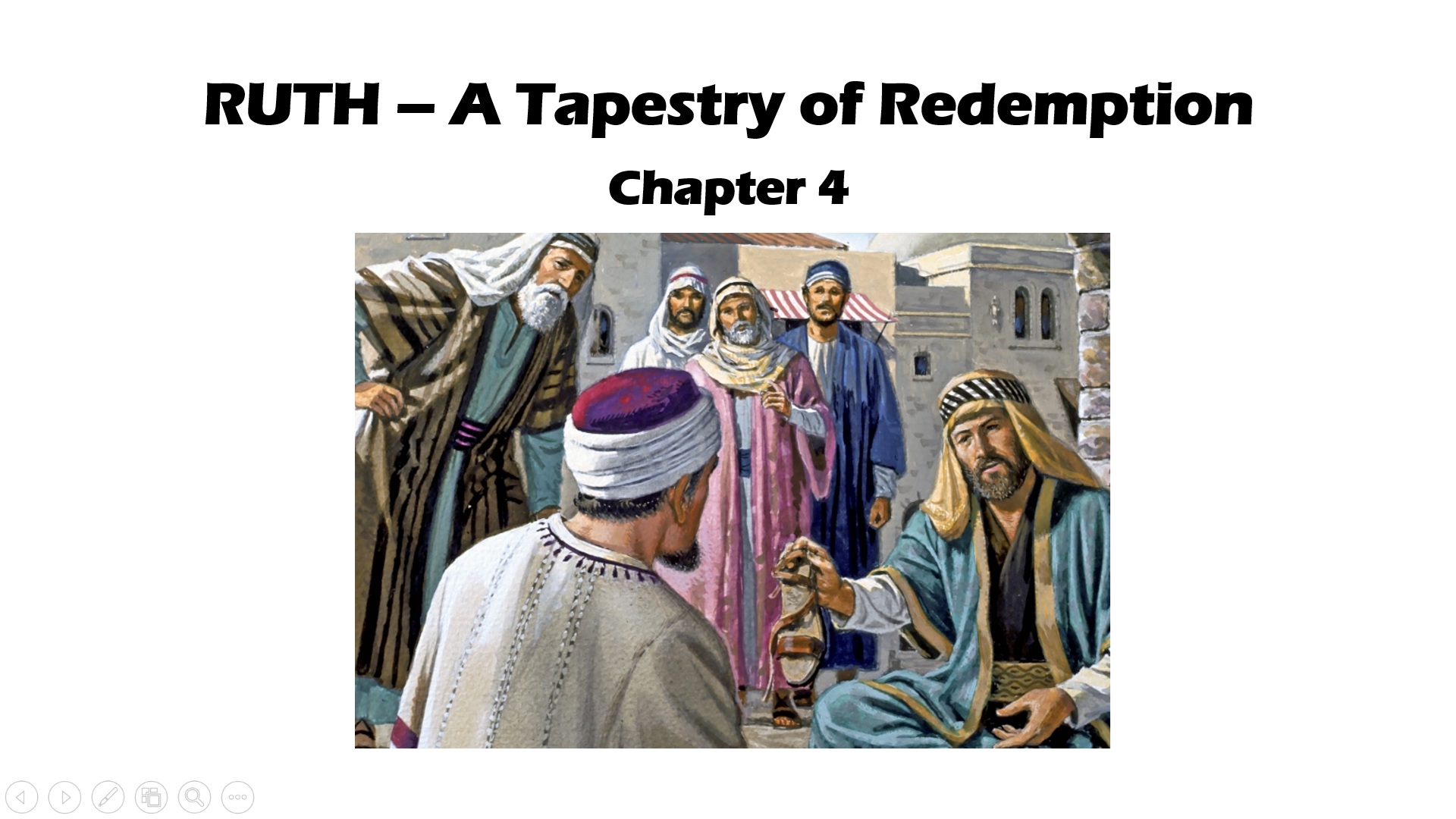
Q5, what ancient Israelite custom did Boaz and the nearer redeemer follow to complete their transaction? The removal of a sandal. This nearer kinsman declines the offer to redeem Naomi’s property by taking off his sandal and handing it to Boaz. This symbolizes that he is handing over his rights to Boaz. Boaz now has the right to walk on Naomi’s land as his property. The city elders witness this agreement. And with that, this unnamed nearer kinsman (that has been so important in the story) disappears from the scene never to be heard from again.
READ Ruth 4:9-10
Q6, True or false? After the nearer kinsman refused, Boaz declared he would redeem the land and marry Ruth. True.
What Boaz does here at the city gate is more than just a nice gesture. [It is] more than him just showing compassion. If you read the Law of Moses, specifically Deuteronomy 25, being a family’s redeemer was among the most noble [of] actions in Israel. At the same time, failing in your responsibility to be a family’s redeemer was considered disgraceful. That is probably the reason why the author does not mention the nearer kinsman’s name in the book of Ruth -- because in their culture it was not a very noble thing that he did.
I am going to read a passage from Deuteronomy 25 that helps to explain the significance of what we just read here in Ruth Chapter 4. This is what Moses said: “If brothers dwell together, and one of them dies and has no son, the wife of the dead man shall not be married outside the family to a stranger. Her husband’s brother shall go in to her and take her as his wife and perform the duty of a husband’s brother to her. And the first son whom she bears shall succeed to the name of his dead brother, that his name may not be blotted out of Israel. And if the man does not wish to take his brother’s wife [to fulfill his obligation], then his brother’s wife shall go up to the gate to the elders and say…” (Deuteronomy 25:5-8).
So, let me stop right there. This is precisely Ruth’s situation. There is no one left in the immediate family to perform the duty of having a son with her in order to preserve the family name, in this case Naomi’s family. It was not that the brothers refused (as in Moses’s example here). It is that they died. But the end result is the same. They cannot perform the duty.
The law at this point requires that the childless widow, in this case Ruth, go to the city elders and inform them of the situation. Well, Ruth is not there. Boaz is speaking on her behalf. Ruth is an outsider. She is a Moabite. There may even be a little bit of a language issue since she is a foreigner. So, Boaz speaks for her. In the end, when the nearer kinsman turns down his right, Boaz agrees to be the family redeemer and to marry Ruth. So, the Jewish citizens in that town, aware of the requirements of the Law, celebrate this. It is a big deal!
Q7, who is referred to 4 times in this section of Ruth as “the redeemer”? V1, v3, v6 and v8. The nearer kinsman. “The redeemer” in all four cases is referring to the nearer kinsman. I find that interesting because the nearer kinsman was more like a “would-be redeemer.” As it turns out the REAL redeemer is Boaz, right? Yet, not once in the book of Ruth, is Boaz referred to as “the redeemer.” He is called “a redeemer” and “one of our redeemers.” But Boaz in the end in fact is THE redeemer in this story. Isn’t that interesting? That is one of the nuances of the book of Ruth.
Q8, again this is a little tricky. According to v 10, what was Boaz's reason for marrying Ruth? It was to perpetuate the family name. That is what it says.
[One class member asked if the answer could also be “To have many children”? That was one of the choices. I pointed out that, technically, all you need is ONE male heir to perpetuate the family name.]
READ Ruth 4:11-12
Apparently at this point there are a lot of people that have gathered around. They were hearing about what is happening. It is a small town. Word travels, right? “Hey, there is something going on at the city gate.”
V 12 mentions Tamar, Judah and Perez. We are going to talk more about them toward the end.
Q9, the people of Bethlehem were very pleased with the decision Boaz made to marry Ruth. So, what did the people do for Boaz and Ruth in response? There were actually two things mentioned in this text that they did. They declared themselves as witnesses and they pronounced a blessing on Boaz and “this young woman,” of course referring to Ruth.
READ Ruth 4:13-17
Q10, what is implied [happened] soon after Ruth and Boaz were married? A baby is born. V 13 says, “the LORD gave [Ruth] conception, and she bore a son. One commentary that I read pointed out that Ruth and her first husband Mahlon had been married for 10 years before he died and yet they were childless. The author is emphasizing the sovereign hand of God here in Ruth’s pregnancy.
Q11 asks, what reasons do the women of Bethlehem offer for Naomi’s sorrow now being turned to joy? I gave you several [choices]. All of the reasons listed are correct. God’s provision of a family redeemer; the birth of a grandson; the love of her daughter-in-law; and that someone to care for her in her old age. All four.
Q12, what was the name of the son born to Boaz and Ruth? Obed.
Now, the narrative ends on a happy note with all of the tragedies that took place at the beginning of the book being reversed. The deaths of Naomi’s husband and her sons are counteracted when Ruth remarries and gives birth to son.
Throughout the book of Ruth, we see evidence of God at work behind every scene. He orchestrates the circumstances and choices of the various individuals. Naomi’s tragic losses at the beginning led her to believe that God was somehow punishing her. In reality this whole story – all four chapters – is about God working to bring healing to Naomi and her family. And He does this through an unlikely Gentile girl named Ruth. And God also uses Boaz, an Israelite man of integrity.
The book of Ruth effectively looks at the interaction between God’s sovereignty and human free will. God somehow – we don’t have to understand how – but God somehow, He weaves together the faithful obedience of His people with His redeeming love, His purposes, right?
Remember my analogy at the beginning of our study? Life resembles the backside of a tapestry, appearing at times to make no sense at all. Just a whole bunch of random events and loose ends; a tangled mess, at least from our perspective. While at times the circumstances of our lives may appear hopeless, God is at work weaving a beautiful tapestry. If we could see the finished image on the other side of God’s design, we would realize that He has a plan. There is a purpose behind every stitch, right? And the end result will be something perfect.
That is what we see played out here in the book of Ruth. We see God working all things out to accomplish His will. God cares what happens and He is constantly at work behind every scene of our lives – even the tragic ones and even the painful ones.
The book of Ruth concludes with a genealogy. This apparently was written long after the events recorded in the book.
READ Ruth 4:18-22
Ten names mentioned here. Ten generations.
Let me read for you this parallel genealogy from Matthew Chapter 1. It covers from Abraham to David: “Abraham was the father of Isaac, and Isaac the father of Jacob, and Jacob the father of Judah and his brothers, and Judah the father of Perez [so this is where the Ruth genealogy begins] and Zerah by Tamar, and Perez the father of Hezron, and Hezron the father of Ram, and Ram the father of Amminadab, and Amminadab the father of Nahshon, and Nahshon the father of Salmon, and Salmon the father of Boaz by Rahab, and Boaz the father of Obed by Ruth, and Obed the father of Jesse, and Jesse the father of David the king. And David was the father of Solomon by the wife of Uriah [Bathsheba]” (Matthew 1:2-6).
Q13, what famous woman in the Bible later became Boaz’s mother? Rahab. Does that surprise you? You already knew that, right? Who was Rahab? She was the one who hid the spies [at Jericho] in the book of Joshua.
Q14, Ruth is related to King David. We all know that. So, here is the trivia question that people will ask you: what is her relationship to him? Ruth is David’s great grandmother.
Q15, True or false? The Matthew 1 genealogy we just read lists four different women in Jesus’s genealogy. True. That Matthew genealogy covers a 1100-year period of time. The four women are: Tamar, Rahab, Ruth and “the wife of Uriah,” a reference to Bathsheba. Three of the four women are Gentiles. Bathsheba who is a Jew was married to a Gentile, Uriah who was a Hittite. In all four cases, God turned really bad circumstances (if you know the stories behind all of these) around for His good, for His glory. These four remarkable women wind up in the Genealogy of the Lord Jesus. Their circumstances began (from a human standpoint) as being hopeless, but they were divinely orchestrated. And in all four cases, God showed these women His redeeming love.
That my friends is the book of Ruth.
Questions
Note: To better help you to answer these questions you are encouraged to use the English Standard Version translation of the Bible.
RUTH CHAPTER 4 QUESTIONS
Ruth 4:1-12
1. Where did Boaz go to settle the redemption issue discussed in Chapter 3? (Circle one)
CITY HALL SYNAGOGUE THRESHING FLOOR CITY GATE NAOMI’S HOUSE
2. Of the following, who is NOT mentioned in the text as attending this meeting? (Check ALL that apply)
___ Boaz ___ local magistrate ___ Ruth
___ Naomi ___ the nearer kinsman ___ ten city elders
3. True or false? The nearer kinsman is willing to redeem property Boaz is selling.
T F
4. When Boaz mentioned that the property to be redeemed included Ruth and would require having a child with her, what was the nearer kinsman’s response? (Check the best answer)
___ He was delighted to hear this ___ He asked for further clarification
___ He changed his mind ___ He praised God for answering his prayer
5. What ancient Israelite custom did Boaz and the nearer redeemer follow to complete their transaction? (Check the best answer)
___ Sacrifice of a male sheep ___ Removal of a sandal
___ Breaking of bread together ___ Giving a solemn oath w/ a handshake
6. True or false? After the nearer kinsman refused, Boaz declared he would redeem the land and marry Ruth.
T F
7. Who is referred to 4 times in this section of Ruth as “the redeemer”? __________________
8. According to Ruth 4:10, What was Boaz's reason for marrying Ruth? (Check the best answer)
___ To perpetuate the family name ___ To have many children with her
___ Because he was in love with her ___ To please Naomi
9. The people of Bethlehem were very pleased with the decision Boaz made to marry Ruth. In verses 11-12 what did the people do for Boaz and Ruth in response? (Check ALL that apply)
___ Gave them a wedding gift ___ Pronounced a blessing on them
___ Declared themselves as witnesses ___ Threw a party for the new couple
Ruth 4:13-17
10. What is implied happened soon after Ruth and Boaz were married? (Circle ONE)
HONEYMOON MOTHER-IN-LAW ISSUES A BABY IS BORN WEALTH INCREASED
11. What reasons do the women of Bethlehem offer for Naomi’s sorrow being turned to joy? (Check ALL that apply)
___ God’s provision of a family redeemer ___ The birth of a grandson
___ The love of her daughter-in-law ___ Someone to care for her in her old age
12. What was the name of the son born to Boaz and Ruth? (Circle one)
BOAZ JR DAVID JESSE MAHLON OBED
Ruth 4:18-22 and Matthew 1:2-6
13. What famous woman in the Bible later became Boaz’s mother? __________________
14. Ruth is related to King David. What is her relationship to him? (Check the best answer)
___ His grandmother ___ His great great grandmother
___ His great grandmother ___ None of these
15. True or false? Matthew 1:2-6 lists four different women in Jesus’s genealogy. T F