Ephesians
PART 1: EPHESIANS 1:1-6
PART 1: EPHESIANS 1:1-6
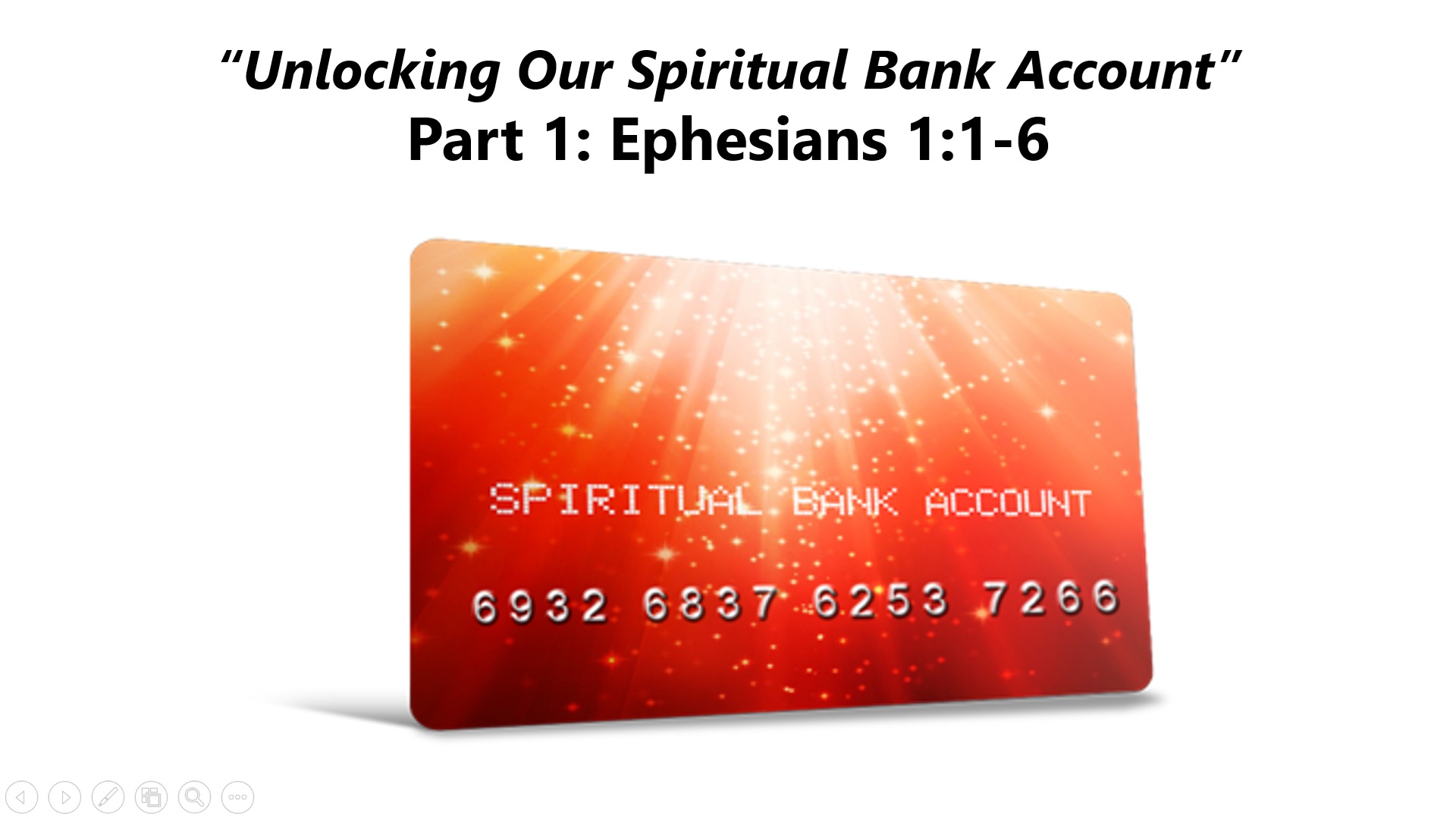
Well, I am really excited about our new study in the book of Ephesians. This morning is Part 1 of who knows how many. As I began to pray about and consider what our approach should be to this study, I felt convicted that, as a class, we really needed to dig deep in order to discover all that is ours in Christ. And that is my purpose for this study. We are going to go at a little slower pace than what you are used to. Each chapter and verse is like peeling back layers of an onion to reveal more and more of the riches that we possess as Christians. So, with that in mind, I have entitled this study in Ephesian, “Unlocking Our Spiritual Bank Account.”
We are going to see as we go through this book the full extent of all that is ours, that we have direct access to, not just after we die, but here and now. We can actually enjoy many of the benefits of our salvation today.
I sent out an e-mail [to my class] this past week asking [them] to consider the following question: “What are the benefits of your salvation (as you understand them)”?
[Class responses to this question included: God’s love and grace; spiritual blessings; God’s power, strength and love; eternal life; peace; sense of security and peace of mind; abundant life; hearing God’s voice through the Holy Spirit; fruit of the Spirit; being part of a church family; being part of the Kingdom; personal relationship with God; forgiveness; discernment].
Usually, at the start of our [new] study I give a brief introduction to the book or subject that we are about to study and I WILL do that. But before I do, I want to address WHY I think Ephesians is so important for us today. It is my observation (having been a Christian most of my life and being in the church) that most Christians are spiritually a lot like this person here… [I showed a picture of a woman who was known as the "Witch of Wall Street"].
Do you all recognize this person? Do you all recognize who she is. OK, let me introduce you to her. Her name was Hetty Green. That name may or may not be familiar. She was a brilliant businesswoman, investor and financier. She made her fortune on Wall Street in the late 1800s. She was considered at one time to be the richest woman in the world. In her old age she became a widow and an eccentric miser. In fact, the Guinness Book of World Records considers her to be the greatest miser of all time. She would dress in all black. There were stories about her refusal to buy expensive clothes or pay for hot water. She had the habit of wearing a single dress that was replaced only when it was worn out. Reportedly she never turned on the heat. There is one story that says that she even neglected treating her son's injured leg, which eventually had to be amputated. Estimates of her net worth when she died in 1916 ranged from $100 million to $200 million (the equivalent today of between $3 to $5 billion).
So, what’s my point in telling you all this? Here you have the richest woman in the world and yet she lived out her days as though she was dirt poor.
It is important, as Christians, that we fully comprehend and appreciate just how much we have in our spiritual bank account. We are children of the King. We are joint heirs with Jesus Christ. What the book of Ephesians tells us will pleasantly surprise you. As spiritual millionaires, there is absolutely no reason why we should be living in spiritual poverty.
OK, so let’s dive right into the book of Ephesians. I am going to start with an introduction. Ephesians Chapter 1 and v 1…
READ Ephesians 1:1
The city of Ephesus is located in the western part of modern-day Turkey. Now, back in Paul’s day, the First Century A.D., this was called Asia Minor. Like most of the civilized world at the time, it was under Roman control. The gospel arrived in Ephesus during Paul’s second missionary journey (Acts 18:18-21). The year was 53 A.D. Paul started the church at Ephesus and then he left it in the care of three individuals – Aquila and Priscilla and Apollos. And then Paul returned to Ephesus a year later on his third missionary journey. This time, Paul stayed there for three years (Acts 19:1-20:1). It was during this period that the gospel spread from Ephesus throughout all Asia Minor.
The city of Ephesus was the religious center of the cult of Diana (also known as Artemis). Its temple was one of the seven wonders of the ancient world. It drew thousands of visitors annually. Ephesus was also a major banking and trading center. It was the second largest city in the known world (Rome, of course, being the largest). It had a population of somewhere between 250,000 and 350,000 people. So, for that day, it was a very large, well-to-do and influential city.
Paul wrote this letter while he was in prison in Rome around 61 A.D. The letter was then carried from Rome and hand-delivered by a man named Tychicus (Ephesians 6:21).
Now, I want to call your attention to [something] I highlighted in v 1. The earliest manuscripts do not contain the phrase “in Ephesus.” Most scholars believe that this letter was originally a circular letter. What is a circular letter? It is basically a statement of doctrine that was circulated among the various house churches in the area. False teachers were prevalent. Paul and the other Apostles reinforced the various churches with sound doctrine. That was important to them.
In many of his letters, like this one, Paul makes it a point to refer to himself as “an apostle.” Here he says, “an apostle of Christ Jesus by the will of God.” Paul met the Lord Jesus on the Damascus Road (Acts 9:1-9). He then apparently – before he went to Jerusalem – went from Damascus to Arabia for three years. Paul mentions that in Galatians 1:17-18. Most Bible teachers believe that during this time he received instruction from the Lord Jesus Himself. Paul was commissioned by the Lord to preach the gospel to the Gentiles (Acts 22:21).
There were some false teachers that questioned Paul’s apostleship because he was not one of the original Twelve. And he was not Matthias, who was [chosen to] replace Judas (Acts 1:15-26). So, who does Pau think that he is anyway, right? He was always defending his apostleship. He says in 1 Corinthians 9:1, and this is just one example, Paul says, “Am I not an apostle? Have I not seen Jesus our Lord?” The implied answer is, “Yes, he has.” So, he claimed to be an apostle of Christ Jesus.
Paul addresses the church, believers. He calls them “saints.” The biblical definition of a saint is simply a person who is under the Lordship of Jesus Christ. A saint is not just a canonized Catholic. A saint is not some sort of a sanctimonious individual. A saint, biblically, is anyone who is a Christian. So, by the biblical definition, we are all saints, if we name Jesus Christ as Lord and Savior.
Paul commends the church at Ephesus for their faithfulness. That is what they were known for. He refers to them as “faithful in Christ Jesus.” If you read the book of Acts, you will notice that Paul had a very special, a very close relationship with this church. Even Jesus Himself (Revelation 2) commends this church for their faithfulness. He says, “I know all the things you do. I have seen your hard work and your patient endurance. I know you don’t tolerate evil people. You have examined the claims of those who say they are apostles but are not. You have discovered they are liars. You have patiently suffered for me without quitting” (Revelation 2:2-3 NLT). Those are the words of Jesus to this church. By the way, Paul’s apostleship was not one of those that the church questioned. They knew who Paul was. They loved Paul. They were a very discerning and faithful church.
READ Ephesians 1:2
Now, this appears to be a fairly standard greeting. But these words are more than just a salutation. These are words of blessing. This is a double blessing – grace AND peace. “Grace” is God’s kindness to undeserving people. That is us. None of us deserves what God has blessed us with, do we? No. “Peace” is the result of our faith in Christ. We are no longer enemies of God. Romans 5:10 says, “For if while we were enemies we were reconciled to God by the death of His Son [that relationship has been reconciled], much more, now that we are reconciled, shall we be saved by His life.” So then, by our faith in Jesus and what He did for us on the cross, dying as payment for our sins, we now have peace with God.
So, right from the start (we have only covered two verses) we get the idea that we are going to receive some tremendous riches out of the book of Ephesians. And it is all from God OUR Father and the Lord Jesus Christ.
That is my rather lengthy introduction. Are there any questions so far?
[One class member commented that the whole world is looking for peace. We are seeking to put an end to all the different wars. And even people themselves are not at peace. And people are busier than ever before trying to fill their lives with meaning and purpose. Another person commented that peace was something we all have a hard time “feeling.” The world is just so chaotic. Peace starts between us and God. This is one of the benefits that we Christians now have. And that allows us to have peace with the people around us. There is no real peace without Jesus. We will not be able to have peace without God].
From v 3-16 in the original Greek in Ephesians is one sentence. Typical Paul. He had long sentences. The English breaks it up into different sentences. But in the Greek, it is one long sentence. It is as though Paul when he is writing this gets caught up in the glorious thought that he has and he cannot stop. He just keeps writing. Now, what is Paul so excited about? Our salvation.
God the Father, God the Son, and God the Holy Spirit – they all participate in the salvation process. V 3-6, which we are going to focus on today, this part of our salvation is what God the Father does. We will look at what God the Son and the Holy Spirit do next time. Let’s read these verses and then we will talk about it.
READ Ephesians 1:3-6
Now, let’s unpack this. V 3, “every spiritual blessing…” The word “blessing” means a gift or a benefit bestowed. Over in Ephesians 2:8 it talks about being saved as “the gift of God.” Our spiritual bank account was opened and it became available for us to draw from when we first got saved.
“Who has blessed us in Christ with every spiritual blessing in the heavenly places…” Over in Ephesians 2:6 it says that He (God the Father) “raised us up with Him and seated us with Him in the heavenly places in Christ Jesus.” Now, we are not in heaven right now, are we? We are still here on Planet Earth. What he is talking about here, “in the heavenly places” – think about it as citizenship really – that is our position in Christ. Our position is in the heavenly places in Christ Jesus. Because we are not there yet, are we? Our citizenship is there, but we are not there yet. We are ambassadors here on earth.
So, God initiated this plan to save us. It is a gift from Him, not just to save us from destruction, from hell. That is mercy. But to be a part of His eternal kingdom. That is grace. Grace and mercy are terms you hear thrown around a lot. They are flipsides of the same coin. Mercy is not getting something bad that we deserve. Grace is getting something good that we do not deserve. Does that make sense? G-R-A-C-E -- God’s riches at Christ’s expense. It is because of Jesus that we get grace, that we get the good stuff. Not because we deserve it.
In v 4 and 5 [we encounter] this wonderful Doctrine of Election that everybody loves so much [note: I am being sarcastic here]; that they get all worked up over whenever they study the book of Romans (and other places). You cannot avoid it. When you read the New Testament, it is there throughout. Here it is in Ephesians. We face it right at the beginning of our study. So, I am going to talk about this doctrine. It is biblical. It must be addressed.
Before I jump in and get anybody mad, full disclosure of where I stand as your teacher… I personally hold to the absolute sovereignty of God. In fact, the older I get, the more I believe in the sovereignty of God than ever before. That being said, I don’t believe that God forces people to be saved who don’t want to be saved nor do I think that He keeps someone from being saved who wants to be saved. I believe that God chooses, yes. It is clearly stated in this passage and other places. It is certainly biblical, taught here in Ephesians. But I also believe in the free agency, the free will of man to choose. “Whoever will call upon the name of the Lord will be saved” (Romans 10:13). That is biblical too. “By grace are you saved through faith” (Ephesians 2:8). That comes right out of Ephesians. “Come unto Me all who labor and are heavy laden,” Jesus says, “and I will give you rest” (Matthew 11:28). There is some choice that we have. So, both God’s sovereignty and man’s free will are taught in scripture, BUT there is an obvious “tension” between these two. Because at first glance they might seem to conflict with each other. That is why it bothers a lot of people. How do I resolve this? Somehow, some way, God is God, the two work together in God’s economy to fulfill His purposes. How exactly that works is a mystery. I don’t have all the answers. I don’t pretend to. I DO think it is possible to believe something is true (like this doctrine) without fully understanding everything about it. There are a lot of things that we believe are true that we don’t fully understand, like how my car works. I know it does but I am not a mechanic. I don’t know all the details. And so, you can believe something without fully understanding everything about it, such as the Doctrine of Election.
[This is what the Baptist Faith and Message has to say about Election:] “Election is the gracious purpose of God, according to which He regenerates, justifies, sanctifies, and glorifies sinners [big words to say He saves us]. It is consistent with the free agency of man [free will], and comprehends all the means in connection with the end. It is the glorious display of God's sovereign goodness, and is infinitely wise, holy, and unchangeable. It excludes boasting and promotes humility.”
This is a doctrine that bothers a lot of people. It does not bother me because it gives me some assurance of my salvation! So, let’s get back to the passage and let’s look at it…
It says, v 4, “Even as [God the Father] chose us in Him before the foundation of the world…” Let me stop there. Even before the Genesis Creation, God chose us. The word “chose” comes from Greek word meaning “to select.” So, it means what you think it means. There is not some hidden meaning.
Now, I will talk about holy and blameless in a minute. [Skipping ahead…]
“In love He predestined us for adoption to Himself as sons through Jesus Christ…” The word “predestined” comes from a Greek word meaning “to predetermine, to foreordain.” It is NOT just foreknowledge. I have had a lot of people try to explain predestination as just being foreknowledge. It is more than that. It is something that God actively did. He adopted us. Has anybody ever adopted children? You selected the kid. They did not select you. So, God chose us. We became His children, the children of the King! By His choice.
V 5 ends with “according to the purpose of His will.” So, make no mistake, this was all part of God’s sovereign plan for US. The more I think about that, the more overwhelming that is to me. That God chose ME? Insignificant me? That is a pretty big thought if you just let it sink in.
Now, why did God do all this? And now we will go back to the middle of v 4 that I skipped earlier… “that we should be holy and blameless before Him.” That is why. What does all that mean? It sounds good. Well, I got a little help from a commentary, John Phillips. He helped me out on this one. He was explaining what this meant and he said, “The work of the Holy Spirit is to make us holy and without blame in the everyday aspects of life. God [the Father] is so pleased with Jesus that He wants everyone to be like His Son.” He goes on to say that being like Christ should be our goal. Now, can any of us be holy and blameless on our own? No. It takes the work of the Holy Spirit in us to do that. That is the point. That is why He saved us.
V 6 is like a benediction. It closes a thought. Each of these [sections] about the Father, Son and Holy Spirit’s involvement in our salvation will close with very [similar] benedictions. Paul’s benediction here that closes the thought about God the Father does says, “To the praise of His glorious grace, with which He has blessed us in the Beloved.” We receive God’s grace and all His benefits (all those things that were mentioned earlier and more) because of Jesus, “the Beloved.”
So, God the Father in the kind intention of His will, because of His love, has given us a gift that we did not earn nor do we deserve. He has this great plan for an eternal kingdom that we get to be a part of. That is good news, right?
Did God have to save sinful mankind? Was He obligated to set up a plan of salvation? He is God. So, the answer is NO. As far as we know, God did not set up a plan to save the fallen angels, like Lucifer and all those who followed him in the rebellion of heaven. No plan we know of for them to be saved. And we know from Hebrews Chapter 2 that the angels are a higher created order than man. It talks about Jesus becoming a human being in Hebrews and for a little while it says that He was “lower than the angels” (Hebrews 2:9).
So, we know that humans are a higher created order than are humas. But can angels repent and be saved? No. And yet for some reason, God has provided a way by which WE humans CAN be saved. Have you ever thought about that? Why us and not the angels? We will answer that next time.