Parables of Jesus - Part 13
The Laborers in the Vineyard – The Ten Minas
The Laborers in the Vineyard – The Ten Minas
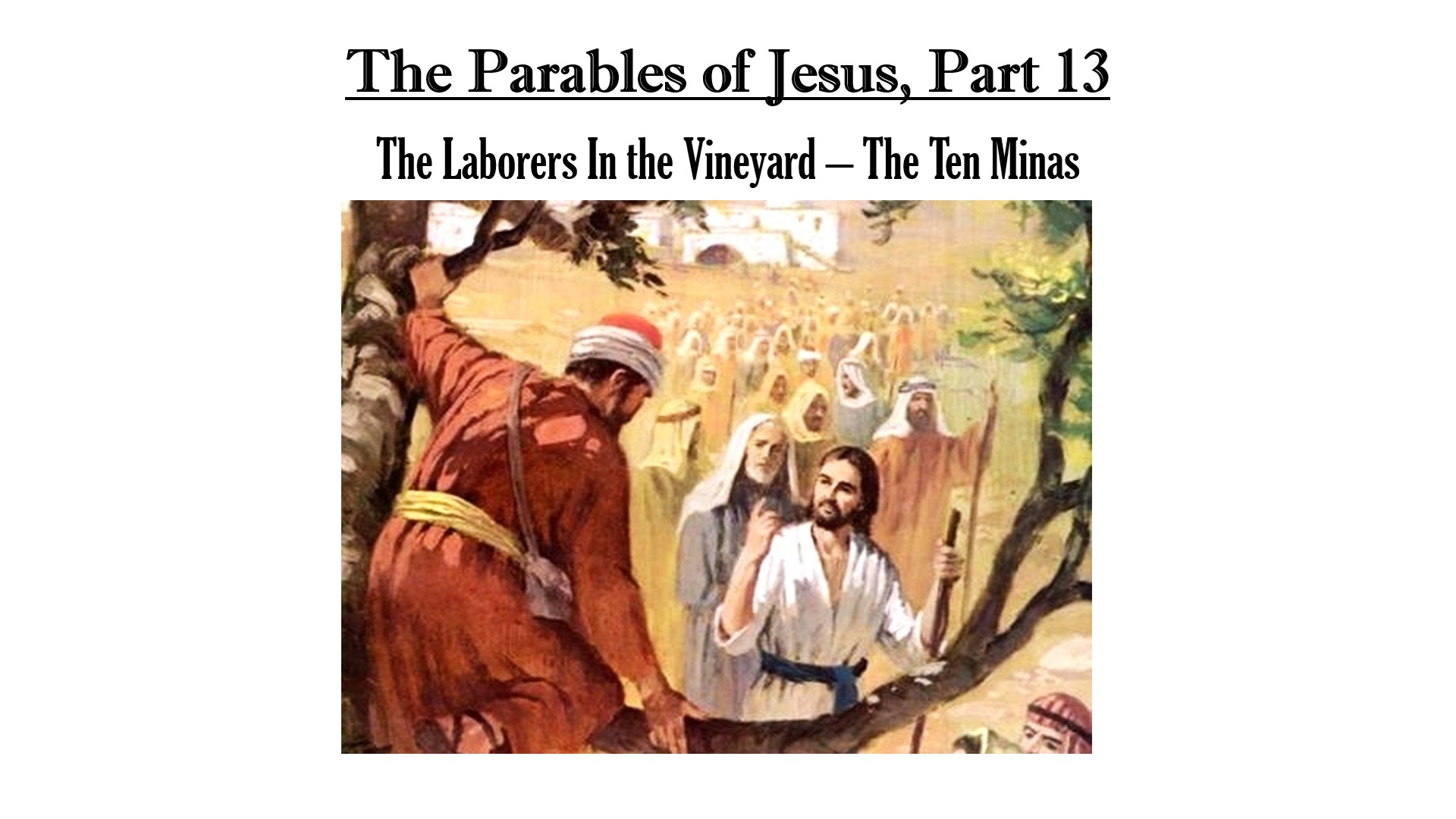
The setting for the two parables we are going to be looking at this morning is Jesus and His disciples are approaching the city of Jericho. Now, do you all recall what famous encounter happens in Jericho? There was a wee little man up in a tree. That is a hint. Zaccheus, right. Jesus meets up with this guy Zaccheus. We are going to talk about him later. The two parables that we are going to look at today are [told by Jesus] around the same time. Then Jesus and His disciples begin from Jericho and they head up the mountain toward Jerusalem. So, time on earth is winding down for Jesus. He is heading up to Jerusalem to complete His mission.
The Laborers in the Vineyard
The first parable we are going to look at is [the Parable of] the Laborers in the Vineyard. It speaks about how God rewards His faithful followers whether they come to God early in their life or later on. Look at the disciples, for example. They followed Jesus at the very beginning of His ministry. They have been with Him day in and day out for three-plus years at this point. But then you have this guy Zaccheus – we will see him in a little bit – he is a contrast. He follows Jesus at the tail end of His ministry. That is one way to look at this parable. The other way to look at is that some people come to Jesus as children [in our class that was 75 percent] while others come to Jesus, they get saved much later in life.
In this parable the master of the house (he is also the owner of the vineyard) represents God. The various laborers represent God’s servants, believers, followers of Jesus. And as you will see, it is not the length of our service that matters as much as our willingness to serve. So, here is the parable beginning in Matthew Chapter 20, v 1…
“For the kingdom of heaven is like a master of a house who went out early in the morning to hire laborers for his vineyard. After agreeing with the laborers for a denarius a day, he sent them into his vineyard” (Matthew 20:1-2).
So, this group shows up for work early in the morning and they all agree to the same amount of money.
Q1, what wage do the laborers hired early in the morning agree to?
One denarius, a day’s wage. Do you think that is fair? It seems pretty reasonable. It was fairly standard for that day. In today’s economy that would be between $150 and $200. In exchange for putting in a full day’s work, hard labor in the landowner’s vineyard, these workers will accept this standard pay for their labor. And they are sent out to work. V 3…
“And going out about the third hour [9 AM] he [the master, the landowner] saw others standing idle in the marketplace, and to them he said, ‘You go into the vineyard too, and whatever is right I will give you’” (Matthew 20:3-4).
So, this 9 AM group also agrees to go work in the landowner’s vineyard.
Q2 says, what wage do they agree to? None of the options I gave you, right?
They do not discuss any particular amount of money. Instead, they just trust the landowner to give them fair payment. So, the answer is none of these. And with that they head straight to work. V 5…
“So, they went. Going out again about the sixth hour [12 noon] and the ninth hour [3 PM], he [the landowner] did the same. And about the eleventh hour [5 PM, late in the day] he went out and found others standing. And he said to them, ‘Why do you stand here idle all day?’ They said to him, ‘Because no one has hired us.’ He said to them, ‘You go into the vineyard too’” (Matthew 20:5-7).
The landowner needs more workers, so he has been going out periodically, making his rounds to the local unemployment line. He solicits people who are willing to work in his vineyard each time. Does he find willing workers? Yes. Everyone he hires goes out and works and you will notice, they never negotiated a wage.
Q3, the excuse given by the late afternoon group for standing idle all day was what?
Nobody would hire them. At least that was their claim. Some people would say they were just lazy. But they said, “nobody has hired us.” So, the landowner hires them. They no longer have an excuse, do they? So, they go out and go to work.
“And when evening came, the owner of the vineyard said to his foreman, ‘Call the laborers and pay them their wages, beginning with the last, up to the first.’ And when those hired about the eleventh hour [the 5 pm, late afternoon group] came, each of them received a denarius. Now when those hired first [the early morning guys] came, they thought they would receive more, but each of them also received a denarius” (Matthew 20:8-10).
Q4, True or false? The owner of the vineyard paid the early morning laborers the same amount that he paid those he hired later in the afternoon.
True. So, how do you think that went over with the other laborers? The early morning guys, think about it, they have worked 11 hours longer than those who started at 5 PM! They have worked a lot longer and they have been out in the heat. So, you can understand their reaction in v 11…
“And on receiving it [the pay] they grumbled at the master of the house, saying, ‘These last worked only one hour, and you have made them equal to us who have borne the burden of the day and the scorching heat.’ But he [the master] replied to one of them, ‘Friend, I am doing you no wrong. Did you not agree with me for a denarius?’” (Matthew 20:11-13).
Q5, True or false? All the laborers were satisfied with the amount they received.
False. It says, “they grumbled” right? They were not satisfied. The workers hired early in the morning think that paying everyone the same amount of money is unfair. “It is not right! Those people only worked ONE hour. We worked ALL DAY in the scorching heat! That is just not fair.” So, the master reminds these disgruntled workers what they had agreed to. What had they agreed to? One denarius, right? They have no grounds to complain. They have not been treated unfairly. They got what they asked for. V 14…
The Master’s Generosity
“Take what belongs to you and go. I choose to give to this last worker as I give to you. Am I not allowed to do what I choose with what belongs to me? Or do you begrudge my generosity?’” (Matthew 20:14-15).
The master made the decision to give all the workers, no matter how long they worked in his vineyard, the exact same wage. Why did he do this? First of all, it is HIS money and it is HIS vineyard. He is the boss. He can do whatever he wants to do. There is also a second reason and more important – he pays all of them the same amount because they all did exactly what he asked them to do. And they all went into the vineyard to work. The result of obedience is a reward – it just so happens to be the same reward for everybody.
[One class member said that he sees this parable as relating to salvation. In the past he thought it was unfair that some people made it to heaven with a deathbed confession. But then the example of the prodigal son and his older brother came to mind. The older brother was very jealous of his younger brother who returned. He had remained home and loyal to his father unlike his brother. But the older brother forgot that the whole time he had been home he enjoyed the riches and comfort of his father’s house. He forgot about the blessings he experienced daily. Likewise, many of us Christians enjoy the fellowship of our Lord while others wander far from Him and are miserable. This person commented that he was glad God spared him from going through all that. We have had the benefit of being with the Lord longer and that is the real blessing.]
Q6, the owner of the vineyard represents God. From this parable, what is it that God rewards? What does this parable teach? That God rewards our what?
Faithfulness -- when we do what He tells us to do.
We mentioned this earlier, the master said, “Do you begrudge my generosity?” This parable speaks to the generosity of God. There are some in the kingdom of God (believers, Christians) who are envious of those on the receiving end of God’s great generosity when they themselves have received God’s mercy and His goodness. But for whatever reason they resent others who have received the same thing they have.
Now, man’s ideas of merit, earned rewards, are irrelevant to God. God rewards our willingness to serve Him, our faithfulness to Him, whether we come to Him early in the morning, say, as children (three-quarters of us in the class raised our hands); or at 9 AM in our teens or 20s; or at noon in our 30s or 40s; or at 3 PM in their 50s and 60s; or at 5 PM older, well advanced in years. God rewards our faithfulness.
Nothing in THIS parable (we are talking about this parable here because there are other parables that do talk about this) teaches that the longer we work, the greater our reward; or that the harder we work, the greater our reward. Nothing in this parable teaches that the more we accomplish, the greater our reward. They all received the same thing, right? Nothing in this parable teaches that God is impressed by our efforts. Now there are other parables, like the one we are getting ready to look at, that talk about how a little more effort gets a little more reward. But we will talk about that here in a minute.
Nothing we can do is going to make God love us more. And do you realize that nothing we do will make God love us less? The prodigal son is an example. God might be proud of us or even disappointed in us at times, but that has no bearing on His perfect love for us. We are His children. He just wants us to be faithful to the task that He has assigned us to do (we have all been assigned a task), no matter how small or insignificant that task may seem.
Jesus closes this parable with a statement concerning God’s economy. And that is v 16…
“So, the last will be first, and the first last” (Matthew 20:16).
If you read the last verse of the previous chapter, Matthew 19, v 30, it says something very similar but in reverse: “But many who are first will be last, and the last first” (Matthew 19:30).
There are various interpretations about this, what Jesus means here. Some say He is talking about how the Jews responded to God early while the Gentiles came to Him later. Some say that those who seek status and importance here on earth will have none in God’s kingdom while those who are humble servants down here on earth will discover that they will be great in heaven. I prefer the interpretation given in Q7 – and that is the application for this parable: ALL who respond to God’s call to salvation, no matter how great or insignificant we are (in the world’s eyes), whether Jew or Gentile, young or old, middle-aged, whatever, religious or not, or whatever, will be received and rewarded by God based on HIS… What did you all say? [mercy, grace, love]. All correct answers. This what I put down – GRACE.
This is why I said that. In Ephesians Chapter 2, Paul says this: “For by grace [by God’s grace] you have been saved through faith [your part was faith]. And that is not your own doing [God’s grace]; it is the gift of God [did you realize that salvation is a gift of God – what a gift!], not a result of works [not a result of anything you did, wonderful as it might have been, keep doing it but that is not what got you saved] so that no one may boast” (Ephesians 2:8-9). God’s amazing grace!
The Ten Minas
Luke Chapter 19 is where we will be for this parable. The mina was a Greek coin and it was worth a lot of money, 100 denarii, about four months wages, thousands of dollars [in today’s economy]. That is what coin represents. So, ten minas is a lot.
Jesus, as He approaches the end of His ministry – He is heading for Jerusalem, Passion Week, we know that is the end – He is teaching His disciples some intense lessons. And He is often using parables. Jesus knows that His disciples are going to face intense persecution after He is gone, so these are important lessons that they need to learn.
The Parable of the Ten Minas, sometimes you will hear it referred to as the Parable of the Pounds. The reason for that is that is the King James Version. Instead of “minas,” it says “pounds.”
So. here is the background. I have already introduced Zaccheus. We talked about him earlier, this is Q8, that encounter in Jericho. You all remember the story. When Jesus is walking along and He sees Zaccheus up in the sycamore tree, He says, “Zacchaeus, come down quickly! I must be a guest in your home today.” And Zacchaeus scurried down the tree quickly and took Jesus to his house in great excitement and joy” (Luke 19:5-6 NLT). But that is not the end of the story. Look at the reaction to what Jesus said in this encounter with Zaccheus…
And when they [the locals, the people there in Jericho] saw it, they all grumbled, “He [Jesus] has gone in to be the guest of a man who is a sinner.” And Zacchaeus stood and said to the Lord, “Behold, Lord, the half of my goods I give to the poor. And if I have defrauded anyone of anything, I restore it fourfold” [So, there has been a change in Zaccheus]. And Jesus said to him, “Today salvation has come to this house, since he also is a son of Abraham. For the Son of Man came to seek and to save the lost” (Luke 19:7-10).
This fits right in with the last parable – grumbling, Jesus extending his grace to Zaccheus, and so forth.
And then Jesus and His disciples leave Jericho. They begin the long ascent up the back side of the Mount of Olives to Jerusalem. It is a long walk and it is all uphill. While they are on their way, Jesus tells them this parable and it starts in v 11…
As they [the disciples] heard these things, He proceeded to tell a parable, because He was near to Jerusalem, and because they supposed that the kingdom of God was to appear immediately (Luke 19:11).
Q9, as they approach Jerusalem, what are Jesus’s disciples expecting? That He is going to set up His kingdom, right?
That is what they are expecting. That is what it says: “They supposed that the kingdom of God was to appear immediately.” This is in their minds. This idea has been stuck in their minds for a while. They used to argue about who would be the greatest when Jesus set up His kingdom. All the talk about Jesus dying (He has mentioned that several times), they have not fully processed that. So, v 12…
He [Jesus] said therefore, “A nobleman went into a far country to receive for himself a kingdom and then return” (Luke 19:12).
Here Jesus (He is the nobleman) is referring to His ascension back to the Father which is recorded in Acts Chapter 1. That will happen later. Jesus continues, v 13…
“Calling ten of his servants, he gave them ten minas, and said to them, ‘Engage in business until I come’” (Luke 19:13).
Q10, the nobleman in this parable represents Jesus. Who do the slaves, the servants represent?
Believers, His disciples, all Christians, all followers of Christ. In Acts Chapter 1, while Jesus is ascending into the clouds, some angels tell the disciples, they say that Jesus will return again one day. That is good news, right? Hey, He is coming back!
Q11, True or false? The nobleman gives the same amount of money to each servant.
True. And he also gives every one of them specific instructions: “Engage in business until I come.”
Q12, what does the nobleman want them (his servants) to do with his money while he is away?
Invest it carefully. Barter, trade, start a new business, whatever -- make money. The money was not given to them free and clear to do with as they pleased. It was not given to go out and have a good time. This money was given to them for a reason. And that reason was to further the master’s business [interests]. That is why he gave them the money.
In the same way, if you want to apply it to us, God has given each of us, who are HIS servants, spiritual gifts, talents, skills, abilities, yes, even material resources. Everything you have. Intelligence, imagination, and so forth. All those are gifts from God given to us. Not everybody has the same things. We all have different gifts, right? We all have different amounts of material possessions. We all have different skills and abilities. It takes the whole church. And so, these are not to used merely for our own selfish purposes. It does not mean you cannot enjoy life, but these are to be used to invest in the kingdom. We are to further HIS interests while we are here waiting for Him to return. V 14…
The Nobleman Returns – The Day of Reckoning
“But his [the nobleman’s] citizens hated him and sent a delegation after him, saying, ‘We do not want this man to reign over us.’ When he returned, having received the kingdom, he ordered these servants to whom he had given the money [the servants that he left] to be called to him, that he might know what they had gained by doing business” (Luke 19:14-15).
Q13, what did the nobleman do after he returned from receiving his kingdom? What did he do?
He called everybody together and said, “Time to report!” It is the day of reckoning. He wants them to give an account of what they did with the money that he gave to them before he left. Now, this is a picture of what will happen at Jesus’s second coming, His return. Jesus WILL be rejected by the world as their king, just like the nobleman in this parable was rejected as king. The people of that far country said, “We do not want this man to rule over us.” But the nobleman received the kingdom anyway. He became their king despite their rejection. The nobleman offers us a great picture of Jesus – He is both Master and King!
Well, upon his return, the nobleman calls his servants in to give an account of what they had done with what he gave them. “What did you all do? Report!” Likewise, just to apply this to us, we will all stand before our Lord and give an account of what WE did with what God gave US. Romans 14:12, great verse… “So then, each of us will give an account of himself [or herself] to God.” Did you all know that? We are going to give an account of ourselves to God.
[One class member said that they found this to be “frightening.” I assured her that this does not affect our salvation. But we need to be aware that we all will be accountable to God one day.]
“The first came before him, saying, ‘Lord, your mina has made ten minas more.’ And he said to him, ‘Well done, good servant! Because you have been faithful in a very little, you shall have authority over ten cities.’ And the second came, saying, ‘Lord, your mina has made five minas.’ And he said to him, ‘And you are to be over five cities’” (Luke 19:16-19).
Q14, what did the servants who invested well receive from the master?
Praise was one. There were two things and they are both in v 17. The first one is praise. The other is authority. They were going to receive a greater level of responsibility. They were given rule over cities, some ten and some five, depending on how well they invested their master’s resources. So, that is be a picture of what we can expect in the life to come.
But not all the servants in this parable invested wisely, did they? There is always one in every group, right? V 20…
“Then another came, saying, ‘Lord, here is your mina [I thought the master gave him ten minas, so where are the other nine minas?] which I kept laid away in a handkerchief; for I was afraid of you, because you are a severe man. You take what you did not deposit, and reap what you did not sow.’ He said to him, ‘I will condemn you with your own words, you wicked servant! You knew that I was a severe man, taking what I did not deposit and reaping what I did not sow? Why then did you not put my money in the bank, and at my coming I might have collected it with interest?’ [even simple interest would have made some money] And he said to those who stood by, ‘Take the mina from him, and give it to the one who has the ten minas’” (Luke 19:20-24).
Q15, True or false? The unfaithful servant in this parable is called “wicked” and cast out into darkness.
No, that is not what happens here, is it? Read carefully. While the unfaithful servant IS called, “wicked,” he is not cast into darkness [so the answer is false]. In v 22 – this is an important distinction I want to make –in the ESV the master says, “I will condemn you with your own words.” That word “condemn” in the ESV is the Greek word krino, a verb meaning “to judge, decide, separate, or discern.” So, I think, in my opinion, the King James Version and the New American Standard interpretation of v 22 is better. It is more correct when they say, “I will judge you.” That is what the word krino really means. And that is an important distinction because this parable is about how God deals with believers, His followers. The result of laziness or doing nothing with what God gave us, is a declaration of disappointment; in this case, pretty harsh words. We ARE judged. We ARE punished. But we are NOT condemned. We are not condemned to hell. We do not lose our salvation. I really felt that was important to point this out [given the way the ESV interprets it.]
There is actually another Greek word used for condemnation other than krino. It is not used here. It is used in other passages where it talks about sending people to hell and so forth.
The good news is that, even if we are lazy, carnal, ineffective Christians – if we are truly saved (I would certainly examine your salvation) – we will NOT be cast out. We will not lose our salvation. Christianity is not about works despite what some denominations emphasize. I am not saying that works are not important. Read the book of James and read the other things that Jesus and Paul teach. Works ARE important but they just do not save you. That being said, we can certainly disappoint our Lord and betray His trust in us, right? The unfaithful servant in this parable IS punished, but he is not condemned by being cast into darkness like you see happen in other parables. Instead, he has what has been entrusted to him taken away. In this case it was given to someone else. V 25…
“And they said to him, ‘Lord, he [this other servant that was to be given the mina] has ten minas!’” (Luke 19:25).
It is almost like they were saying, “That’s not fair!” We have heard that before, haven’t we? Whatever God (the master) decides is fair.
“I tell you that to everyone who has, more will be given, but from the one who has not, even what he has will be taken away” (Luke 19:26).
God rewards faithful service and the proper use of the gifts, talents, skills, abilities, resources that He has given us. Now, this parable has a surprise ending, v 27...
“But as for these enemies of mine, who did not want me to reign over them, bring them here and slaughter them before me’” (Luke 19:27).
Q16, who is it that the nobleman has slain at the very end of this parable? It was not his unfaithful servant. Who was it?
Those who refused to have him rule over them. [Those who rejected him.] Here we see what happens to all who oppose Jesus. When the nobleman eventually comes to power, his enemies are killed. News flash! Read Revelation [Chapter] 19. That is what happens, His enemies are killed at the Battle of Armageddon. Jesus WILL eventually return and He will rule as King – as King of kings and Lord of lords. The fate that awaits ALL of Jesus’s enemies… destruction! Whoever will not be ruled by the grace of Christ will be ruined by His wrath.
What is the application? I am glad you asked. God is so good to us. He showers us with blessings every day. He provides us with the material and spiritual resources. He gives us clear direction in His Word. He guides us by His Spirit. He rewards our obedience with the promise of eternal life. He rewards our faithful service. One day you and I will be called home to claim our eternal reward. But we are not there yet. We are STILL HERE. There is still work to be done for our Lord, right? You still have time! So, may we continue to be faithful servants until that day comes! Like the song says, “May all who come behind us find us faithful.”
Questions
Note: To better help you to answer these questions you are encouraged to use the English Standard Version translation of the Bible.
Parables of Jesus - Part 13
Part 13 Questions
The Laborers in the Vineyard (Matthew 20:1-16)
1. What wage do the laborers hired early in the morning agree to? (Circle ONE)
ONE DENARIUS TEN DENARII ONE MINA TEN MINAS NONE OF THESE
2. What wage do the laborers hired the third hour [9 AM] agree to? (Circle ONE)
ONE DENARIUS TEN DENARII ONE MINA TEN MINAS NONE OF THESE
3. The excuse given by the later workers for standing idle all day was WHAT? (Check the BEST answer)
___ they were injured ___ laziness, apathy ___ they were unqualified
___ nobody would hire them ___ they were retired ___ they could not find a job
4. True or false? The owner of the vineyard paid the early morning laborers the same amount that he paid those who were hired later in the afternoon.
T F
5. True or false? All the laborers were satisfied with the amount they received.
T F
6. The owner of the vineyard represents God. From this parable, what is it that God rewards? Our _________________ (Circle the best answer)
ACCOMPLISHMENTS FAITHFULNESS INTELLIGENCE LONGEVITY SKILL
7. Matthew 20:16 and Matthew 19:30 are quoted often. There are various interpretations. Fill in the blank below.
ALL who respond to God’s call to salvation, no matter how great or insignificant we are, whether Jew or Gentile, young or old, religious or not, will be received and rewarded by God based on His _____________
The Ten Minas (Luke 19:12-27)
8. This parable was told soon after Jesus’s famous encounter with WHO? (Circle ONE)
CAIAPHAS JAIRUS LAZARUS NICODEMUS ZACCHEUS
9. As they approached Jerusalem, what were Jesus’s disciples expecting, v 11? (Check the BEST answer)
___ that Jesus would suffer and die ___ that Jesus would set up His kingdom
___ that Jesus would return to heaven ___ that Jesus would teach in the temple
10. The nobleman in the parable represents Jesus. Who do the slaves (servants) represent? (Circle ONE)
BELIEVERS THE JEWS GENTILES PHARISEES OTHER
11. True or false? The nobleman gives the same amount of money to each servant.
T F
12. What does the nobleman want them to do with his money? (Check the BEST answer)
___ Spend it wisely ___ Invest it carefully ___ Guard it closely ___ Give it to the poor
13. What did the nobleman do after he returned from receiving his kingdom? (Check the BEST answer)
___ Ate a big meal ___ Threw a party ___ Met with his servants ___ Handed out gifts
14. What did the servants who invested well receive? (Circle ALL that apply)
AUTHORITY MONEY PRAISE RICHES TROPHIES
15. True or false? The unfaithful servant in this parable is called “wicked” and cast out into darkness.
T F
16. Who is it that the nobleman has slain at the very end of this parable? (Check ONE)
___ His unfaithful servants ___ Those who refused to have him rule over them
___ His business competitors ___ Those who refused to invest in his business