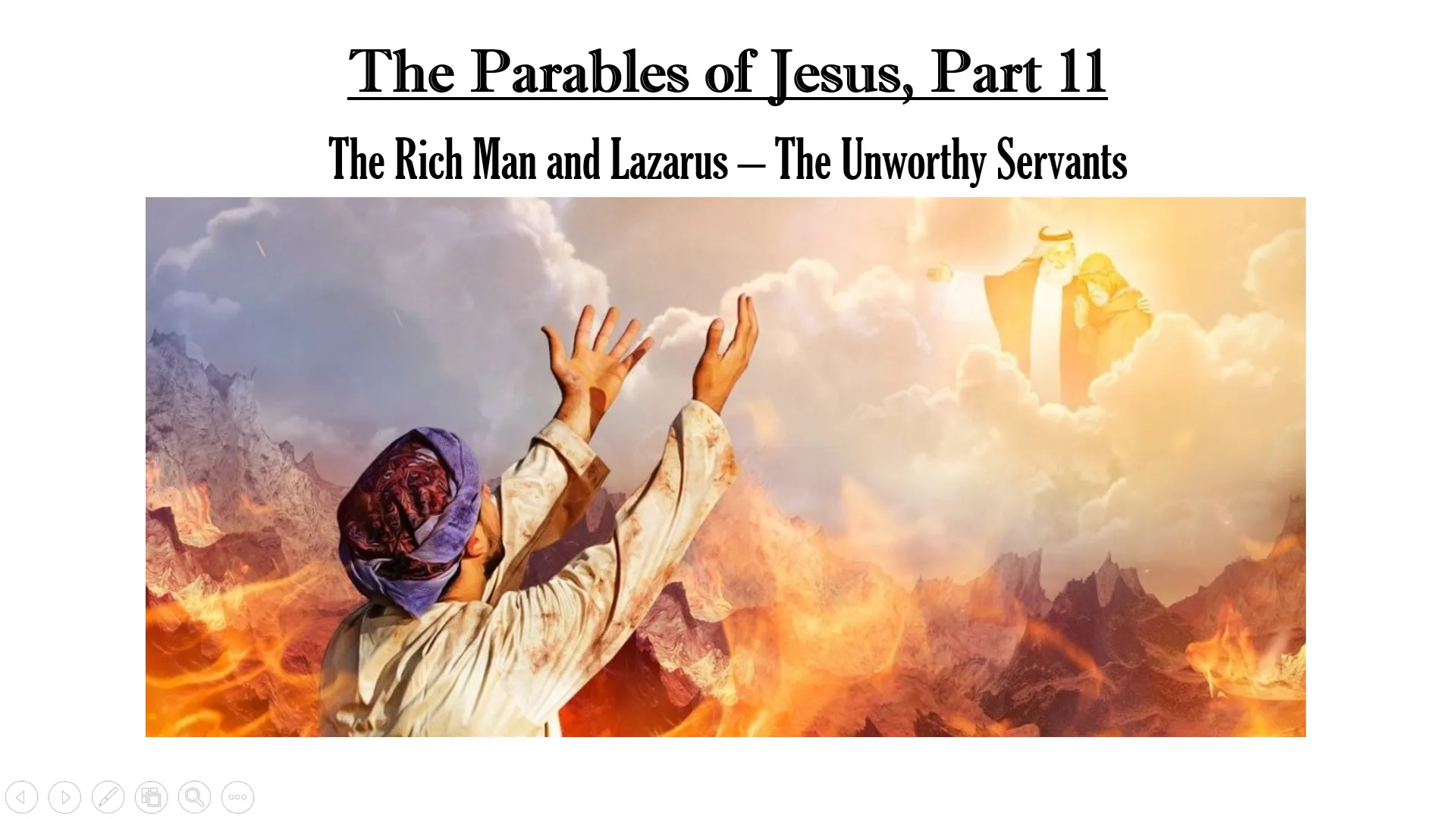
Parables of Jesus - Part 11
To set the stage for our study this morning, Jesus is winding up His time east of the Jordan River in the region of Perea. This is a period characterized by Jesus teaching many parables.
The Rich Man and Lazarus – The Unworthy Servants
To set the stage for our study this morning, Jesus is winding up His time east of the Jordan River in the region of Perea. This is a period characterized by Jesus teaching many parables. These parables are covered primarily in Luke’s gospel from Chapters 13 thru 17. In this 2- to 3-month window, Jesus actually taught one quarter of all the parables recorded in scripture (10 of the 40 parables are recorded during this time). Now, what is interesting is that, no matter where Jesus goes, even in the smaller rural communities, He attracts crowds of people. And you can be sure that where Jesus is, the Pharisees from the local synagogues are going to be right there in the crowd listening to every word He says.
You Cannot Serve Two Masters
One of the points that Jesus made in the parables we covered last time was that no one can serve two masters. He said, “You cannot serve both God and money” (Luke 16:13). And while you and I may not see this statement as being particularly controversial, it apparently riled the Pharisees up when He said that.
Q1, how did the Pharisees react when Jesus said this?
V 14 in the ESV says that they “scoffed at Him.” The King James Version says “they derided Him.” The NIV says that they “were sneering at Jesus.” The NET Bible says they “ridiculed Him.” You might wonder why did they reacted so harshly to this statement that Jesus made.
And that is the subject of Q2, the reason for this reaction to Jesus is stated in v 14, which is, they dearly what?
They loved money. That is what it says. They “dearly loved their money.” That is why they were so upset at Jesus. And Jesus looks at them and says, “You like to appear righteous in public, but God knows your hearts. What this world [values so highly] is detestable in the sight of God” (Luke 16:14-15 NLT). That is what Jesus told them. And this prompts Jesus to tell His next parable, which is the Parable of the Rich Man and Lazarus.
The Rich Man and Lazarus
Now, this is the only one of Jesus’s parables where He actually uses real names for some of His characters. It is my personal opinion and it is shared by several of the commentaries I read (so I am not alone here) that Lazarus was a real live, actual person. Now, he is not the same Lazarus as Jesus will raise from the dead later – [he is] a different Lazarus – and that the events described in this parable are based on Jesus’s knowledge of actual events that took place. Now, the other parables could have been also, but here He actually names names. Jesus mentions a conversation between the rich man and Father Abraham. Father Abraham, of course, refers to Abraham, the great patriarch from the Old Testament. As Jesus tells this parable, Abraham is in heaven. Jesus mentions Abraham by name, and since he is a real person and He mentions him by name, that is why I believe, and these other commentaries believe, that Jesus mentions Lazarus by name because he is a real person. Even though the events are real, presumable, it still is a parable because it teaches important spiritual events from a story.
Q3, what is different about this parable from Jesus’s other parables that leads many to believe it was an actual event that took place?
Now, I gave you my answer (the use of actual names), but you may have had something else.
[Comments included the setting for the parable, in the afterlife; and the possibility that the Lazarus was representative of poor people and the rich man was representative of wealthy people].
Well, let’s go ahead and get started and look at the parable. We start in v 19 of Luke Chapter 16. This is Jesus telling the parable:
“There was a rich man who was clothed in purple and fine linen and who feasted sumptuously [he was well fed with good food] every day. And at his gate was laid a poor man named Lazarus, covered with sores, who desired to be fed with what fell from the rich man’s table. Moreover, even the dogs came and licked his sores. The poor man died and was carried by the angels to Abraham’s side. The rich man also died and was buried” (Luke 16:19-22).
Q4, which words and phrases that I gave you to choose from DO NOT describe the rich man in this parable?
He was not merciful. He was not compassionate. He does not appear to be particularly religious. And he was not righteous. The other [phrases] I gave pretty well describe him [well-dressed, very wealthy, well-fed and materialistic].
One of the points emphasized in the Parable of the Unrighteous Manager (last week) was that our money, time, energy and material possessions are God-given and that they should be used to serve others. They don’t belong to us. We are merely stewards of the resources God has entrusted to us. We need to be looking for opportunities to invest in the lives of people. Jesus reminded us in Luke Chapter 12: “Everyone to whom much was given, of him much will be required, and from him to whom they entrusted much, they will demand the more” (Luke 12:48). The rich man fits that category. He certainly had the means and the opportunity and I would say even an obligation to help Lazarus. But he did not do that, did he? At least based on what Jesus said in this parable he did not.
Q5, True or false? The rich man was obligated to help Lazarus.
I gave you Leviticus 25:35-38 as a cross reference. That is a hint. If you read that [passage] you will see that the answer is TRUE. The Law states in that passage, “If your brother becomes poor and cannot maintain himself with you [which certainly describes Lazarus], you shall support him as though he were a stranger and a sojourner, and he shall live with you [there is no indication in the passage that the rich man ever brought poor Lazarus into his house]. The rich man had a moral obligation, in that Jewish society he lived in and under the Law, to help Lazarus. But he did not do that. Jesus paints a very bleak picture of Lazarus’s miserable life on earth. All this in full view of the rich man who chose on a daily basis to ignore poor Lazarus and his plight. Now, I think Lazarus’s friends were the ones that brought him and laid him at the gate. They were hoping that the rich man would have sympathy for poor Lazarus, but unfortunately, none was forthcoming. Not that we are ever told. He just let him lay there.
Both the Rich Man and Lazarus Died
So, Jesus says that Lazarus died and was carried, v 22 says, to “Abraham’s side.” You will often hear the term “Abraham’s bosom” (from the King James Version) which is figurative language for being in Paradise with God. Remember this is still Old Testament (I know this is a New Testament parable) – Jesus has not gone to the cross yet. Hades was a place of the dead. You were either in paradise or in torment. So, this is a term synonymous with heaven, a place of comfort and joy for the righteous after they die. This is where they go. So, Lazarus is now with God. That is what you need to see. That is what Jesus is telling us. The rich man on the other hand, well, he dies also. It says “he also died and was buried.” Listen to what Jesus says about him in v 23…
“And in Hades, being in torment, he [the rich man] lifted up his eyes and saw Abraham far off and Lazarus at his side. And he called out, ‘Father Abraham, have mercy on me, and send Lazarus to dip the end of his finger in water and cool my tongue, for I am in anguish in this flame’” (Luke 16:23-24).
So, the rich man ends up in Hades, the place of the dead, where he is in torment. The description given of his dreadful conditions leads me to conclude that he is in what we would call “hell,” that place of utter despair and separation from God. Jesus refers to hell later – this would be the hell we know of today – as a “place of outer darkness where there will be weeping and gnashing of teeth” (Matthew 8:12). That is a little bit different description, but it still is not a very nice place [to be]. He is still in torment. He is in the flame.
Q6, the rich man and Lazarus had one thing in common. What was that?
They both died. Death is no respecter of persons, is it? No matter how rich and famous or insignificant we are, we will all eventually die (unless the Lord comes back first). No matter what position you hold, no matter how famous you are, no matter who you are, you are going to die. We have only so much time on this old earth and then one day -- our time runs out. We do not know when that will be. Only God knows. Hebrews 9:27 says, “It is appointed for man [and woman] to die once, and after that comes judgment.”
Now, in this parable Jesus gives us some insight into what comes after death. It is not “soul sleep.” It is not reincarnation. That is not biblical. It is not a state of unconsciousness. So, with that I am going to skip ahead to Q9, True or false? Based on this parable, there is consciousness after death. True. Either that will be a consciousness in heaven, in the presence of the Lord – as Paul said, “to be absent from the body is to be present with the Lord” (2 Corinthians 5:8 KJV) – it is either going to be that OR consciousness in the torment of hell, eternally separated from God. There will be consciousness.
So, let’s go back to Q7, what was the rich man requesting [of Abraham in v 24] that he himself had not been willing to offer Lazarus?
Mercy. “Have mercy on me.” That was his request. “I want mercy.” Interesting, the rich man had NOT been merciful toward Lazarus. And yet, he wants mercy! How about that!
“But Abraham said, ‘Child, remember that you in your lifetime received your good things, and Lazarus in like manner bad things; but now he is comforted here, and you are in anguish. And besides all this, between us and you a great chasm has been fixed, in order that those who would pass from here to you may not be able, and none may cross from there to us’” (Luke 16:25-26).
Q8, what barrier existed between the rich man and Abraham?
A deep chasm. Abraham tells the rich man, “There is a great chasm fixed that none may cross.” There is no bridge or passageway between heaven and hell. Wherever you go after death – whether it be heaven or hell – that is where you will remain forever. Now, that is a very sobering thought! There is no second chance [after death] taught in the Bible. There are some people that actually teach that, but it is not in the Bible.
“And he said, ‘Then I beg you, father, to send him [Lazarus] to my father’s house—for I have five brothers—so that he may warn them, lest they also come into this place of torment.’ But Abraham said, ‘They have Moses and the Prophets; let them hear them’” (Luke 16:27-29).
Why Did the Rich Man Go to Hell?
So, the big question is this, and it is the subject of Q10; the million-dollar question is: “What is the sin that sent the rich man to hell?”
Now, I am going to answer that. I just want you to hold your thought right there. This is a vitally important question. The rich man is pleading with Abraham to send Lazarus to his five brothers to warn them. But Abraham says, “They have Moses and the Prophets; let them hear them. They have the Word of God. They have the words of these Old Testament preachers, these prophets. They have of the Word. They have God’s Word. Let your brothers hear them.”
So then, I ask you the question again… why did the rich man go to hell? What was his great sin? Was it being rich? Was it refusing to help Lazarus? It was unbelief. He had the sin of unbelief. Did he have Moses and the prophets while he was alive? He was a good Jew. Of course he did. But he would not heed God’s word. He did not believe God. He would not listen to the prophets who proclaimed God’s truth. Instead, the rich man placed his hope and faith (like we saw in an earlier parable) in himself and his possessions. How did that work out for him? Not so well.
Q11, why does Abraham refuse the rich man’s request to send Lazarus to warn his brothers?
They have God’s Word. They have it already, right? They have the truth. Anyone can find the truth if they seek it. That was true in Jesus’ day and it is even more so today. We have the entirety of God’s holy Word. God has always been revealed in His creation. Paul talks about that [in Romans Chapter 1]. But now we have the preaching of God’s Word, His truth on television and radio, numerous internet web sites; even the great preachers of old who have died, you can hear their messages. And you have a variety of Christian music and all this literature, these books, Christian bookstores are filled with these great books from all these great authors, all conveying God’s truth in many languages, not just in English. The Gospel message (yes, it still needs to be proclaimed in places where there are some unreached people [groups]) for the most part, especially in the civilized world, it has been preached. It is out there! We have heard it.
Romans 1:18 tells us that many people “by their unrighteousness suppress the truth.” It isn’t that most people in America don’t know the truth. They have heard it. But they simply say, “I don’t need God.” They reason to themselves, “I’m a good person, I’m OK. God would never send me to hell.” And it is quite a risk to be taking I would say. Or they might be like those folks that we talked about [in an earlier parable] when that king sent out the invitation to his dinner who said, “Not now. I’m busy. Maybe later. Maybe some other time.” But then that later time never came, did it? They never got another chance. Their window of opportunity comes and goes before they know what happened. Romans 1:20 concludes, “So, they are without excuse.”
Well, the rich man said “No” to God while he was alive on earth. And now, in death, listen to his response to Abraham, v 30…
“And he said, ‘No [he is still saying “no”], No father Abraham, but if someone goes to them from the dead, they will repent.’ He [Abraham] said to him [the rich man], ‘If they do not hear Moses and the Prophets, neither will they be convinced if someone should rise from the dead’” (Luke 16:30-31).
What do you make of the rich man’s claim that, “if someone goes to them from the dead, they will repent”? Would that really make a difference? Well, Abraham does not seem to think so.
Now, I want you to consider something. In John Chapter 11 (shortly after Jesus teaches this parable) Jesus gets the word that his friend Lazarus has died. He is in Perea somewhere and He gets the word. He and His disciples head to Bethany. Lazarus has died. And they travel to Bethany and there Jesus raises another guy, ironically by the name of Lazarus, from the dead. We know that at this scene where Lazarus is raised from the dead there were hundreds of people including some Pharisees from Jerusalem who were there. But in John 11:53 we read that, instead of believing that Jesus was really the Messiah sent by God, it says the Pharisees plotted to kill Him [Jesus]! That was their reaction to Jesus raising someone from the dead. And then later, when Jesus Himself was raised from the dead, there was no mass repentance by the Pharisees, was there? They still refused to believe that Jesus was the promised Messiah. Now, there were some Pharisees that did believe. We know of that from scripture. But, by and large, the Pharisees did not believe. They rejected Jesus. Even after Jesus was raised from the dead, they still did not believe. After Lazarus was raised by Jesus; after Jesus was raised, still unbelief. What Abraham was saying was true wasn’t it? Even when people WERE raised from the dead, there was still unbelief.
One final thought about the rich man and Lazarus…
Had the rich man been willing to help out Lazarus, to meet his physical needs, like the Law required, as he was obligated to do, it is very likely that there would have been some sort of dialog between the two men. Lazarus would have at some point, being a righteous man, probably have had the opportunity to share with the rich man how to get to heaven. Lazarus obviously had spiritual insight that the rich man did not have. Look where they ended up. This is an example of how meeting one’s physical needs could, in fact, produce a greater eternal reward. But he did not do that, did he?
Application
Here is the application: How are we saved? We are saved by accepting God’s provision for our salvation, which is through Jesus Christ. And it is all in God’s word. It is all spelled out there – Gospel of John and other places. Paul talks about it a lot [in his letters]. Acts talks about how we are saved. And so, we all, like the rich man, make our own choices whether to reject or accept God’s provision for eternal life through Jesus Christ.
Now there is a warning to all readers (everybody who hears and reads the word of God) – there is a fleeting window of opportunity to make that choice. None of us knows how long that window will remain open. None of us are guaranteed tomorrow. Yesterday is gone. Tomorrow may never come for us. We do not know what today holds. All we have is right now. We don’t even know that we have an hour from now. Your decision, though, that you make while you still have life is going to have eternal consequences. So, make the right choice.
The Unworthy Servants
We have one last parable to cover and that is the Parable of the Unworthy Servants. Just three verses. This one is not very long at all.
So, Jesus again is alone with His disciples. They are still in Perea. He is spending a lot of His time talking to His disciples and getting them ready for what is about to happen. And He is talking about faithful service.
You know, it is only human nature to want to be praised or to be well-compensated for a job well done, isn’t it? Don’t we all want to get good pay and be told we are doing a good job? We all want that. But what is my true motivation for doing a good job? What should it be? Is it to receive praise and more money? Or am I motivated to do my best because that is what God expects of me? I had to ask myself that question a lot when I was working for bosses I did not particularly like. I had to remind myself who my Boss really was. Anyway, that is the question Jesus is addressing in this parable. So, here it is…
“Will any one of you [talking to His disciples] who has a servant plowing or keeping sheep say to him when he has come in from the field [to the servant], ‘Come at once and recline at table’? Will he not rather say to him, ‘Prepare supper for me, and dress properly, and serve me while I eat and drink, and afterward you will eat and drink’? Does he thank the servant because he did what was commanded?” (Luke 17:7-9).
Like I said, short and sweet, three verses. I will get to v 10 here in a minute. In Jesus’ day, what was a servant’s job? It was simply to serve the master, right?
Q12, according to Jesus in this parable, when do the servants normally get to sit down and eat their own meal?
Once the job is done, right? Serving the master. That is their job. After they have completed their duties, he has eaten his dinner and he is happy, then they can serve their own dinner. But their primary responsibility is to serve their master.
Now, in this short parable who are the servants? Us, right? Those of us who follow Jesus. His disciples and then, by extension down through the ages, us, you and me. We are the servants. So, if we are the servants, who is the master? Our Lord and Savior, Jesus Christ. Following Jesus and serving Him should be regarded as an honor and a privilege. What makes us think that just because we do what we are expected to do, we deserve some kind of special treatment by God? He owes us. Why should we? It is what He has called us to do! That is what the Master expects of us. We, like the servants in this parable, are merely doing our job.
“So, you also, when you have done all that you were commanded [here is the application – this is what you say], ‘We are unworthy servants; we have only done what was our duty’” (Luke 17:10).
So, a servant who was doing what he was told to do should not expect to receive congratulations from his master. That is his job or her job! Jesus is rebuking spiritual pride here. Instead of expecting something extra from God (because we were such good servants to Him), our attitude should be one of humility – “We are but unworthy servants!”
Q13, what central truth about our service to God does Jesus teach in v 10?
That our service to the Lord is our duty, yes, but it is also our honor and our privilege. We gladly serve Jesus, not to get something from Him, but rather, to give back just a little because of what He has done for us. Our gratitude to the Master for saving us from hell!
Q14, who determines whether we will receive a reward for our service?
Pastor Mike? The Pope? You? Me? Who decides? Our Master will decide that, our Lord, Jesus!
Application
“Well done good and faithful servant.” Now, those are the words I want to hear Jesus say to me someday. Don’t you want to hear those words? For me, that will be reward enough. But until that day comes, as long as we still have breath, as long as I have breath, there is work to be done for the kingdom, isn’t there? He is leaving us here for a reason. We may all eventually retire from our jobs or careers (I highly recommend it by the way), but we never retire from being the servants of Jesus.
Questions
Note: To better help you to answer these questions you are encouraged to use the English Standard Version translation of the Bible.
Parables of Jesus - Part 11
Part 11 Questions
Background To the Parables (Luke 16:13-15)
1. How did the Pharisees react to Jesus saying, “You cannot serve God and money”? (Check the BEST answer)
___ They argued with Him ___ They ridiculed Him
___ They questioned Him ___ They ignored Him
2. The reason for this reaction to Jesus is stated in verse 14, because they dearly WHAT? (Circle ONE)
LOVED TO BE NOTICED LOVED GOD LOVED TO ARGUE LOVED MONEY
The Rich Man and Lazarus (Luke 16:19-31)
3. What is different about this parable from Jesus’s other parables that leads many to believe it was an actual event that took place? ____________________________________________
4. Which words and phrases below DO NOT describe the rich man in this parable? (Check ALL that apply)
___ compassionate ___ religious ___ well dressed ___ very wealthy
___ well fed ___ righteous ___ merciful ___ materialistic
5. True or false? The rich man was obligated to help Lazarus (see Leviticus 25:35-38).
T F
6. The rich man and Lazarus had one thing in common. They both ________ (Circle one)
EVENTUALLY DIED LIKED DOGS LIVED LIFE TO THE FULLEST LOVED GOD
7. The rich man requested something of Abraham in v 24 that he himself had not been willing to offer Lazarus. What was it? ______________________________
8. What barrier existed between the rich man and Abraham? (Check ONE)
___ deep chasm ___ fiery flame ___ great wall ___ army of angels
9. True or false? Based on this parable, there is consciousness after death. T F
10. What does this parable teach was THE sin that sent the rich man to hell? It was his ______ (Circle ONE)
FALSE DOCTRINE LACK OF COMPASSION LOVE OF MONEY UNBELIEF
11. Why does Abraham refuse the rich man’s request to send Lazarus to warn his brothers? (Check the BEST answer)
___ Once dead, a person cannot live again ___ Their destiny has been pre-determined
___ They have the truth of God’s word ___ They have sinned too much to be saved
The Unworthy Servants (Luke 17:7-10)
12. According to Jesus in this parable, when do the servants normally get to sit down and eat their own meal? (Check the BEST answer)
___ When they have come in from the field ___ When they have been given permission
___ Only after they have said their prayers ___ Only after they have served the master
13. What central truth about our service to God does Jesus teach in verse 10? (Check the BEST answer)
___ Our service needs to be affirmed ___ Our service is necessary for salvation
___ Our service is a duty, honor and privilege ___ Our service ensures rewards in heaven
14. WHO determines whether we will receive a reward for our service or not? ______________