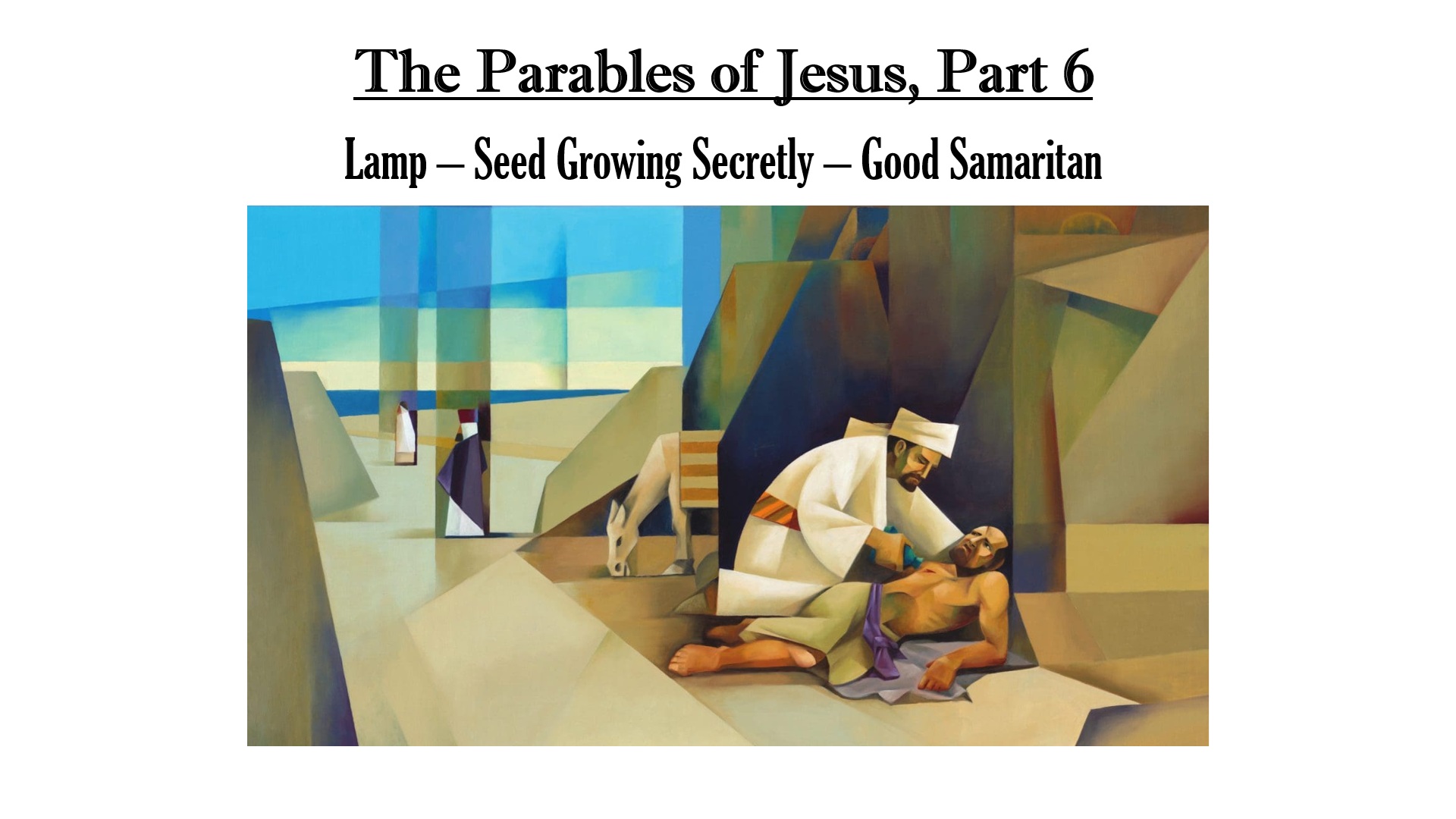
Parables of Jesus - Part 6
How many of you have in your Bibles a “Harmony of the Gospels”? Do you all have access to one of those in your own study? It puts the four Gospels side by side and [lists things that happened] in chronological order.
Lamp – Seed Growing Secretly – Good Samaritan
How many of you have in your Bibles a “Harmony of the Gospels”? Do you all have access to one of those in your own study? It puts the four Gospels side by side and [lists things that happened] in chronological order. Well, if you have a Harmony of the Gospels or if you have access to something similar to that, you will notice that we have been studying the parables in the order that Jesus taught them. Now, it just so happens that the next two parables that are on our list to be studied (in chronological order) we have actually studied already in Mark Chapter 4 (when we did our study in Mark’s Gospel earlier this year).
Matthew Chapter 13 [that we just looked at] and Mark Chapter 4, the teachings of Jesus, happened at the same time. So, Matthew and Mark cover a lot of the same parables. We just looked at eight Kingdom of Heaven parables in Matthew Chapter 13. And although he covered eight, Mark covers two that Matthew did not cover. They are also Kingdom of Heaven parables. So, we are going to look at those two and they are going to go right along with the other eight that we already looked at.
The Lamp
The first one we are going to look at this morning is The Lamp. We will go through these rather quickly. Psalm 119:105 – a verse you all know – “Thy word is a LAMP unto my feet and a light unto my path.” So, the lamp is God’s truth that is found in His word. God’s word lights our path. It shows us the way we need to go. It identifies obstacles, dangers we need to avoid.
It is appropriate then that Jesus refers to Himself as “the light of the world” (John 9:5). In the opening verses of the Gospel of John, Jesus is described as “the light of men” (John 1:4). So, while this parable represents, in one sense, the truth of God’s Word, more specifically it represents the truth of the Gospel message. We are talking about the kingdom of heaven, kingdom of God, right? So, the truth of the Gospel. And what is that truth, the truth about Jesus? That He is God’s Son. He is the Savior of the world, sent from heaven to deliver us from the curse of sin. With that in mind, let’s take a look at the Parable of the Lamp and it begins in Mark Chapter 4, v 21…
And He [Jesus] said to them [His disciples], “Is a lamp brought in to be put under a basket, or under a bed, and not on a stand? For nothing is hidden except to be made manifest; nor is anything secret except to come to light. If anyone has ears to hear, let him hear” (Mark 4:21-23).
Q1 asks, according to Jesus, where should one place a lamp that has been lit?
On a stand, a lampstand. And then Jesus basically asks, “What is the purpose of a lamp?” The answer is obvious. It is to give light in a dark space; to reveal what we are unable to see in the darkness. If a lamp is hidden, it will not serve its purpose, will it? So that is Jesus’s whole point.
Application
If we profess Jesus as our Lord then our responsibility is to shine our light, to reveal The Light (Jesus) in a world darkened by sin. You and I were once lost in the darkness ourselves, right? But then the light of the Gospel shined through in us and we found Jesus. Now, the world thinks that there is some big secret to happiness. But we have the answer, don’t we? We have the answer that they are looking for. Jesus tells His disciples (and us), “YOU are the light of the world… Let YOUR light shine before men in such a way that they may see your good works, and glorify your Father who is in heaven” (Matthew 5:14 and 16). We are to share Jesus Christ with others, to light their way to the kingdom of heaven. There is your application.
Now, following the light is an exercise of faith on that other person’s part. We can give them the light, but following it is on them. That is where they exercise faith. Merely hearing the truth and acknowledging it are not enough. Let me give you a real-world example. Let’s say that I went to the hospital because I was having chest pains, and the doctor tells me, “We have done some tests and I have bad news. You have cancer.” The knowledge is important. That is for sure. But that knowledge is not going to be what cures me, is it? I have to do something. I must undergo treatment for my cancer. I have to follow the path that is laid out for me if I am going to be cured of cancer, right? Knowledge itself is not enough.
And He [Jesus] said to them, “Pay attention to what you hear: with the measure you use, it will be measured to you, and still more will be added to you. For to the one who has, more will be given, and from the one who has not, even what he has will be taken away” (Mark 4:24-25).
Q2, the underlying truth is that we are to do WHAT with the blessings that we have been given by God?
[Class answers including “share the truth” and “give back”]
So, the application as it applies to the kingdom of heaven (or kingdom of God, same thing) is clear. We are the light of the world, right? Jesus said we were. We are to shine our light for the benefit of those who are lost. We are to share it. We are to shine our light. The light is the glorious Gospel message that we received, that there is hope, there is eternal life in Jesus Christ.
I don’t really understand fully these last two verses (v 24 and 25). There is a lot there that I probably need to go through and unpack. There are a lot of things we do not know, but there are some things we DO know about this passage. We have to light the pathway to the kingdom for others. That is what we DO know about this passage. We need to share our light.
The Seed Growing Secretly
This next parable is the Parable of the Seed Growing Secretly. Now, we have talked before about what the seed is, in the Parable of the Seed. It is the Gospel message. It gets planted and, if it is in the right environment (a receptive heart), it is going to grow. So here it is…
And He [Jesus] said, “The kingdom of God is as if a man should scatter seed on the ground. He sleeps and rises night and day, and the seed sprouts and grows; he knows not how. The earth produces by itself, first the blade, then the ear, then the full grain in the ear. But when the grain is ripe, at once he puts in the sickle, because the harvest has come” (Mark 4:26-29).
Q3 asks, what is the kingdom of God like? What does Jesus compare it to?
A man scattering seed on the ground. The truth of the Gospel when planted into the hearts of people, like the seed planted by the farmer, though unseen in the ground, it grows gradually. We do not see what is happening but it is growing gradually. In this parable the seed sprouts up and grows while the farmer is asleep (and while he is doing other things). God is giving the increase. God is the One making it grow. We Christians, like the man in this parable, are to faithfully plant the seed (the Gospel message) and then let God take care of the rest.
Application
Now, the application as it relates to the kingdom of heaven is that the seed of the Gospel is planted. So, we play a part in the process. It is our responsibility to carry the message, isn’t it? But then the seed grows by the power of God.
Q4, from the time of planting to the harvest, who is involved in this process?
The man who plants and God. Those two and maybe some others. But certainly, God and the man that planted. So, that is the application. We are involved in this process of sharing the Gospel, but the seed grows by the power of God.
Background for the Parable of the Good Samaritan
I want to spend the balance of our time in one of my favorite parables, the Parable of the Good Samaritan. I think you all should be aware of this one. Luke is the only Gospel writer that tells this parable (in Luke Chapter 10).
The background is as follows: a man comes to Jesus and he asks Him two very pertinent questions. He is an educated man described as a “lawyer.” In other words, he is a religious scribe. In Jesus’s day scribes belonged to the party of the Pharisees. They were professional students and defenders of the Law. Sometimes they were referred to as “lawyers” because one of their responsibilities was to administer the law as judges in the Sanhedrin (the Jewish governing body at the time). So, they really knew the Law. And they liked to show off their knowledge whenever they had the chance.
We are told right off the bat, in v 25, that the scribe in this passage wants to put Jesus to the test.
So, Q5, True or false? When the lawyer (scribe) asks Jesus questions, his underlying motive is to learn more and to apply God’s truth to his life.
False. Obviously, that is not his motive. The scribe wants to demonstrate his superior knowledge of the Law. Here is his opportunity to show Jesus up in a public setting. So, let’s read beginning in v 25…
And behold, a lawyer stood up to put Him [Jesus] to the test, saying, “Teacher, what shall I do to inherit eternal life?” He [Jesus] said to him, “What is written in the Law? How do you read it?” And he answered, “You shall love the Lord your God with all your heart and with all your soul and with all your strength and with all your mind, and your neighbor as yourself” (Luke 10:25-27).
“What Shall I Do to Inherit Eternal Life?”
The first question the scribe asks is a really important one – “What shall I do to inherit eternal life?” Like most people today this man believes that heaven is attainable by DOING something. So, what do you have to do? Some act, some action I have to take. He thinks he knows the answer already. He is just testing Jesus. Well, Jesus knows the man’s intentions because Jesus can read his mind (Jesus is God). That’s why Jesus answers his question with a question of His own. He basically asks this know-it-all scribe, “Well, you know the Law. What does it say to you?” The scribe, anxious to show off his knowledge of the scriptures quotes not one, but two Old Testament passages. He quotes Deuteronomy 6:5 and Leviticus 19:18. These two verses summarize the entire Law, namely, to have a devoted love for God and a selfless love for your fellow man. It is a pretty good answer actually because, later, Jesus Himself, when He is asked which is the greatest commandment, will use these very same verses in His response (see Matthew 22:36-40). So, this guy gives a pretty good answer, doesn’t he?
And He [Jesus] said to him, “You have answered correctly; do this, and you will live” (Luke 10:28).
Q6, “Do this and you shall live.” Do what? What is the context?
Keep the Law. Jesus’s answer to him also comes right out of scripture, Leviticus 18:5, where God instructed Moses and the people of Israel. This is what God said: “So you shall keep My statutes and My judgments, by which a man may live if he does them.” God said that man could be justified and go to heaven if he kept the Law. Did you all know that was in there? God said it.
Now, the question comes, is that really possible? Can a person keep the law – you have to keep it perfectly – and be justified? The answer is NO. There is an Old Testament and a New Testament for a reason. [We have been given] the new covenant because we could not keep the old covenant. We cannot keep the Law perfectly. If you break the Law in any one part and you have broken it all! In Galatians 2:16 this is Paul giving the answer to the question I just asked. Paul says, “yet we know that a person is NOT justified by works of the law but through faith in Jesus Christ, so we also have believed in Christ Jesus, in order to be justified by faith in Christ and not by works of the law, because by works of the law no one will be justified. Yes, if you could keep the law perfectly you could be saved, you could be justified. But nobody can. We cannot keep the law perfectly. So, we have a problem, don’t we?
That is why Jesus left His throne in heaven and came down here to earth and became human and went through all that He did (His death on the cross and everything else) for us. We could NOT save ourselves no matter how hard we tried, no matter how good we were. No matter how much we tried to keep the Law and do the right things. We could not keep the Law of God perfectly. We needed divine intervention! And so, Jesus left heaven and came down to earth to where we were. He became our Savior and our Deliverer! Praise God that He did! Where would we be without Him?
Now, had this scribe been completely honest with Jesus at this point, he would have said something like this: “Master, I’ve tried to love God with all my heart, soul, strength and mind. I’ve tried! And I have even tried to love my neighbor as myself and it is hard. I just can’t do it. I have failed miserably.” With that being said, his follow-up question would have been the same question that Nicodemus asked Jesus, “So, what can I do to inherit eternal life?” “How do I get eternal life if I can’t keep the Law? What do I do?” If he had been honest, he would have asked that follow-up question, wouldn’t he? But he is not honest with Jesus. Instead, he is filled with pride. Listen to the actual statement he makes to Jesus…
But he, desiring to justify himself, said to Jesus, “And who is my neighbor?” (Luke 10:29).
Q7, the Parable of the Good Samaritan was told in response to a question that Jesus was asked. What was the question?
I just gave it to you. He asks Jesus several questions but the actual parable was in response to that question. “Who is my neighbor?”
V 29 says that the scribe wants to “justify himself.” This can be taken one of two ways. On one hand, he may have felt as though he looked bad asking and then answering his own question and he was trying to save face. He wants to show Jesus and the crowd gathered around Jesus that he really does know what he is talking about. So, that is one possibility. On the other hand, being a lawyer and a legalist, he probably DOES think that he CAN justify himself in a spiritual sense by keeping God’s law. He is a lawyer. Like any good lawyer he is looking for loopholes. He wants to push the envelope as far as he can and still (technically) be in compliance. So, he asks the follow-up question, “Who is my neighbor?” In other words, “OK Jesus, define ‘neighbor’ for me.”
Remember that Jesus, being God, can read this man’s mind. He knows this guy. He knows this guy better than he knows himself. Jesus knows his prideful heart and his legalistic mindset. Undoubtedly this scribe has a limited group that he considers to be his neighbors. Jesus now replies to the man’s question and clears up his rather faulty idea about who is one’s neighbor. And that is the backdrop to the Parable of the Good Samaritan. Here it is, v 30, the parable begins…
The Good Samaritan
Jesus replied, “A man was going down from Jerusalem to Jericho, and he fell among robbers, who stripped him and beat him and departed, leaving him half dead” (Luke 10:30).
So, we have this man; he is traveling down a main road, a main highway that goes from Jerusalem down to Jericho. And he gets robbed and beaten up by a gang of thugs. He becomes a victim of a crime. He was minding his own business. He had every right to be traveling on this public thoroughfare. He was not looking for trouble. What happened to him was not his fault. Sometimes things happen to us that are outside of our control. That was the case here with this guy. So, now we see him lying bleeding and helpless on the side of the road. The man in this parable represents all hurting people, whether they have physical, mental or emotional wounds. The world around us is full of people like this. You probably know some yourself. Maybe you have been one of those.
Q8 asks, in this parable the man who was beaten up most needed what?
Someone to show compassion. What hurting people do NOT need is religion as usual and condescending attitudes. They need help. They need someone to come alongside them and show them compassion. They need God’s love.
“Now by chance [it just so happened] a priest was going down that road, and when he saw him [the wounded man] he passed by on the other side. So likewise, a Levite, when he came to the place and saw him, passed by on the other side [he did the same thing]. But a Samaritan, as he journeyed, came to where he was, and when he saw him, he had compassion” (Luke 10:31-33).
Jesus tells us that three different people come walking down that very same road right after this incident took place. All three of them see the man lying there bleeding and helpless. The first man is a priest. He is a clergyman. The second man is a Levite. He is a religious layperson. The third is a Samaritan.
So now we are going to come to part of the application for this lesson.
Q9, the Samaritan in this parable represents any person or group that we do not particularly like (note: I did not say “hated”). To make this personal, who would that be in YOUR life?
[Class responses included Democrats, liberals, Mormons, Islamic people]
So, these two religious guys pass by on the other side. You would think that these supposed “men of God” would show more compassion than others. But that is not the case, is it? The religious guys do not help the man at all. They do not even stop to give him words of encouragement -- “Hang in there, buddy. It will get better!” I can guarantee you, though, that whatever their reason for not stopping, they had a great excuse. Perhaps they had an important meeting that they had to get to. They were too busy. That is one of my go-to excuses, “I am really busy.” Maybe they felt that by touching a dead body (they did not know if he was dead or not), or they would become ceremonial “unclean.” Hey, we can’t have that! “I have duties to attend to.” Maybe they thought that the thieves were hiding nearby and this was a trap. If they stopped to help maybe the thieves would jump them. They were thinking all about themselves. One of my favorite excuses, perhaps this is what they were thinking is, “I am not qualified. I have not had first aid training. I am not medically qualified to help this guy. What good could I do?” So, they just kept going.
Q10, the two “religious” guys that came along responded how?
They did nothing. They just walked right on by.
But then along comes one of those disgusting [Democrats, Muslims, Mormons] -- a disgusting Samaritan came by. The Jews hated them, as my mother used to say, “with a pink and purple passion.” The Jews viewed the Samaritans as good-for-nothing half-breeds. A lot of them had been dissimilated with other people groups and intermarried. They were not “pure” Jews. So, what does this good-for-nothing guy do? He feels compassion for the wounded man. This means more than just feeling sorry for the guy. He goes a step further…
“He went to him and bound up his wounds, pouring on oil and wine [their medical treatment of that day]. Then he set him on his own animal and brought him to an inn and took care of him. And the next day he took out two denarii [two days wages] and gave them to the innkeeper, saying, ‘Take care of him, and whatever more you spend, I will repay you when I come back’” (Luke 10:34-35).
Q11, what was the outward evidence of the Samaritan’s compassion for this injured man? He did some things, right?
He went to him. He bound up (attended to) his wounds. He took care of him. He put something helpful on his wounds. He provided for his care. Specifically, he took him away from the danger zone, from out in this austere environment where he would have died if he were just left there. He took him to an inn somewhere, maybe to Jericho. And then he actually tells the innkeeper, “Hey, I am going to pay you to take care of this guy. I am going to be traveling through here and when I come back, I will repay you whatever extra you need.” This guy is amazing!
Now, I want you to notice several important things from this parable: First, the injured man never asks for the Samaritan’s help. His physical need is recognized and voluntarily met. Second, the Samaritan uses his own resources and money to help a man he doesn’t even know. Presumably he is a stranger. Third, what the Samaritan does is not in his job description. It was certainly not something Samaritans and Jews did for each other. They hated each other. But he does it anyway even though it was “politically incorrect.” He goes the extra mile. Fourth, the Samaritan finds time to take care of the injured man even though he probably has other things he needs to do. I am sure he was busy too. He was on the road to Jerico for a reason. He had something he was headed to. Fifth, the whole time the Samaritan is caring for the injured man – all these things that he does – he not once becomes injured himself. That is not a fear he has. He is not thinking about himself. Some people have the idea that, if they help somebody out, by association they will become like them. Maybe they will catch whatever disease they have. But that was not the case here. The Samaritan is not thinking about himself. He is thinking about the injured guy.
And finally, what I want you to see is that there is absolutely nothing in it for him. No personal gain. There is no monetary benefit for him. He is not going to make a lot of money off this deal. No recognition. He is not going to be on the local radio station giving interviews. The only reward is knowing that he is helping somebody else out; the personal satisfaction of doing a good deed, doing the right thing. That is all.
Q12, what did the Samaritan risk by helping out the man?
He risked a lot. Everything on that list. He risked becoming injured or a victim himself. It is possible that the thieves WERE hiding out nearby. He risked catching a disease. He did not know what disease the guy had. He could have been a leper. He risked a financial burden, personal cost. It does not mention how long the injured guy was at the inn. He could have been there eight months! Maybe he had a long road to recovery. That could have cost him a lot of money but he was committed to it. He risked criticism for a Samaritan helping a Jew. You know his buddies gave him a hard time. “You did what?” Not to mention the risk of liability if something went wrong while the man was in his care. There is a reason why today we have all these Good Samaritan laws, because people were suing other people for trying to help out. Something could have gone wrong and he would have had that liability back then. So, he was risking quite a bit.
Now, Jesus closes this parable by asking the scribe a question…
“Which of these three, do you think, proved to be a neighbor to the man who fell among the robbers?” (Luke 10:36).
The scribe’s answer is in v 37… “The one who showed him mercy.” That is the correct answer, right? What is Jesus final statement to the scribe and, by application, to us here in this room today? What is it? “You go, and do likewise.”
Application
Q13, according to Jesus, who is our neighbor? What does this parable teach us?
Notice I said to pick the BEST answer. That our neighbor is anybody we cross paths with. Who am I to show compassion to? Whoever comes across my path, whether I know them or not; whether I like them or not; whether they are a Democrat or a Muslim or whatever.
Will I go to heaven because I help my neighbor out? No. That only comes by my faith in Jesus and my commitment to Him. We go to heaven because of our faith in Christ. Because we are Christians, because we have been saved by grace, because we follow our Master, the Lord Jesus Christ, we want to do what He says. We want to be obedient to Him. And part of being obedient to Him is “go and do likewise.” Show compassion to people that you cross paths with. That is the application.
Now, I want to close with a passage from Matthew Chapter 25. It goes right along with what we have been talking about here…
“Then the King will say to those on His right, ‘Come, you who are blessed by My Father, inherit the kingdom prepared for you from the foundation of the world. For I was hungry and you gave Me food, I was thirsty and you gave Me drink, I was a stranger and you welcomed Me, I was naked and you clothed Me, I was sick and you visited Me, I was in prison and you came to Me.’ Then the righteous will answer Him, saying, ‘Lord, WHEN did we see You hungry and feed You, or thirsty and give You drink? And when did we see You a stranger and welcome You, or naked and clothe You? And when did we see You sick or in prison and visit You?’” (Matthew 25:34-39).
“When, Lord? I don’t remember any of that. When did we do that?”
“And the King will answer them, ‘Truly, I say to you, as you did it to one of the least of these My brothers, you did it to Me’” (Matthew 25:40).
Q14, the next time you minister to a person’s need, who is it that you are you really serving?
JESUS. Have you ever thought of it that way before? Wow! There is your application for the parable right there. So, the next time you come across the path of somebody in need, ask yourself, “If this person were Jesus, what would I do?” And then proceed accordingly.
I don’t know who said this [originally], but it comes right out of our passage today and I will close with this:
“The thieves said, ‘What’s thine is mine; I’ll take it.’ The priest and the Levite said, ‘What’s mine is mine; I’ll keep it.’ The Samaritan said, ‘What’s mine is thine; I’ll give it.’”
Food for thought.
Questions
Note: To better help you to answer these questions you are encouraged to use the English Standard Version translation of the Bible.
Parables of Jesus - Part 6
Parables of Jesus Questions - Part 6
The Lamp (Mark 4:21-25)
1. According to Jesus, where should one place a lamp that has been lit? (Circle best answer)
UNDER A BASKET UNDER A BED IN YOUR HAND ON A STAND
2. The underlying truth of v 24-25 is that we are to do WHAT with the blessings that we have been given by God? ______________________________________________________
The Seed Growing Secretly (Mark 4:26-29)
3. Jesus said, WHAT is the kingdom of God like? (Check the best answer)
___ A man going into a far country ___ A bridegroom inviting guests
___ A man scattering seed on the ground ___ A boat going fishing
4. From the time of planting through the harvest, who is involved in this process? (Check best answer)
___Nobody ___ the man who plants ___ God ___ both the man who plants and God
The Good Samaritan (Luke 10:25-37)
5. True or false? When the lawyer (scribe) asks Jesus questions, his underlying motive is to learn more and to apply God’s truth to his life.
T F
6. Jesus tells the lawyer, v 28, “Do this and you shall live.” Do WHAT? (Circle one)
EXERCISE FAITH KEEP THE LAW REPENT SELL EVERYTHING
7. This parable was told in response to a question that Jesus was asked. What was the question? (Check the best answer)
___ “What shall I do to inherit eternal life?” ___ “How can I love God completely?”
___ “Who is my neighbor?” ___ “What is written in the Law?”
8. In this parable the man who was beaten up most needed WHAT? (Check the best answer)
___ words of encouragement ___ an invitation to church or synagogue
___ someone to show compassion ___ good health insurance
9. The Samaritan in this parable represents any person or group that we do not particularly like. To make this personal, who would that be in YOUR life? ______________________
10. The two “religious” guys that came along respond how? (Circle the best answer) They…
GIVE WORDS OF COMFORT PRAY FOR THE MAN RENDER AID DO NOTHING
11. Verse 33 tells us that the Samaritan “had compassion.” What was the outward evidence of his compassion for this injured man? ____________________________________________
12. What did the Samaritan risk by helping out the man? (Check all that apply)
___ Becoming injured or a victim himself ___ Financial burden, personal cost
___ Catching a disease the man may have ___ Criticism for helping out a Jew
13. According to Jesus, who is OUR neighbor? What does this parable teach us? That our neighbor is… (Check the best answer)
___ That person who asks for our help ___ Anybody we cross paths with
___ Someone that we know personally ___ A person who looks and acts like us
14. Read Matthew 25:34-40. The next time you minister to a person’s need, WHO is it that you are you really serving? ______________________