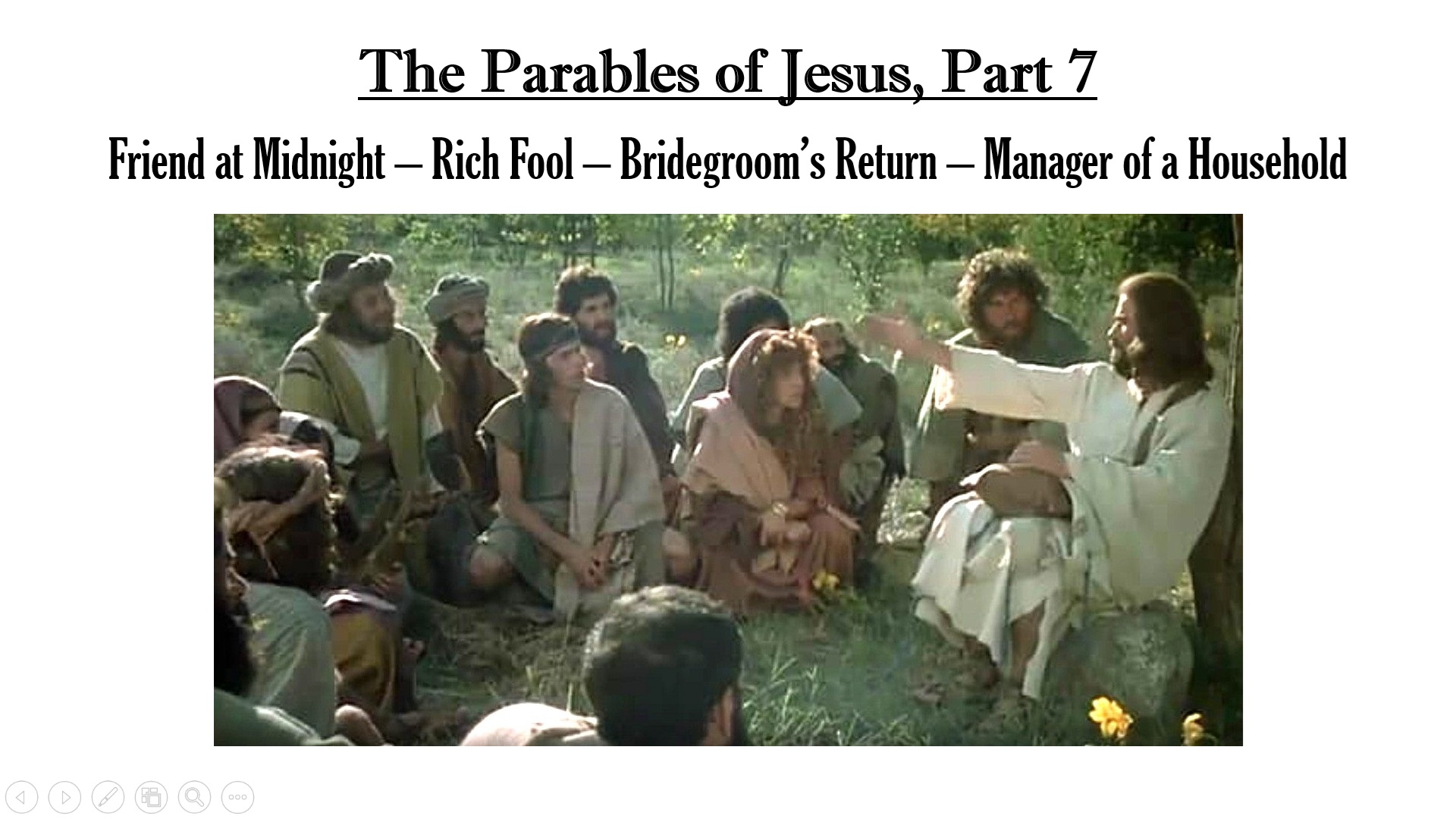
Parables of Jesus - Part 7
As I was preparing this lesson, two profound thoughts came to my mind. Not particularly deep thoughts. I just started thinking about them.
Friend at Midnight – Rich Fool – Bridegroom’s Return – Manager of a Household
As I was preparing this lesson, two profound thoughts came to my mind. Not particularly deep thoughts. I just started thinking about them. The first one was that the parables we have been studying are not merely nice stories or illustrations. They are actually the words of Jesus Himself. These are the words of God. They are important. The second thought I had was this: our concept of God determines the way we live our life. If a reporter came up to me, put a microphone in my face and asked, “Sir, who is God to you?” what would I say? Well, my theology tells me that God is eternal, holy, loving, and kind; that He is omniscient, omni-present, and omnipotent. He is a good God who sovereignly runs the universe. So, I would probably say something along that line if I were asked about God. But then I started thinking, as I go through my daily routine, when I pray, as I go through my day and interact with people, even on the highway, the question I ask myself is, “Do I really believe that about God?” Or is it just something I have been taught to believe? Is it real or not. Those are questions I began to ask myself this week. So, we are going to be looking at four parables that will go right along with those thoughts.
The Friend at Midnight
The setting for the first parable that we are going to look at – The Friend at Midnight – is found in the first 4 verses of Luke Chapter 11.
Q1 asks, based on those first few verses in Luke 11, what is that the disciples request of Jesus?
“Lord, teach us to pray” (Luke 11:1). And so then, Jesus proceeds to do just that. He teaches His disciples how to pray in what we call the “Lord’s prayer” (Luke 11:2-4). Now, Jesus follows that lesson up with a parable ABOUT prayer. And that is this parable we see here. Not only is it a parable about prayer, it is a parable of contrasts. Here it is, Luke Chapter 11, v 5…
And He [Jesus] said to them [His disciples], “Which of you who has a friend will go to him at midnight and say to him, ‘Friend, lend me three loaves, for a friend of mine has arrived on a journey, and I have nothing to set before him’; and he will answer from within, ‘Do not bother me; the door is now shut, and my children are with me in bed. I cannot get up and give you anything’? I tell you, though he will not get up and give him anything because he is his friend, yet because of his impudence [persistence] he will rise and give him whatever he needs” (Luke 11:5-8).
OK, so here you have a friend who is awakened at midnight by somebody pounding on his front door. He staggers to the door in his pajamas half asleep to see who it could be. He discovers that it is a friend, perhaps his next-door neighbor, who needs some food in order to feed some late-arriving guests.
Q2 asks, what was the friend’s response to being awakened in the middle of the night?
“Don’t bother me!” He is a bit put out for having been disturbed from his sleep. I would be too. Now, we are told in this parable that, despite his less than enthusiastic attitude, he ends up providing the friend what he had requested. He gives him some food.
Q3, True or false? According to Jesus in this parable, the friend finally gives in because the person making the request is someone he knows and likes.
That is false. The reason is stated in v 8, “because of his persistence.” It is not because he is his friend.
[Some in the class were confused about this and I had to clarify the answer for them]
A lot of people have a similar view of God. If we need something bad enough, if we just keep bothering God long enough, He will eventually hear us and give in to our request. But remember, this is a parable about prayer, yes, but it is also a parable of contrasts. This parable shows us how God is NOT.
So, that takes us to Q4, how is God’s response to our requests (when we go to Him in prayer) different from that of the friend in this parable?
Now, I asked you to check the BEST answer. So, I am looking for one answer here. There are a lot of good possibilities here, but there is one best answer. What is the best answer? God wants to help us.
Now, it is true that God is busy running the universe, but He is never too busy for us. And yes, God has perfect standards, but that does not impact how He responds to us. And then, no, God does not always give us what we ask for. Sometimes His answer is “no” or “wait.” Sometimes He says “yes” but not always. The biggest difference between God’s response and the friend’s – what I believe this parable is emphasizing – is that God WANTS to help us. He is not put out by us.
“Seek and You Will Find”
Look at what Jesus says in v 9…
“And I tell you, ask, and it will be given to you; seek, and you will find; knock, and it will be opened to you. For everyone who asks receives, and the one who seeks finds, and to the one who knocks it will be opened” (Luke 11:9-10).
God is NOT put out at all by our requests. God loves us. He wants to bless us. Did you all know that? He wants the very best for us. This very important point is driven home in the next two illustrations that follow. These are not separate parables. They just emphasize Jesus’s main point about God’s loving character. So, look at v 11…
“What father among you, if his son asks for a fish, will instead of a fish give him a serpent; or if he asks for an egg, will give him a scorpion? If you then, who are evil [fallible, imperfect sinners], know how to give good gifts to your children, how much more will the heavenly Father give the Holy Spirit to those who ask Him!” (Luke 11:11-13).
For those of us who have been saved, God is indeed OUR heavenly Father. As such, He desires to give us, His children, good gifts. Think about it. If an earthly father will not intentionally hurt his own children, why would God? God knows how to give good gifts. Just look around at all your blessings. They are gifts from God, right?
Now, at this point it is important that we not go to the opposite extreme. God is not merely a cosmic Santa Claus who exists only to hand out presents. He does not just give blindly anything and everything we ask for. He is not a genie in a bottle. He is a loving Father who, as I said before, wants the best for us. He wants us to ask Him for HIS desires for us. Because He knows best, right? Jesus prayed in the garden just before His arrest – you all remember this – “Nevertheless, not My will, but Yours, be done” (Luke 22:42).
Application
So, God’s desire for our lives is far better than anything else we could imagine for ourselves! God is a good and loving Father. How many of you really believe that? Then here is the application for this parable -- PRAY like you believe it.
Jesus’s Warning About Greed
We are going to shift gears now to another parable. This is actually in the next chapter in Luke, Luke Chapter 12, the Parable of the Rich Fool. This parable addresses the danger of greed. Jesus warns those listening to Him, “Take care, and be on your guard against all covetousness [greed]…” (Luke 12:15).
Greed is defined as “a strong desire to have more than one needs or deserves.” You don’t know anybody like that, do you? Now, it really comes down to a matter of one’s priorities. Do we want something for our own personal satisfaction and gain or is our main desire to honor and please God (with whatever it is)? So, the Parable of the Rich Fool offers us God’s perspective on how we are to view our earthly possessions.
The setting for this parable is important. I don’t know if you remember this about Jesus, but a lot of His teaching was interactive. He knows His audience and He knows what they need. He goes off questions they ask and it flows like that. And so, in the first part of Luke Chapter 12, Jesus is teaching on the dangers of hypocrisy (talking about the Pharisees). And then He begins talking about the Holy Spirit.
Then Q5 asks, what then prompts Jesus to stop teaching about the Holy Spirit (which He was doing in v 12) and the next thing you know He is giving a parable about greed?
Something or someone makes Jesus shift gears. What is it? Someone asks Him a question. Let’s go to v 13 and see what happens here…
Someone in the crowd said to Him, “Teacher, tell my brother to divide the inheritance with me” (Luke 12:13).
That comes out of the blue, right? Now, in that culture the Jewish rabbis (and Jesus is considered a rabbi) often settled civil disputes. So, this man wants Jesus to settle some sort of civil matter between he and his brother. It has something to do with their family inheritance.
But He [Jesus] said to him, “Man, who made Me a judge or arbitrator over you?” And He said to them [turning to the crowd], “Take care, and be on your guard against all covetousness [greed], for one’s life does not consist in the abundance of his possessions” (Luke 12:14-15).
So, Jesus is setting us up for this parable He is about to tell. Jesus refuses to get involved with this family’s legal matter. He is under no obligation to settle a civil matter. That is not why He is here. Jesus knows the man’s motive for bringing this up (remember Jesus is God). Jesus recognizes that there is a deeper issue here – it is an issue of the heart, this man’s heart. Now, we are not told any of the details about what the man’s dispute is, but apparently, based on Jesus’s response to the man, the crux of the man’s problem is his own materialism and greed. Jesus recognizes His audience’s (this man who brought up the question) spiritual need. So, you can check that one also. He recognizes a spiritual need.
The Rich Fool
Jesus shifts gears and now He begins to talk about greed. And He does so by way of a parable and that begins in v 16.
And He told them a parable, saying, “The land of a rich man produced plentifully, and he thought to himself, ‘What shall I do, for I have nowhere to store my crops?’ And he said, ‘I will do this: I will tear down my barns and build larger ones, and there I will store all my grain and my goods. And I will say to my soul, “Soul, you have ample goods laid up for many years; relax, eat, drink, be merry.”’ But God said to him, ‘Fool! This night your soul is required of you, and the things you have prepared, whose will they be?’ So is the one who lays up treasure for himself and is not rich toward God” (Luke 12:16-21).
Q6, God calls the rich man in this parable a “fool” (v 20) for all the of the reasons listed EXCEPT for one. I gave six pretty good reasons but one of them is NOT the reason. Which one is NOT a reason?
[The class struggled with this question. Here are the six reasons I gave to choose from: (1) self-centered thinking; (2) self-reliance; (3) hard work and planning; (4) presumption about his own life; (5) failure to acknowledge God; (6) feeling of security in his wealth. Rather than give the answer we just went through each reason individually]
In this parable we have this hard-working, self-made man who is planning ahead. In our society today this successful businessman would be highly regarded. There is nothing wrong with what he is doing. His life philosophy, however, is summarized in his statement – “relax, eat, drink, and be merry.” “It’s all about me!” “What shall I do?” “This is what I will do.” “I will tear down my barns.” “I will store all my grain and my goods.” I, I, I, me, my -- He is self-centered in his thinking. He is obviously self- reliant because he says, “I will do this” and “I will do that.”
One thing that stood out to me is the rich man’s presumption – “Soul, you have ample goods laid up for many years.” Oh, yeah? Before the day ends this man dies. God takes him. The man feels so secure in his wealth. But that proves to be a false security, doesn’t it? Here is a man who is so wrapped up in himself and his own abilities that he fails to acknowledge God’s place in his life. It is all about him. Do you see that? God has no place in his life. So, God calls him a fool. From the very beginning (in this man’s life) God has been blessing him with good health, obviously a very intelligent mind, so that he can work and make a living and be successful. God has made the grain in his fields grow. God is the One who sent the rain and sun. God controls the climate that allows him to enjoy a great yield. And, in the end, it is God who holds the man’s very life in His hands. The rich man dies and his wealth gets passed down to somebody else. What did the man’s life consist of apart from God? Nothing of any lasting value. It is a sad story.
So then, he is called a fool for self-centered thinking, self-reliance, presumption about his own life, failure to acknowledge God, and a feeling of security in his wealth. His hard work and planning were not what he was called a fool for. That is actually a good thing. It is all those other things that makes him a fool in God’s eyes.
Application
There is a warning here for all us. Do not stash away God’s blessings and keep them for yourself. Be a good steward of what He has given you. Invest your resources and yourself in the lives of others. Glorify God in the way you live. Strive to please your Master with the way that you use what He has let you “borrow.” Remember that we really do not own anything, do we? It all belongs to God. We are just the steward that He has entrusted all these things with and in some cases people with (children, grandchildren, nieces and nephews). So, there is your application.
There is a verse that goes right along with this parable. You know this verse. It comes from Matthew 16:26 -- “For what will it profit a man if he gains the whole world and forfeits his soul? Or what shall a man give in return for his soul?” Your soul is worth more than all the money in the world. Invest your life wisely in the things of God.
The Bridegroom’s Return
The next two parables deal with Jesus’s return. As the disciples listen to Jesus tell this parable they do not fully understand what He is talking about. When Jesus finishes, Peter asks Him, “Lord, are You telling this parable for us [the disciples] or for all [them out there, the crowds]?” (Luke 12:41). Well, the truth is that Jesus is telling it both for His disciples’ sake and for us sitting here in this room today 2000 years later. That is the answer to Peter’s question.
In the parable of The Bridegroom’s Return Jesus uses the illustration of the bridegroom (today we say “the groom”) returning from the wedding feast with his bride. Jesus’s main point for this parable is BE READY!
“Stay dressed for action and keep your lamps burning, and be like men who are waiting for their master to come home from the wedding feast, so that they may open the door to him at once when he comes and knocks” (Luke 12:35-36).
In Jesus’s day the bridegroom (the groom), in conjunction with the wedding, would hold a wedding supper with his family. Afterwards he would claim his bride. He would go over to the bride’s house and she would accompany him back to his house. At some point late that night, he would return to his own house with her. The man’s servants were to be ready for his return. They are dressed and ready and they have their lamps lit at his house. Now, they do not know exactly when he is going to return. It is going to be sometime that night, maybe early the next morning. At some point they are going to come back. But they have to be ready whenever he comes. When that knock comes at the door, they spring into action and open up the door. Jesus continues in v 37…
“Blessed are those servants whom the master finds awake when he comes. Truly, I say to you, he will dress himself for service and have them recline at table, and he will come and serve them. If he comes in the second watch, or in the third, and finds them awake, blessed are those servants!” (Luke 12:37-38).
To show his appreciation for his servants staying up late and being ready for his return, the master of the house, even before heading off to his honeymoon, serves them dinner. That is pretty nice, isn’t it? Whether he comes back late in the evening (the second watch) or in the wee hours of the morning (the third watch), those who waited are “blessed.” In other words, the master rewards them all for remaining alert and shows them his appreciation.
Q7, who does the bridegroom that returns in this parable represent?
Jesus.
Q8, who do the “blessed servants” in this parable represent? Believers, us, right?
Those of us on earth eagerly awaiting Jesus’s return. That is us right now, right? The bride is the church with whom Jesus returns to earth. Read Revelation. These are the saints who have died. They come back with Jesus. The church comes back with Jesus, right? Read Revelation 19. So, the return from the wedding feast to his house represents Jesus’s return to earth. When will Jesus return? Does anybody know the exact hour? No. The Bible says nobody knows, right? With that being said, we need to be ready.
So then, the answer to Q9 (I said check all that apply), what truths does this parable teach us about the return of Christ?
Does it teach that His physical return is certain? Yes. He is coming back, right? Does it teach that the time of His return is uncertain? Yes. Does it teach that He will return with His bride? Yes. Does it teach that we need to be ready for His return? Yes. All the above. So, there is your application. We need to be ready.
In the verses that follow Jesus uses the analogy of a thief which ties right into the Parable of the Bridegroom. It further emphasizes the importance of remaining in a constant state of readiness.
“But know this, that if the master of the house had known at what hour the thief was coming, he would not have left his house to be broken into. You also must be ready, for the Son of Man [Jesus speaking of Himself] is coming at an hour you do not expect” (Luke 12:39-40).
And then Peter asks the question we began with: “Lord, are You telling this parable for us [the disciples] or for all [the crowd]?” (Luke 12:41).
We do not know when a thief may come. We need to be on our guard at all times. We have all kinds of tools at our disposal nowadays that will help us. Thieves do not normally publish schedules of their heists. That is usually not the case. Likewise, God has revealed to no man the day and time of Jesus’s return. So, you have one analogy where the thief breaks in. That is a bad thing. You have another one where Jesus is coming again. That is a good thing. In either case we do not know when it is going to happen. In both cases we need to be ready. So, there is your application. Are you ready? Are you ready for His return? He could come back today!
The Manager of a Household
This parable deals with Jesus’s return. It begins when Jesus is alone with His disciples and He asks them a question.
And the Lord said, “Who then is the faithful and wise manager, whom his master will set over his household, to give them their portion of food at the proper time?” (Luke 12:42).
A “manager,” sometimes referred to as a “steward” or a “servant,” is a person that has been hired to take care of the master’s household while he is away. In a real sense, every human being is a manager of that which God has made. He has set us over certain things in His household. We are to take care of it. Jesus presents the example of a manager who performs his duties in one of two possible ways. There are two scenarios here. Jesus lays out both of these scenarios for us and what the end results of them are. The first scenario is in v 43…
“Blessed is that servant whom his master will find so doing when he comes. Truly, I say to you, he will set him over all his possessions” (Luke 12:43-44).
Q10, True or false? In the first scenario, the manager does as he is told.
True. He performs his duties exactly the way his master told him to. As a result, the manager is rewarded. He maybe gets a promotion, or gets a pay raise or whatever. So then, doing a good job for the master while he is away, yields a positive outcome. “Well done, good and faithful servant!”
Oh, but there is a second scenario in this parable…
“But if that servant says to himself, ‘My master is delayed in coming,’ and begins to beat the male and female servants, and to eat and drink and get drunk…” (Luke 12:45).
In this scenario the manager is NOT performing his duties the way he should, is he? It is kind of obvious, isn’t it? He is abusing the servants and things like that.
Q11, in the second scenario that we are about to look at here, what prompts the manager’s reckless behavior?
We have already seen it. It has already been mentioned. It is his own faulty reasoning. It says, “But if that servant says to himself…” So, he is thinking this stuff up in his own mind. He begins to question his master’s return or when he is going to return or if he is going to return. He becomes skeptical about when it is going to happen. His root cause is not false teaching. Now, sometimes we can get messed up with false teaching, but that is not his issue. And it is not that he is going through a mid-life crisis. We are certainly not told that. As for temptation by the devil, well, certainly the devil does tempt us, but that is not mentioned in this parable. And maybe he has a desire for power and maybe he doesn’t. What gets this guy in trouble is his faulty reasoning. That is what sends him down the wrong path.
Let’s hear what Jesus says in v 46…
“The master of that servant will come on a day when he does not expect him and at an hour he does not know, and will cut him in pieces and put him with the unfaithful” (Luke 12:46).
That just sounds like it hurts. It sounds painful!
Q12, in both scenarios there comes a day of reckoning for the manager. So, his day of reckoning comes when?
When the master returns. He is held accountable for what he did by the master. The result for the manager in the second scenario is NOT good. He is punished severely and re-assigned to a place “with the unfaithful.” We will talk more about that in a minute. I want to finish up with v 47 and 48 and then we will go back.
“And that servant who knew his master’s will but did not get ready [that was in the previous parable] or act according to his will, will receive a severe beating. But the one who did not know, and did what deserved a beating, will receive a light beating. Everyone to whom much was given, of him much will be required, and from him to whom they entrusted much, they will demand the more” (Luke 12:47-48).
God Disciplines His Children
So, let’s talk about Q13. According to Jesus in these verses, there are varying degrees of punishment for disobedience depending on what?
I gave you several choices and they all sound pretty good. But just based on what Jesus says here – just based on that and nothing else – it seems to be based on some level of knowledge, how much the servant knew about what his master wanted. V 47 says “who knew.” V 48 says, “who did not know.” So, it is some level of knowledge. It has nothing to do with how long the servant has been employed. It has nothing to do with how much the master likes them. It is not a matter of favoritism. And the truth is that the master expects a lot from ALL of his servants. [The answer to Q13 then is how much the servants know about what the master wants].
V 48 in the New Living Translation says, “When someone has been given much, much will be required in return; and when someone has been entrusted with much, even more will be required.” The Master (our Lord) has a high expectation of His servants.
So, if you look at both of these parables about Jesus’s return side by side, we get a picture of what Jesus expects of us while we await His return. We wait diligently and eagerly for His return. But while He is away, however long that is – it could even for the rest of our lifetime – we diligently do what He has told us to do.
[Going back to Jesus’s teaching in v 47 and 48…]
I am not going to be dogmatic about what all this means, but some things seem clear. There is a reward for obedience and a punishment for disobedience. We will be held accountable for the truth we had been given and the degree to which we respond [obediently] to that truth. As God’s children, He expects us to behave a certain way. When we don’t, the Bible teaches us (Hebrews Chapter 12) about God disciplining His children like any good parent would.
Jesus is NOT teaching that [if we mess up] God is going to send us to hell. That is not what these verses are talking about. That would be taking [scripture] out of context. However, God DOES discipline us. Our salvation is secure in Christ. Praise God! But, like any good parent, God will discipline us in order to get us back on the right track. He has to do that sometimes. Even with me!
Application
So, the application, in closing, for these last two parables: BE ALERT for Jesus’s return. And in the meantime, BE RESPONSIBLE to do what He wants and behave like you are one of His children.
Questions
Note: To better help you to answer these questions you are encouraged to use the English Standard Version translation of the Bible.
Parables of Jesus - Part 7
Part 7 Questions
The Friend at Midnight (Luke 11:5-13)
1. The setting for this parable is the first 4 verses of Luke Chapter 11. What do the disciples request of Jesus? To teach them WHAT? ________________________________________
2. What was the friend’s response to being awakened in the middle of the night? (Circle one)
DON’T BOTHER ME GOOD MORNING MAY I HELP YOU?
3. True or false? According to Jesus in this parable the friend finally gives in because the person making the request is someone that he knows and likes.
T F
4. How is God’s response to our requests different from that of the friend in this parable? (Check the best answer)
___ God is extremely busy running the universe ___ God’s requirements are much higher
___ God wants to help us ___ God always gives us what we ask for
The Rich Fool (Luke 12:13-21)
5. What prompts Jesus to stop teaching about the Holy Spirit (v 12) and to give a parable about greed? (Check all that apply)
___ question that someone asks Him ___ recognition of His audience’s needs
___ it was the next point in His sermon ___ obligation to settle a civil matter
6. God calls the rich man in this parable a “fool” for all the of the reasons listed below EXCEPT for one. Which is NOT a reason? His… (Check the best answer)
___ self-centered thinking ___ presumption about his own life
___ self-reliance ___ failure to acknowledge God
___ hard work and planning ___ feeling of security in his wealth
The Bridegroom’s Return (Luke 12:35-41)
7. WHO does the bridegroom that returns in this parable represent? (Circle the best answer)
CHURCH DEAD IN CHRIST HOLY SPIRIT JESUS NOBODY IN PARTICULAR
8. WHO do the “blessed servants” in this parable represent? (Circle the best answer)
ANGELS BAPTISTS BELIEVERS TWELVE DISCIPLES NOBODY IN PARTICULAR
9. What truths does this parable teach us about the return of Christ? (Check all that apply)
___ His physical return is certain ___ He will return with His bride
___ The time of His return is uncertain ___ We need to be ready for His return
The Manager of a Household (Luke 12:42-48)
10. True or false? In the first scenario, v 42-44, the manager does as he is told.
T F
11. In the second scenario, v 45, what prompts the manager’s reckless behavior? (Check the best answer)
___ His own faulty reasoning ___ He succumbs to a false teaching
___ He is tempted by the devil ___ His thirst for power
___ His rebellion against authority ___ He had a mid-life crisis
12. In both scenarios there came a day of reckoning for the manager. He was either rewarded or punishment for his actions. When did this day occur? (Circle the best answer)
UPON HIS DEATH ON HIS PERFORMANCE EVALUATION WHEN HIS MASTER RETURNED
13. According to Jesus in v 47-48, there are varying degrees of punishment for disobedience depending on WHAT? (Check the best answer)
___ How much the master likes or dislikes his servants
___ How much the servants know about what the master wants
___ How long the servants have been employed by the master
___ How much the master expects of his servants