Parables of Jesus - Part 10
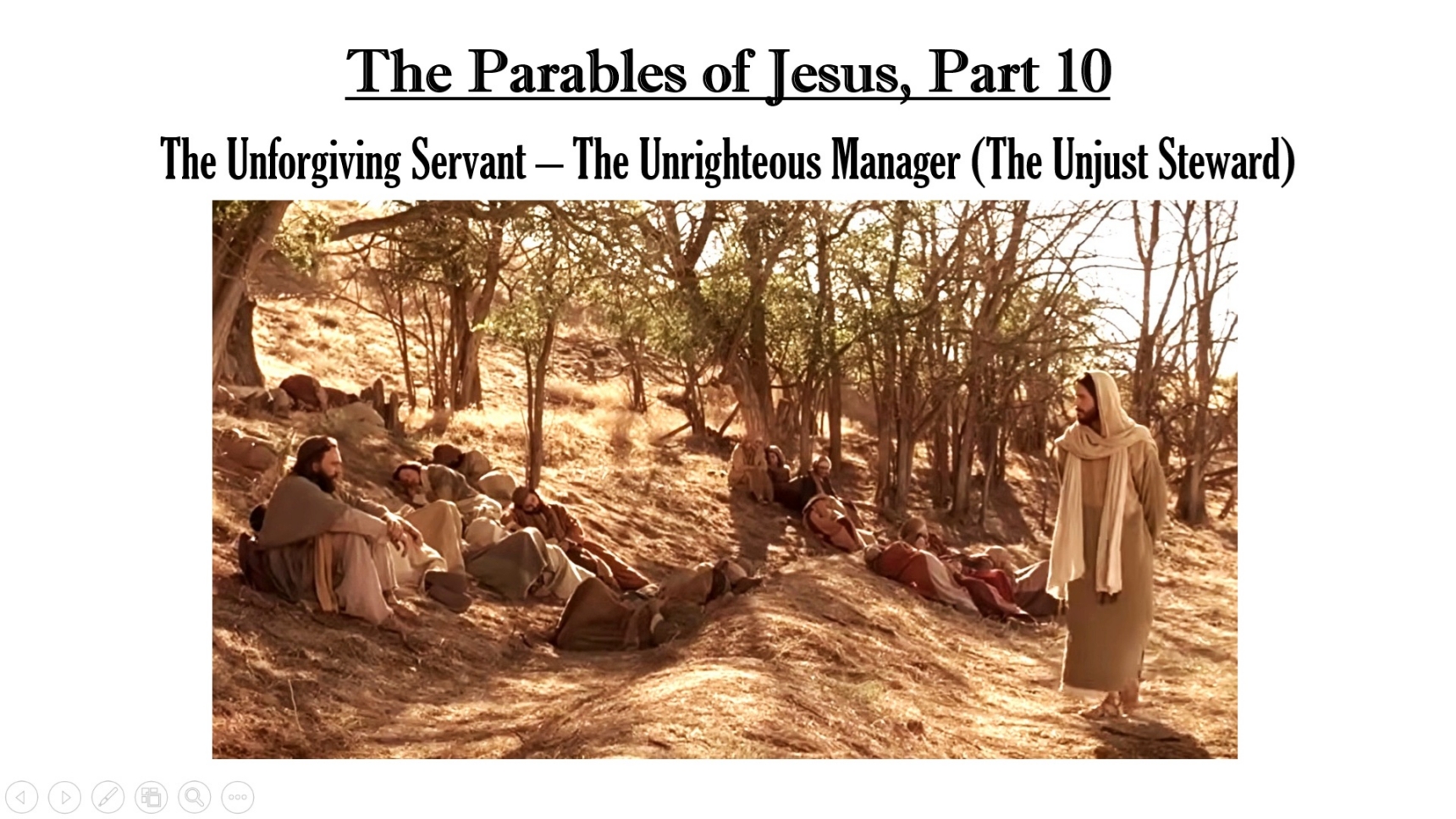
So, as we continue the study of Jesus’s parables, Jesus and His disciples are in the middle of His two-month ministry “beyond the Jordan.”
The Unforgiving Servant – The Unrighteous Manager (The Unjust Steward)
So, as we continue the study of Jesus’s parables, Jesus and His disciples are in the middle of His two-month ministry “beyond the Jordan.” They are somewhere east of the Jordan River probably in the region of Perea. Most of Jesus’s teachings during this time are recorded by Luke. Matthew records a few things, but most of them are in Luke. Jesus and His disciples are together somewhere in the Perean countryside. Jesus spends much of this time one-on-one with His disciples. It is an important period because Jesus’s days on earth are winding down. He now is less than six months away from the cross.
How Often Must I Forgive My Brother?
Jesus has been talking to His disciples about the subject of forgiveness. That is the background to this passage. Peter asks Jesus a really good theological question…
Then Peter came up and said to Him [Jesus], “Lord, how often will my brother sin against me, and I forgive him? As many as seven times?” (Matthew 18:21)
Q1, what question did Peter ask which prompts Jesus to tell the parable we are about to look at?
What did you all say? “How often must I forgive my brother?” The second part of his question (he thinks he is being generous) is, “As many as seven times?” Most of the rabbis in the synagogues at that time taught that you were required to forgive someone up to three times. Peter is like, “Seven times. Is that good, Lord?”
Well, his question reveals a flaw in human nature, which is, feeling like we need to maintain a complete record of offenses. We often demand full restitution from our offenders or, worse yet, we write them off completely. Many a relationship has been ruined over silly disagreements, wrongs that were perceived done against them that were probably nothing really. But people will just hold onto these grudges and ruin relationships over them.
But Jesus teaches something radically different as we are about to see. The conduct that He expects of us, His followers, when we become victims of wrongdoing (and we all will at one time or another), our response that Jesus says we are to have is radical by the world’s standards. Jesus teaches true Christianity. Look at His answer to Peter in v 22…
Jesus said to him, “I do not say to you seven times, but seventy-seven times” (Matthew 18:22).
Some translations will say “seventy times seven.”
That leads us to Q2. The point He is making here is that we are to forgive others how often?
Is it a numerical number? Always, right? We are to forgive someone again and again and again and again. There is no numerical number that we are to keep track of because otherwise we would have our ledger out – “OK, you’ve only got two more times! I’ve forgiven you seventy-five times over the last three years. Two more times. That’s it!” That is NOT the idea. Just keep forgiving.
The Unforgiving Servant
Jesus is going to follow up that statement with this parable. He is going to drive home His point. That is what He does with these parables. He emphasizes what He is trying to teach and He does it through these stories, these parables. This is the Parable of the Unforgiving Servant. In this parable Jesus teaches the consequences of unforgiveness. We see the whole issue of forgiveness or unforgiveness from God’s perspective. This is v 23…
“Therefore, the kingdom of heaven may be compared to a king who wished to settle accounts with his servants. When he began to settle, one was brought to him who owed him ten thousand talents. And since he could not pay, his master ordered him to be sold, with his wife and children and all that he had, and payment to be made. So, the servant fell on his knees, imploring him, ‘Have patience with me, and I will pay you everything.’ And out of pity for him, the master of that servant released him and forgave him the debt” (Matthew 18:23-27).
Q3, True or false? In this parable, the king represents God.
True. We are going to see that by the way.
That being the case, Q4, who does the servant in this parable, the one who has been forgiven this huge debt, who does he represent?
All believers. Us, believers. Have we been forgiven a huge debt? Yes. Now, on the list I gave you several choices. Is everybody in the world forgiven? No. They could be. How about the Twelve Disciples? Are they forgiven? I think you could check them off also. There is some question about Judas. We will not debate that today. And then of course the angels, they are in a completely different economy if you will. They are not forgiven. So, do not check them off.
One of the king’s servants, he owes 10,000 talents. In today’s economy that would be hundreds of millions of dollars. In other words, a staggering sum of money. Unfortunately for the servant, there is no way he can possibly repay such an enormous debt. The contemporary justice of that day called for that servant and his entire family to be sold. The servant begs the king not to do this and he offers to pay back all he owes over time. He pleads, v 26, “Have patience with me!”
Q5, what does the servant in this parable request of the king (his master)?
Patience. Well, the king would have been within his legal rights to sell his servant. But he doesn’t do that, does he?
Q6, instead of getting what he asked for, which was patience, what does the servant receive?
A pardon. The king shows compassion toward his servant and forgives his debt completely. Wow!
I asked if the king, the master in the parable represents God and he does because isn’t that precisely what God did for us? We owed a huge sin debt and THE King required full payment for that sin. Romans 6:23, in fact, says that the payment we owe for our sin (the wages of our sin) is death. That is a pretty steep price to pay, isn’t it?
[One class member pointed to the end of that verse, Romans 6:23 which says, “the free gift of God is eternal life in Christ Jesus our Lord.” Praise God the end for us is NOT death!]
I remember me at the age of 10 with this fear of hell looming over my head – “God, please don’t send me to hell!” That was my plea to God for mercy. God would have been justified to do whatever He wanted with us. He is the King of the universe. He is sovereign. Instead, He felt compassion for us. At no cost to us, Jesus came to earth on a mission and He paid our sin debt, right? That payment was rendered in full on a Roman cross. Like I said, when Jesus is telling this parable that is only six months away. Jesus knows. Because of what Jesus did, God, just like the king in this parable forgave our debt completely. He showed us mercy. He gave us a full pardon! Our part was simply to accept His pardon. All the work was done by Jesus.
A Failure to Forgive
Well, there is a surprising twist to this story, V 28…
“But when that same servant [the one that had just been forgiven all that debt] went out, he found one of his fellow servants who owed him a hundred denarii, and seizing him, he began to choke him, saying, ‘Pay what you owe.’ So, his fellow servant fell down and pleaded with him [notice what he is pleading for], ‘Have patience with me, and I will pay you.’ He refused and went and put him in prison until he should pay the debt” (Matthew 18:28-30).
No sooner has the servant been forgiven his huge debt then he goes and finds one of his co-workers, fellow servants, who owes him much less, 100 denarii. By the way, that is 100 days wages, the equivalent of about eight thousand dollars in today’s economy. That is no small amount, I will grant you that, but it is a lot less than what he owed. You would think that the servant, having just been forgiven his mountain of debt, could find it within himself to forgive his co-worker. You would think that, wouldn’t you?
Q7, what does the servant’s co-worker request of the servant who had just been forgiven his debt by the king? What did he plead for?
Patience. The same thing [he had pleaded for]. The unforgiving servant grabs his co-worker and begins choking him, demanding payment. His co-worker says, “Have patience with me and I will repay you.” He pleads for patience.
Q8, instead of getting what he asked for, what does the co-worker receive?
Punishment. The servant who had been forgiven so much by the king is himself unwilling to forgive. Quick to anger, he has his co-worker thrown into prison!
When we fail to forgive someone who has wronged us, we are no different from the unforgiving servant in this parable. What makes us think that we somehow deserve God’s forgiveness? Do we? We do not! The individuals who wrong us do not deserve our forgiveness either. That is not the point. Why should we forgive them? Give me one good reason why I should forgive them. As a Christian, as a believer, why should I forgive them? Why should we show compassion? Well, there are actually two reasons. One is that Jesus tells us to. But the other reason is because we have been forgiven, right? God expects those of us who have received His abundant mercy to be merciful ourselves. Far too often we Christians are a lot like that unforgiving servant, aren’t we?
So now we go to v 31. Well, what happens is there are some whistle-blowers. They take news about what the servant just did back to the king.
“When his fellow servants saw what had taken place, they were greatly distressed, and they went and reported to their master [the king] all that had taken place. Then his master summoned him [that servant] and said to him, ‘You wicked servant! I forgave you all that debt because you pleaded with me. And should you not have had mercy on your fellow servant, as I had mercy on you?’” (Matthew 18:31-33).
Did you catch that? “You wicked servant!” Why was he wicked? Because he had been unforgiving. Unforgiveness is wickedness.
“Should you not have had mercy on your fellow servant, as I had mercy on you?” It’s a rhetorical question. The obvious is answer is YES, you should have!
The Consequences for Unforgiveness
“And in anger his master delivered him to the jailers, until he should pay all his debt. So also, My heavenly Father will do to every one of you, if you do not forgive your brother from your heart” (Matthew 18:34-35).
So, the king hands this unforgiving servant over to the prison officials. He revokes his earlier pardon. Now, notice that the king does NOT sell him and his family into slavery, as was his original plan. But he DOES still punish him. The spiritual application is clear. God will judge an unforgiving spirit.
Q9, True or false? Answer carefully. The degree to which we are forgiven of our debts by God is directly related to how much we ourselves are willing to forgive our own debtors.
Just to help you out, I gave you Matthew 6:12. That is a dead giveaway. This is part of the Lord’s Prayer and it says, “And forgive us our debts, as we also have forgiven our debtors...” So then, there IS a direct correlation. The answer is true. Surprising, isn’t it?
Now, I want to clarify something. I do NOT believe this passage is teaching that God revokes our salvation. Because there are people out there who do not believe in [the doctrine of] eternal security who will point to passages like this as an example. But I don’t believe that is what this parable is talking about. I don’t believe that is the application. Such a teaching runs counter to the preponderance of scripture that actually talks about our security as believers in Jesus. In other passages where Jesus is talking about God sending someone to hell (like in Matthew 8:12, 22:13 and 25:30), the language is totally different. He says things like, “Bind him,” “cast into the outer darkness,” “there shall be weeping and gnashing of teeth.” You don’t see that language here.
The unforgiving servant finds himself in a prison of his own making. His fellowship with the king and his fellows and other people in his life is broken. He brought it all on himself by his own critical, self-centered, self-righteous, self-serving and condescending attitude. He did it to himself!
Being out of fellowship with God in this life is a miserable place for a believer to be. Admit it. Have you ever been out of fellowship with God as a believer? I have. It is not pleasant. You know you are not doing right and God cannot bless for the [unconfessed] sin in your life. You have to deal with it. But I will tell you, being miserable as a believer, being out of fellowship, is a lot better than going in hell. It can be a temporary condition if you deal with it, if you deal with that sin in your life, which is what God wants you to do. Repent. Turn away from your sinful attitude.
There is a one-point application for this [parable], Ephesians 4:31-32. Paul says: “Let all bitterness and wrath and anger and clamor and slander be put away from you, along with all malice. [This is what you do instead…] Be kind to one another, tender-hearted, [here it is, are you listening…] forgiving one another, as God in Christ forgave you” (Ephesians 4:31-32).
[There were several good comments. One person said, “the first sentence from the king involved him and umbrellaed his family. Similarly, Israel would be judged as a whole for one man’s sin. And then afterwards God said, ‘You are going to stand on your own.” Another person noted that “Bitterness and unforgiveness are human nature. They are part of our sin nature. But Jesus’s teachings run counter to that. The principles Jesus taught often go against what our own heart or best thinking say we ought to do.” Jesus is radical in His teachings and true Christianity is a radical way to live. The example of Erica Kirk came to my mind, how she was able to forgive the man who had recently killed her husband].
The Unrighteous Manager (The Unjust Steward)
The next parable is called the Parable of the Unrighteous Manager, based on the wording of the ESV. You will sometimes hear it called the Parable of the Unjust Steward. This is a parable of contrasts. It illustrates how NOT to be. It is not a very familiar parable, but I really like it because it has a lot of nuances to it. It is a very interesting parable and it is contained in Luke Chapter 16.
He [Jesus] also said to the disciples, “There was a rich man who had a manager, and charges were brought to him that this man was wasting his possessions. And he called him and said to him, ‘What is this that I hear about you? Turn in the account of your management, for you can no longer be manager’” (Luke 16:1-2).
The rich man here represents the worldly system. In this parable, he does NOT represent God! We are going to see that here in a minute. The manager (some translations call him a steward) typifies a person who holds to the principles of the world. So, this will be a parable of contrasts. This is the way the world is, not the way we are supposed to be. The manager had been hired to manage, to oversee a certain rich man’s estate. That was his job. One would expect a person in that position to have integrity; to be honest and trustworthy. But the manager in this parable has none of those traits. In fact, to be blunt, he is a crook. He is unrighteous. He is not a good guy. He has been misusing resources that do not belong to him for his own benefit. And he got caught with his hand in the cookie jar, so to speak. He just received some bad news from his boss.
Q10, the manager, the main character in this parable, realizes that what bad thing is about to happen to him?
He is about to be fired. So, the manager assesses the situation with worldly reasoning, v 3…
“And the manager said to himself, ‘What shall I do, since my master is taking the management away from me? I am not strong enough to dig, and I am ashamed to beg’” (Luke 16:3).
As he sees it, his options are limited. PLAN A is to go out and get another job. But most jobs in that day involved manual labor and he is not physically able to do that or he does not want to do that. So, he rules that out. PLAN B is to beg for money – go out on the street corner and hold a sign up. No way. He is much too proud to do that! So, he considers PLAN C. This is in v 4…
“‘I have decided what to do, so that when I am removed from management [it is inevitable], people may receive me into their houses [I still want to have friends].’ So, summoning his master’s debtors one by one, he said to the first, ‘How much do you owe my master?’ He said, ‘A hundred measures of oil.’ He said to him, ‘Take your bill, and sit down quickly and write fifty.’ Then he said to another, ‘And how much do you owe?’ He said, ‘A hundred measures of wheat.’ He said to him, ‘Take your bill, and write eighty’” (Luke 16:4-7).
This plan allows the soon-to-be-unemployed manager to obtain a cash flow. At the same time, he will save face and actually win the friendship of the people he is going to have to live with after he is fired. It is an ingenious plan! He goes out under the guise of collecting his master’s debts, and he entices everyone who owes his master money into paying their debt by reducing the amount they owe.
Q11, in response to his bad situation, the manager’s plan is to do what?
He will offer debt relief to his master’s debtors. That is pretty good. Everybody wins! Except for the master and we will talk about that later.
[One person made the observation that this manager showed what a terrible manager he was by having to ask the people how much they owed. He should have already known this].
Now, you would think that the master when he gets wind of the manager’s actions would become upset. After all, the master is only going to be get back a portion of the money that he is owed. But look at his reaction in v 8…
“The master commended the dishonest manager for his shrewdness” (Luke 16:8a).
So, Q12, True or false? When the manager’s boss found out about the plan, he got angry.
False. He commended the guy. He praised this scoundrel for what he did. And that is often the way the world is. Let me explain. How many movies do you know where they make heroes out of people who pull off these amazing heists. The whole Oceans 11, 12 and 13 series where they ripped off the casinos of all this money. They are our heroes! Recently the Louvre was robbed and we were amazed at how they pulled that off. We revere these people that are criminals. They pull off these ingenious schemes and we applaud them. Like I said, this is a parable of contrasts. The master in this parable is NOT representative of God who is righteous. The master here is not righteous. He is worldly-minded. Like I said, the world is duly impressed by tactics like the one used by the unrighteous manager in this parable. I have to admit it was pretty ingenious plan. Part of me kind of likes the guy – just being honest. He took a different approach. I have to give him some credit. He tried.
In his commentary on this passage, J. Vernon McGee summarizes the parable by saying this: “The worldly lord [speaking of the master] commended his worldly steward [that manager] for his worldly wisdom according to his worldly dealings.” That pretty well summarizes what happened.
Six Applications for This Parable
So, I started looking at this parable and I am scratching my head – “What is Jesus trying to teach us in this really rather unusual parable? What is He trying to say?” He is certainly NOT encouraging us to do what this unrighteous manager did. Don’t behave like that. There is a contrast that is pretty clear. Rather than revere the cleverness of worldly thinking, we are to pursue godly character. Don’t be like him. There are several spiritual applications and each of the verses that remain (from v 8-13), each one has a different application. Jesus is expounding. This [parable] has a lot of layers to it. It is a very interesting parable. And so, Jesus now spends some time (which He doesn’t normally do) really explaining it and giving application for the parable.
So, this last phrase is at the end of v 8…
“For the sons of this world are more shrewd [they are more clever] in dealing with their own generation than the sons of light” (Luke 16:8b).
Application: Unbelievers (the sons of this world) are better at taking advantage of the opportunities presented to them as they prepare for their future here in THIS world than believers (the sons of light) are as they prepare for their future in the world to come. That is an interesting thought. How prepared are we (Christians) really for our future in eternity? V 9…
“And I tell you, make friends for yourselves by means of unrighteous [worldly] wealth, so that when it fails, they may receive you into the eternal dwellings” (Luke 16:9).
What is that all about? When I first read this, I was saying, “I need commentaries on this one.” Jesus is saying that the wealth of this world; the money that we make in our secular jobs, material possessions, even though they ARE of this world, they are not evil in and of themselves. Now, they could be. What is the root of all sorts of evil? It is not money. It is the LOVE of money, right? It is making money your god. If we are not careful, these worldly things could distract us (I have been there), could lead us to adopt evil attitudes and maybe even to behave in ungodly ways. It could happen. But in and of themselves, they are not evil. Your money, your time, your energy and material possessions are blessings from God. They are resources to be used wisely. And none of those things belong to us. Did you realize nothing you own belongs to you? Did you know that? You are merely managers of what belongs to God.
Application: We are to be wise with the resources God has entrusted us with. We should look for opportunities to invest in the lives of others. If we squander our resources or make foolish decisions, it will negatively impact the kingdom’s work (because your money is tied up in things that could otherwise be used for God’s use). It is OK to enjoy your things. You have worked hard for them. Enjoy your life (travel, hobbies, etc). But also realize that there is a bigger picture. Our resources also need to be used for God’s glory.
[Someone commented on how amazed he was at how much stuff he had accumulated when they moved. “I had to ask God to forgive me for collecting so much junk!”] OK, v 10…
“One who is faithful in a very little is also faithful in much, and one who is dishonest in a very little is also dishonest in much” (Luke 16:10).
Application: We are to be faithful, to continue to do the right thing with the many resources that God has blessed us with. In conjunction with v 10, I came up with Q13, which is really a case study. I wanted to see what you all thought…
Q13, if a person of modest means tithes, is generous, and spends their money wisely [what Jesus has been talking about doing]; and then suddenly inherits great wealth [you win a lottery or a rich uncle dies or whatever], would you expect their wealth to change them?
[Class responses were mixed. Some said yes, it would. Some said they didn’t know and some said probably not; and good reasons were offered for each of these. My personal opinion is probably not. After all, you are who you are. I would expect such people to continue to tithe, to continue to be generous and to spend wisely. Only now they have greater financial resources to draw from than they did before].
“If then you have not been faithful in the unrighteous wealth, who will entrust to you the true riches?” (Luke 16:11).
Application: There is a connection between the spiritual and the material. A believer who is faithful with their material riches (physical blessings that they have) will more than likely also be faithful with their spiritual blessings. What you spend your time and money on is a key indicator as to what is in your heart. V 12…
“And if you have not been faithful in the use of that which is another's, who will give you that which is your own?” (Luke 16:12).
Q14, True or false? We must prove ourselves to be faithful and obedient to God with what we have right now before He will entrust us with more.
That is true. By the way, what I just said, that is the application.
I was thinking about my own life when this actually happened. This was taught to me as a teenager. Before my father bought me my first car (he worked at a car dealership, so he could get these cars pretty cheap), I had to first prove myself worthy and show him that I had the necessary driving skills in our family car. If I had not gained his confidence, he would not have let me drive his car any longer and he certainly would never have bought me my own car. But because I was faithful and proved myself worthy, he surprised me on my birthday with a new car (it was four years old, but to me it was new). That was the greatest day in my life up to that point. That is the way God is with us. And then the last one, v 13…
“No servant can serve two masters; for either he will hate the one and love the other, or else he will be devoted to one and despise the other. You cannot serve God and money” (Luke 16:13).
Q15, Jesus teaches us not to have divided loyalties. According to this verse, as believers, we cannot serve both God and WHAT?
Money. You cannot serve both God and money.
There are a lot of things in this world that compete for our time and affections [Amen]. We can only serve one Master and that is God. That is Jesus, our Lord, right?. He is not only our Savior. He is our Lord. He is our Master. We can only serve one Master.
Questions
Note: To better help you to answer these questions you are encouraged to use the English Standard Version translation of the Bible.
Parables of Jesus - Part 10
Part 10 Questions
The Unforgiving Servant (Matthew 18:21-35)
1. What question does Peter ask which prompts Jesus to tell this parable? (Check the best answer)
___ “Who will be greatest in the Kingdom?” ___ “How often must I forgive my brother?”
___ “Why should I forgive my brother?” ___ “Who is my brother?”
2. The main point of Jesus’s answer to Peter is that we are to forgive others _____ (Circle one)
ONCE A DAY 3 TIMES 77 TIMES 490 TIMES ALL THE TIME
3. True or false? In this parable, the king represents God. T F
4. Who does the servant in this parable, the one who has been forgiven much, represent? (Check ALL that apply)
___ religious people worldwide ___ ALL believers
___ Twelve Disciples ___ the angels of heaven
5. What does the servant in this parable request of the king (his master)? (Circle one)
A PARDON PATIENCE A PROMOTION PUNISHMENT
6. Instead of getting what he asked for, what does the servant receive? (Circle one)
A PARDON PATIENCE A PROMOTION PUNISHMENT
7. What does the servant’s co-worker request of the servant who had just been forgiven his debt by the king? (Circle one)
A PARDON PATIENCE A PROMOTION PUNISHMENT
8. Instead of getting what he asked for, what does the co-worker receive? (Circle one)
A PARDON PATIENCE A PROMOTION PUNISHMENT
9. True or false? The degree to which we are forgiven of our debts by God is directly related to how much we ourselves forgive our own debtors (see also to Matthew 6:12). T F
The Unrighteous Manager/ The Unjust Steward (Luke 16:1-13)
10. The manager, the main character in this parable, realizes that WHAT bad thing is about to happen to him? (Check the best answer)
___ He is about to be arrested ___ He is about to be fired
___ He is about to get demoted ___ He is about to be sued
11. In response to his bad situation, the manager’s plan is to do WHAT? (Check BEST answer)
___ get another job ___ go into hiding ___ negotiate with his boss
___ go beg for money ___ offer debt relief ___ none of these
12. True or false? When the manager’s boss found out about the plan, he got angry. T F
13. Based on v 10, if a person of modest means tithes, is generous, and spends their money wisely; and then suddenly inherits great wealth, would you expect their wealth to change them? (Check one)
___ YES, a lot ___ YES, a little ___ Probably NOT ___Don’t know
14. Based on v 12, True or false? We must prove ourselves to be faithful and obedient to God with what we have right now before He will entrust us with more. T F
15. In v 13 Jesus teaches us not to have divided loyalties. According to this verse, as believers, we cannot serve both God and WHAT? (Circle the BEST answer)
COUNTRY MONEY THE POPE SATAN SELF