Parables of Jesus - Part 12
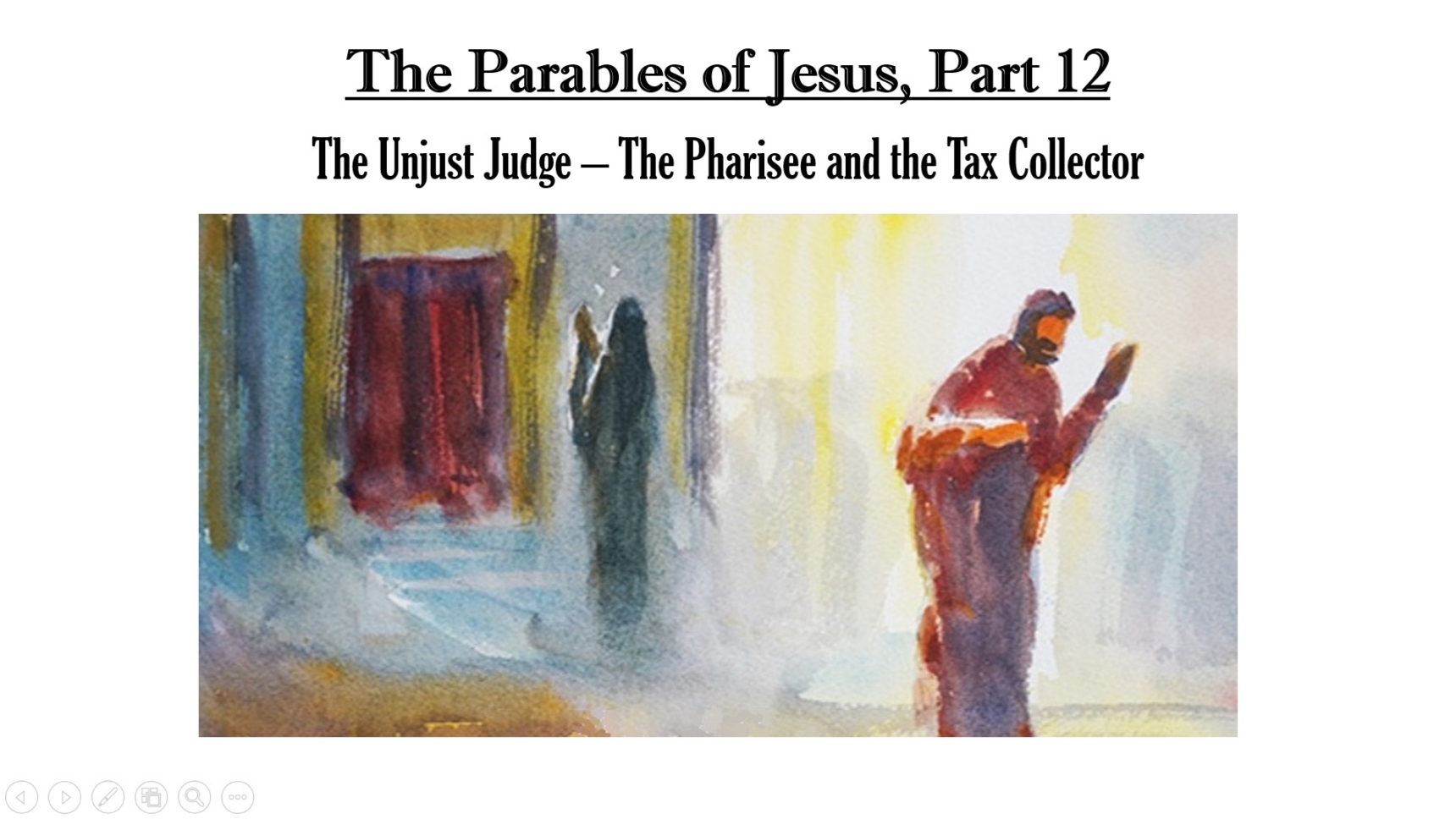
The Unjust Judge – The Pharisee and the Tax Collector
The Unjust Judge – The Pharisee and the Tax Collector
We have been doing the parables in chronological order, the way Jesus taught them. Since we left off last time (the last parables we studied) a lot has actually taken place in Jesus’s ministry. About a month has passed. Jesus has left Perea (that is where He has been) and He has traveled to Bethany and He raised His friend Lazarus back to life. You all know that story. That is from John Chapter 11. So, that has happened since our last lesson. We know that, instead of believing in Jesus, the religious leaders in Jerusalem, when they heard about what Jesus did, they plotted to kill Jesus. And so, Jesus and His disciples left Jerusalem and Judea and they headed north to Galilee and Samaria. That is where we find Jesus as we come to these parables here.
The Context for the Parables
Jesus is in a town (it is unnamed) somewhere in Galilee when He is approached by a small contingent of Pharisees. They ask Jesus a question – “When is the kingdom of God going to come?” And Jesus’s response was interesting. He said, “The kingdom of God is in the midst of you.” Now, why would He say that? Because He is the King. He is the Messiah, right? You cannot have a kingdom without a king. Well, He the King is there. But they, of course, did not believe Jesus was the King, was the Messiah. So, in the rest of Luke Chapter 17, Jesus uses that conversation with the Pharisees as a springboard; and the rest of the chapter He is teaching His own disciples about the future, about His second coming. It is interesting that Jesus has not even left yet and He is already talking about His second coming; He talks about the Son of Man coming and that nobody knows when that is going to happen.
By the way, did you all know that – I was thinking about this whole thing about Jesus’s second coming – did you all realize that the Christmas carol “Joy to the World,” that was actually written about the second coming. That is one of the few hymns we sing that is actually about Jesus’s second coming. We do not sing a whole lot of songs about the second coming, do we? But that is one of the few that we do. If you listen to the words, all those apply to Jesus when He comes and sets up His kingdom on the earth and reigns for a thousand years (Revelation 20). I just thought that was interesting. Every time you hear “Joy to the World,” think about that. This is about His second coming. But we always sing in in conjunction with Christmas (His first coming). Interesting.
Jesus is talking [to His disciples] about His second coming and the judgment that is going to follow that. Nobody knows when that is going to happen. So, that is the context as we come to Chapter 18.
The Unjust Judge
We get to this first parable we are going to talk about, [the Parable of] the Unjust Judge. These parables are about prayer. Jesus knows that He will soon go to the cross. He will be resurrected and ascend back to the Father. He knows this is the plan. Jesus knows this. Nobody else knows, but He knows. He knows that after He is gone that persecution for His followers is going to ramp up. While they are with Him, they have not been persecuted. Jesus has, but they have not. But when He goes away, they are going to face persecution and we see this in the book of Acts, right? And He knows that after He leaves that there is going to be the strong desire on the part of His disciples and His followers for His return; because He promised He was going to come back. And most of them anticipated that that would happen very quickly, in their lifetimes. So, it is in this context that Jesus teaches His disciples these lessons about prayer.
Jesus was an authority on prayer. He was an authority on a lot of things, but certainly about prayer. During His earthly ministry prayer was a regular part of His life. Just read the gospels. Jesus is always getting away and praying to His Father, getting alone with the Father. Some of His prayers are actually recorded for us. So, as Jesus talks about prayer in these next two parables, we can learn a lot about prayer. So, we are going to dive right in now. Beginning in Luke Chapter 18, v 1…
And He [Jesus] told [His disciples] a parable to the effect that they ought always to pray and not lose heart. He said “In a certain city there was a judge who neither feared God nor respected man. And there was a widow in that city who kept coming to him and saying, ‘Give me justice against my adversary.’ For a while he refused, but afterward he said to himself, ‘Though I neither fear God nor respect man, yet because this widow keeps bothering me, I will give her justice, so that she will not beat me down by her continual coming’” (Luke 18:1-5).
Q1, what is the main theme of this parable?
It is about prayer. But specifically, it about persistence in prayer.
Q2, True or false? This is a parable of contrasts in that the judge is NOT like God.
That is true. This parable shows us how God is NOT. There are some parables of comparison and some parables of contrast. This is contrast. This judge, by his own admission, does not fear God, but he finally gives in to this widow who keeps pestering him.
Q3, based on that, why does this judge give in to the widow and grant her request?
Is it because he is a kind-hearted guy? Did he listen to all the evidence and say, “Hey, she has got a case. I need to help her out.” Was that it? No! What was it? Because he was bothered by her. He was getting tired of seeing her in his office day after day! He doesn’t really care about her or her case. He gives her what she asks for so he can finally be rid of her. She was nagging him. He just wants her to go away and quit bugging him, quit nagging him.
God is NOT like that. He is NOT bothered by us. [This is] a parable of contrast. The truth is that God loves us. He cares about us. He wants the best for us. And Jesus’s point is that if this judge (who does not fear God), if he will give somebody that he doesn’t even care about what they want, how much more will our loving God readily and generously give to us, His dear children. God is not at all like the judge in this parable. He is not too busy for us. It is not like we have to pester God and finally He will feel compelled to listen to us. God is NOT at all like that. We do not have to beg and plead with God to get His attention. He wants to hear from us.
[A class member commented that she thinks that God allows us to have children so that we can have some small understanding about the depth of God’s love for us as His children.]
The Application for This Parable
And the Lord said, “Hear what the unrighteous judge says [This is the whole point of what He is trying to say]. And will not God give justice to His elect [the believers in Jesus Christ], who cry to Him day and night? [The obvious answer is “yes, He will]. Will He [God] delay long over them? I tell you, He will give justice to them speedily” (Luke 18:6-8a).
Let me stop right there.
Q4, what does Jesus state specifically in v 7 that God will give to His children, whom He refers to as “the elect”? What will He give them?
It is the same thing the widow asked for. Justice. Applying this to us, His followers, that leads us to Q5, when will justice be given to us? When Jesus comes back. He has been talking about His return, right? And if you read Revelation 20 and you read Matthew 25, which talk a lot about Jesus’s second coming, that is where you find the justice taking place. [That is] when you have the judgment that follows.
V 8 says “speedily.” I found that interesting. Other translations say “swiftly.” Some say “quickly.” You get the sense this is going to happen soon, right? That is how we see it, but this is about God’s time, which is not our time. So, as I read the commentaries on this, what they are saying is that God’s justice, when it comes (when He returns), will come swiftly. So, in context, Jesus is talking about justice for the righteous ultimately coming when He returns and we have the final judgment.
Jesus ends this parable by posing a question at the end of v 8…
“Nevertheless, when the Son of Man comes [He is talking about Himself at the second coming], will He find faith on earth?” (Luke 18:8b).
The Vital Ingredient of Persistent Prayer
Q6, what does Jesus say is the vital ingredient of a persistent prayer life?
Faith. Whatever you may be praying about, faith is necessary. Doubt, which is simply a lack of faith, is unbelief; and unbelief is sin; and sin hinders our prayer life. Complete faith in God is what Jesus wants from us – whatever we are praying for.
Will He find it in us when He returns? In the last days "many will have a form of godliness” (2 Timothy 3:5) – they will appear to be godly – but few will have faith. Trials and tribulations have a way of weeding out the phonies. I have known many Christians who play the “Christian” game and then something happens in their life and they get mad at God and they quit going to church and just drop [out]. Only those who possess genuine faith will remain standing after the storms of life have passed through.
I have got a great verse for you that links faith to prayer: “You can never please God without faith, without depending on Him. Anyone who wants to come to God [we come to God in prayer] must believe that there is a God [He really exists] and that He rewards those who sincerely look for Him” (Hebrews 11:6 Living Letters).
He answers our prayers. He gives the best for us. So, that is a really good verse. I thought I would share it with you.
[One class member pointed to the example of James, our Lord’s brother who spent a great deal of time in prayer. He was called "Old Camel Knees" by early Christians because his knees became hardened like a camel's from constant, devout prayer. The book of James tells us what genuine faith looks like.]
We cannot please God without faith. We must depend on Him completely. When we approach God, we must believe that He is THE sovereign God of the universe who truly loves us and He rewards us if we sincerely seek Him. Now, notice that He rewards those that seek Him, “sincerely look for Him,” for HIM. Not what He can do for us. It is not what He can do for us or what He can give us. Our goal should be a closer relationship with HIM. It should not be about what we can get from Him.
I am thinking about my earthly relationships and how I became close to all these people through my life. I look back at my parents, aunts and uncles and relatives and my sisters and my wife and grandkids and others (a few close friends that I have). Why am I so close to them? Is it because of what they can do for me or what they can give me? Our relationship through the years has been built on love and trust. A relationship of just wanting to be with them and around them and talk to them. [It is] not so much [for] what they can do for me. Oh sure, I will take a good home-cooked meal any day. But that is not what makes me love [my wife] Robin, for example. It is who she is and the relationship that we have established communicating with each other. That is the way it needs to be with God. He is the God of the universe who wants to have a relationship with us. He sent His Son to die for us so that we could have that relationship. We don’t spend enough time just worshipping Him and enjoy being in His presence.
God is not bothered by us. He welcomes us with open arms into His presence! He is not like that judge [in this parable]. He is not like, “Go away! You again?” No, that is not like God at all. So, the next time you pray, approach God as the loving Father that He is – One who wants the very best for you. Do you all believe that? If you know that God truly loves you, then you can rest assured that He HEARS you and that He WILL come through and act in your best interests. He may not necessarily give you what you ask for. He is going to give you what you need, what is best for you -- in His perfect timing. No matter how bleak or hopeless the situation might appear, God is going to come through.
This is Matthew Henry [note: he was a 17th Century Presbyterian minister and Bible commentator]. This is how he summarizes the parable, which I thought was really good. These elements show this is a parable of contrasts:
“This widow was a stranger…but God’s people are His own elect. She was but one…but the praying people of God are many [there is power in corporate prayer, isn’t there?]. The judge bade her to keep her distance…but the Father bids us come to Him. She came to an unjust judge…we come to a righteous Father. She came upon her own account…but God Himself is engaged in our cause [we are not alone]. She had no friend to speak for her…we have an Advocate with the Father [Jesus]. She was not encouraged to ask…but we have a promise that it shall be given to us. She had limited access to the judge…but we may cry to God day and night. Her pleading provoked the judge…but our pleading pleases God.”
I liked the way he summarized the parable, so I just thought I would share that with you.
[Brief discussion about how often we ought to pray about something that is on our mind. Keep bringing it to God. He wants to hear from you. He wants you to be honest with Him].
The Pharisee and the Tax Collector
Both these parables [are about prayer]. Notice that Jesus tells them back-to-back. There is no gap in between. You end one parable with v 8 and you start the other parable with v 9. This next one is called the Parable of the Pharisee and the Tax Collector.
[This parable] contrasts two guys. These men are as far apart on the religious ladder as you can get. The Pharisee, he is way at the top rung of the religious ladder. He is the most “religious,” the one who supposedly is closest to God. He is way up there. The tax collector, he is an employee of the Roman government. You cannot get much worse than that. The horrible, terrible Roman government – a bunch of Gentiles! It is considered to be the very bottom rung. He is right down there with all of those other sinners!
As Jesus tells this parable, apparently, He is no longer alone with His disciples. At some point He is in this town (we don’t know where), but these Pharisees listen to Him talk and they start gathering around. V 9…
He [Jesus] also told this parable to some who trusted in themselves that they were righteous, and treated others with contempt [I do not think He is talking about His disciples. I think He is talking about the Pharisees. We know that they are around]: “Two men went up into the temple to pray, one a Pharisee and the other a tax collector” (Luke 18:9-10).
Two guys at the totally [opposite] end of the religious spectrum.
Q7, what are these two men doing in the temple?
Praying. So, this contrast in their prayers is going to contrast the hearts of these two men, who they are. Here we go…
“The Pharisee, standing by himself, prayed thus [here is his prayer and I know you will be duly impressed]: ‘God, I thank You that I am not like other men, extortioners, unjust, adulterers, or even like that tax collector. I fast twice a week; I give tithes of all that I get’” (Luke 18:11-12).
Q8, in this prayer, what word appears 5 times?
“I, I, I, I, I…” The Pharisee’s prayer is filled with self-righteousness. He is apparently quite impressed with his own goodness. You can tell that from the prayer. “Look at me, God!” Notice how in his prayer the Pharisee “preaches” to God. But in reality, he is not talking to God. He is merely announcing to everyone who can hear him just how “good” he is. How do I know that? Because in the Sermon on the Mount Jesus offers this description of this kind of prayer (it was apparently quite common in that day). Jesus said, “For they love to stand and pray in the synagogues and at the street corners [in this case, in the temple], that they may be seen by others” (Matthew 6:5). That is what is going on in this case.
Q9, in his prayer, what does the Pharisee request from God? Nothing. Why not?
Because he has everything. He is spiritually fine. He has got it all. He does not need anything from God. He is good! So, that is the Pharisee. That is one prayer.
But there was another man praying in the temple, v 13…
“But the tax collector, standing far off, would not even lift up his eyes to heaven, but beat his breast, saying, ‘God, be merciful to me, a sinner!’” (Luke 18:13).
Q10, the tax collector, what does he request from God?
Mercy. He says, “be merciful to me, a sinner!” It is a prayer of repentance. He needs forgiveness, and so, he begs God for mercy.
Q11, what does it mean that the tax collector “beat his breast”? What does that mean? Was he mentally ill? Was he upset or filled with rage? Was that it?
He was overcome with sorrow. He is in deep despair. What about? His own spiritual condition. He recognizes who he is. He is a sinner and he needs forgiveness.
The End Result of the Two Prayers
Well, what was the end result of these two prayers? Jesus is going to tells us.
“I tell you, this man [the tax collector] went down to his house justified, rather than the other [the Pharisee]. For everyone who exalts himself will be humbled, but the one who humbles himself will be exalted” (Luke 18:14).
The tax collector, it says, is “justified” by God. In other words, this is the answer to Q13 -- When you see the term “justified” in the New Testament, it means salvation. He got saved. That was the end result of his prayer. He asked for mercy and he gets salvation. So, his broken and contrite heart (which David talks about in Psalm 51), that moved God deeply. That is what moved God. It was not the words he used. It was the condition of his heart. And so, the tax collector received the mercy he asked for and much more!
On the other hand, the proud Pharisee did not get saved. He did not get justified. In his own estimation he was already a good man. In his mind he had no need to repent. So, Q12, what did the Pharisee receive from God? Well, he asked for nothing and he got nothing. You could say he got what he asked for, which was nothing. But God was not at all impressed by his so-called goodness, was He? He bragged about it, but God was not impressed.
True humility is simply seeing ourselves the way God sees us, the way we really are. The Pharisee saw himself as something great when he was not. The tax collector saw himself as a sinner needing God’s mercy, which he was. The great paradox of life is that the unrighteous often think they are OK; while the righteous, we are well aware of our own sinfulness and a need for mercy. As a result, we seek God’s forgiveness. We are not perfect, right? We are just forgiven. I really think that that point is illustrated very effectively in this parable.
Questions
Note: To better help you to answer these questions you are encouraged to use the English Standard Version translation of the Bible.
Parables of Jesus - Part 13
Part 12 Questions
The Unjust Judge (Luke 18:1-8)
1. What is the main theme of this parable? (Check the best answer)
___ that God always grants our requests ___ that we should be persistent in prayer
___ that the pursuit of justice is noble ___ that we don’t need to pester God
2. True or false? This is a parable of contrasts in that the judge is NOT like God.
T F
3. Why did the judge in this parable finally give in to the widow and grant her request? Because he was _______ (Circle the best answer)
BOTHERED BY HER CONVINCED SHE WAS RIGHT A KIND-HEARTED MAN
4. What does Jesus state specifically in verse 6 that God will give to His children, the elect? Hint: It is the same thing the widow asked the judge for. (Check the best answer)
___ anything they ask for ___ spiritual gifts ___ justice
___ material blessings ___ wisdom ___ the desires of their heart
5. When will the gift in Question 4 be given to us?
(Hint v 8) _________________________
6. Based on the last sentence in verse 8, what does Jesus believe to be the vital ingredient of a persistent prayer life? (Circle ONE)
FAITH HOPE JOY LOVE PEACE
The Pharisee and the Tax Collector (Luke 18:9-14)
7. Jesus contrasts two men in the Temple. What are they doing? (Circle ONE)
GIVING PRAYING SACRIFICING SINGING TEACHING
8. In the Pharisees prayer, verses 11-12, what word appears 5 times? ________________
9. In his prayer, what does the Pharisee request from God? (Circle ONE)
BLESSINGS HONOR MERCY WISDOM NOTHING
10. In his prayer, what does the tax collector request from God? (Circle ONE)
BLESSINGS HONOR MERCY WISDOM NOTHING
11. What does it mean when it says the tax collector “beat his breast”? That he was ________ (Check the BEST answer)
___ suffering from mental illness ___ filled with rage
___ upset about how bad his life was ___ overcome with sorrow
12. What was the end result of the Pharisee’s prayer? What did he receive from God? (Circle ONE)
WISDOM SALVATION PRAISE HONOR NOTHING
13. What was the end result of the tax collector’s prayer? What did he receive from God (Circle ONE)
WISDOM SALVATION PRAISE HONOR NOTHING