Parables of Jesus - Part 9
In Jesus’s life and teachings, we see the heart of God. God is holy and He hates sin. But He is also compassionate and merciful and He loves sinners.
The Lost Sheep – The Lost Coin – The Wayward Sons (The Prodigal Son)
In Jesus’s life and teachings, we see the heart of God. God is holy and He hates sin. But He is also compassionate and merciful and He loves sinners. These characteristics are going to be on display in the parables we will look at this morning.
The Setting for These Parables
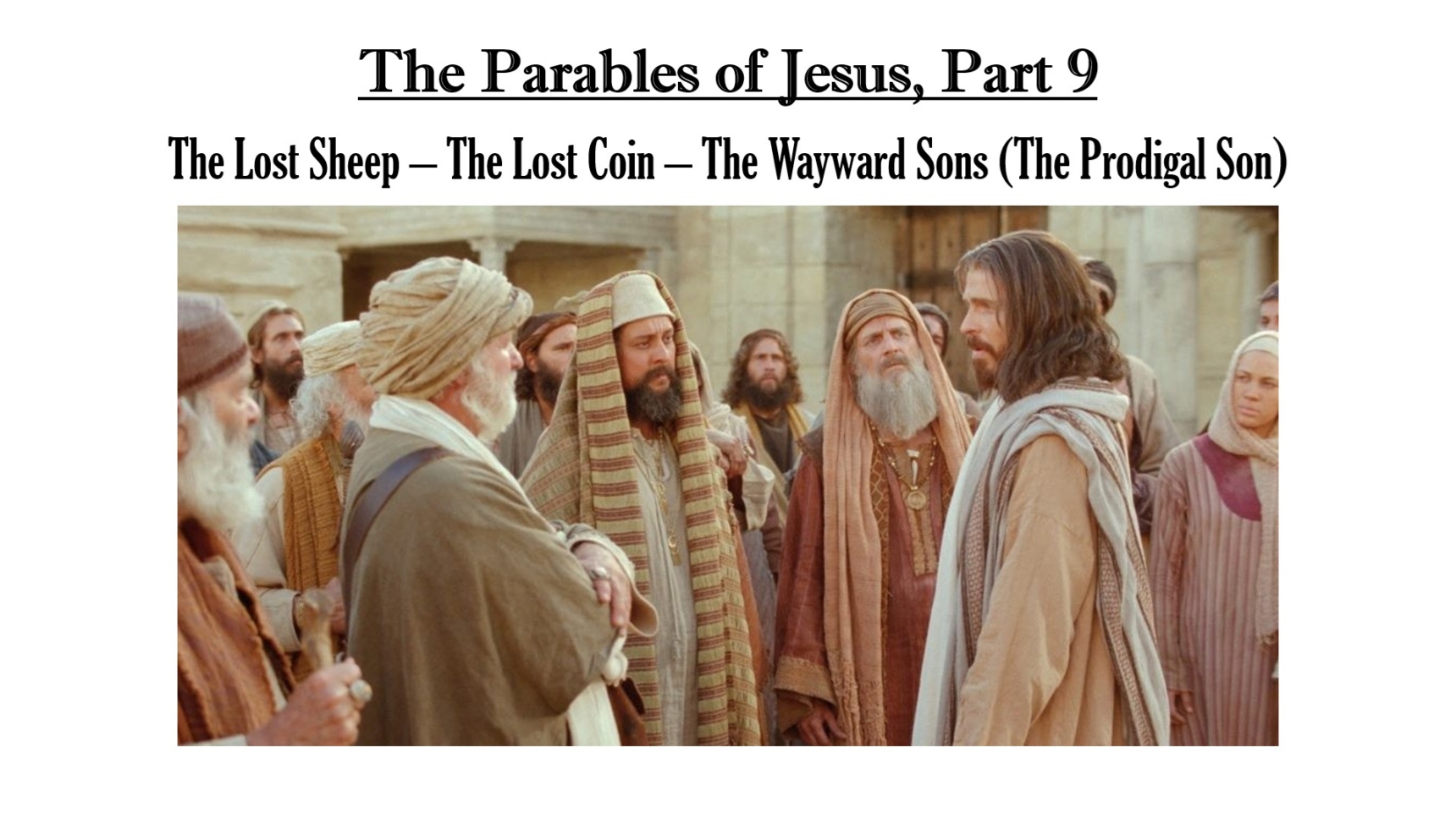
Jesus is somewhere beyond the Jordan River. He is ministering in either Perea or Decapolis. He has been moving to various places and everywhere He goes great crowds follow Him. Among those in the crowds are some Jewish religious leaders. Now, while the Pharisees back in Luke Chapter 14 (last week’s lesson) were friendly to Jesus and even invited Him to dinner, the Pharisees that Jesus encounters in Luke Chapter 15 (today’s lesson) at another town, they are not so friendly. Chapter 15 opens with scribes and Pharisees grumbling. Jesus is doing something that they do not approve of – big surprise.
Q1, why did the Pharisees “grumble” at the beginning of Chapter 15? What was their beef?
He was associating with sinners. How dare Him? With tax collectors and sinners? Jesus? In v 2 they (the Pharisees) look at Jesus and they point their dignified fingers at Him and say, “This man receives sinners and eats with them!” So that is the answer. He was associating with sinners!
Now, we actually saw this play out earlier in our study, the very first study we did back in The Parables of Jesus, Part 1. Jesus had just called Matthew, a tax collector, to follow Him as His disciple. Matthew threw a dinner party in Jesus’s honor. He invited all of his tax collector friends to come and that is where we heard the Pharisees grumbling previously. This was back in Luke Chapter 5...
And the Pharisees and their scribes grumbled at His disciples, saying, “Why do you eat and drink with tax collectors and sinners?” And Jesus answered them, “Those who are well have no need of a physician, but those who are sick. I have not come to call the righteous but sinners to repentance”’ (Luke 5:30-32).
So, Q2 asks, what analogy did Jesus use to justify why He was eating with tax collectors and sinners?
A physician, right? A physician healing sick people. That is what it says in v 31. Jesus came to heal those of us who were spiritually sick. The truth is we were more than just sick. We were dying!
Jesus, being the Son of God has the heart of God. His desire is to see sinners repent, to turn to God and be saved. He wants everyone to accept God’s invitation to heaven. We saw that last time. He wants us to have a personal relationship with the one true living God. This is why Jesus associates with the worst of the worst, those dreaded tax collectors and sinners.
Jesus receives us sinners just as we are, warts and all. He does not insist that we first go and clean up ourselves and then come to Him. That is not a condition, is it? No. He meets us right where we are. He loves us no matter our past. What a contrast Jesus is to those religious leaders and their “holier than thou” attitude.
This open criticism of Jesus by the Pharisees prompts Jesus to tell three parables back-to-back-to-back: One is about a lost sheep, one about a lost coin, and one about a man with two wayward sons.
The Lost Sheep
Now, what you need to understand is that this first parable is a parable of comparison NOT contrast. This was an agrarian society and the shepherds of that day protected their flock. That was their livelihood. So, all of their sheep were important. Jesus is telling this parable because of these grumbling Pharisees. He is looking around at all these people. Many of them are shepherds or they certainly knew shepherds in their life.
So, He [Jesus] told them [the Pharisees and scribes] this parable: “What man of you, having a hundred sheep, if he has lost one of them, does not leave the ninety-nine in the open field, and go after the one that is lost, until he finds it?” (Luke 15:3-4).
Of course that is what you are going to do. Those sheep are valuable to you.
“And when he has found it, he lays it on his shoulders, rejoicing. And when he comes home, he calls together his friends and his neighbors, saying to them, ‘Rejoice with me, for I have found my sheep that was lost.’ Just so, I tell you, there will be more joy in heaven over one sinner who repents than over ninety-nine righteous persons who need no repentance” (Luke 15:5-7).
Jesus asks in v 4, “What man of you, which one of you would NOT do what this shepherd did?” This is not a parable of contrast. It is a parable of comparison. Of course that is what you would do.
So then, Q3, true or false? Leaving the flock and searching for a missing sheep was expected of any shepherd in Jesus’s day.
That IS true. Every good shepherd does that! That is their job. This shepherd in this parable leaves his 99 other sheep. They are grazing out in the open countryside. He goes out to find the one stray sheep. This shows how much the shepherd cares about the one missing sheep.
Now, some people would say that this was reckless behavior on the shepherd’s part. But a lot of shepherds had help. For example, when the angels appeared to the shepherds [outside Bethlehem] there were multiple shepherds, not just one guy out there. Sometimes there was just one shepherd, but when you have 100 sheep, you will probably have multiple shepherds on the job. So, the chief shepherd goes searching while he leaves his attendants in charge. That is probably what happens in most cases. It is not that he is being reckless and leaving his flock unprotected. So, he goes out and he looks for that one stray. He is concerned about it. He goes looking for it, finds it, and brings it home, back to the rest of the flock.
Q4 asks, what does the shepherd do next?
He throws a party and celebrates. He does not chew the sheep out for going missing. He celebrates. He and his friends all rejoice together. It is a happy occasion.
Now, there is a spiritual application for this parable.
And that is the subject of Q5. God’s love for each individual is so great that He [God] actively does WHAT?
He seeks, looks for, searches, pursues.
[Someone in class made the point that the reason the shepherd knew the one sheep was missing was because he was closely monitoring his flock. He was keeping track, regularly counting them. I commented that this close monitoring of the flock by the shepherd is much like the cashier of today who monitors the contents of their cash drawer. They can tell if any money goes missing].
So then, the shepherd pursues, searches, seeks and finds the missing sheep. This parable has a happy ending!
Second Peter 3:9 (a verse we all know and that I quote all the time) reminds us that God is patient toward us, not wishing for any of us to perish but for all of us to come to repentance. To make this personal -- God was patient toward ME and did not want ME to perish. He wanted ME to come to repentance so He pursued ME! Jesus came to seek and to save those who were lost (Luke 19:10). That was all of us. We were all lost at one point. Once He finds us, once we receive Christ and are saved, there is much joy as God and all the host of heaven celebrate.
So, that parable is pretty straightforward. It is fairly easy to understand. But He follows it up, just to drive home His point, with a similar parable. And that is the Parable of the Lost Coin.
The Lost Coin
A woman is down on the floor in a dark room looking for her lost coin. She has ten silver coins and one of them, as will happen [goes missing]. She is diligently searching for that one lost coin. So, let’s get into this parable…
“Or what woman, having ten silver coins, if she loses one coin, does not light a lamp and sweep the house and seek diligently until she finds it? And when she has found it…” [it does not say how long it took her, it may have taken her weeks] “…she calls together her friends and neighbors, saying, ‘Rejoice with me, for I have found the coin that I had lost.’ Just so, I tell you, there is joy before the angels of God over one sinner who repents” (Luke 15:8-10).
Q6 asks, why does the woman in this parable tear her house apart looking for one coin? After all, she has nine coins left. So, what is the big deal? The good news is that she eventually finds the coin, but why does she go to all that trouble? Because she values it. She wants it. It is precious to her. Losing even one is not acceptable to her.
Q7, true or false? Based on these last two parables, every person matters to God. Absolutely!
We all have value. YOU matter to Him and aren’t you glad that you do? Praise God!
The Wayward Sons/ The Prodigal Son
I want to spend the rest of the time on my favorite parable. It is one that you all know as The Prodigal Son, but I have renamed it – a better name I think – the Parable of the Wayward Sons. The reason I call it this is because the father [in the parable] has two sons. We always want to focus on the younger one, the “prodigal,” the one that runs away and eventually comes back home. But the older son plays an important part in this parable, especially as it relates to those Pharisees. Remember, that is what started all these parables, those grumbling Pharisees. V 11…
And He [Jesus] said, “There was a man who had two sons. And the younger of them said to his father, ‘Father, give me the share of property that is coming to me.’ And he divided his property between them [his two sons]. Not many days later, the younger son gathered all he had and took a journey into a far country, and there he squandered his property in reckless living. And when he had spent everything, a severe famine arose in that country, and he began to be in need” (Luke 15:11-14).
So, the younger son decides to leave the love, security, and comforts of his home for what appears to be greener pastures. He is lured away by the attractions of the world. He begins to desire the world and the things of the world more than the things of his father. He even begins to live like the world and to adopt their values.
Q8 asks, what did the younger son do with his inheritance?
I listed a lot of things that he could have done with all that money, but what did he do? He squandered it. He didn’t do any of the things I mentioned. He squandered it all.
Satisfied for a season, this young man eventually becomes bankrupt and empty. He finds himself in a spiritual drought and he is all alone. His so-called “friends” had treated him well while he had a lot of money. But now that he has run out of all that they have abandoned him. With his wealth gone, so are they. He became expendable. He was no longer useful to them. So, v 15, what is he going to do?
“So, he went and hired himself out to one of the citizens of that country, who sent him into his fields to feed pigs. And he was longing to be fed with the pods that the pigs ate [now that is desperation], and no one gave him anything” (Luke 15:15-16).
Flat broke and abandoned by his friends, the younger son ends up getting this great job feeding the pigs! The passage observes that, “no one gave him anything.” The world does not like needy, hurting people. They like givers. “What can you give me? What’s in it for me?” That is this world’s attitude. “What have you done for me lately?”
You know, sin has a way of blinding us. We get a distorted view of ourselves, of the world, and of the world’s pleasures. But, as God reminds us of who we are and who He is, we begin to put everything back into proper perspective. And that is what happens with this young man in this parable. Look at v 17...
“But when he came to himself, he said, ‘How many of my father’s hired servants have more than enough bread, but I perish here with hunger! I will arise and go to my father, and I will say to him, “Father, I have sinned against heaven and before you. I am no longer worthy to be called your son. Treat me as one of your hired servants”’”’ (Luke 15:17-19).
Q9 says, what prompted the younger son to return home?
He faced reality. It was not the advice of a friend because all of his friends were gone. He was not going to go home and ask for money. He was too ashamed. Maybe he missed his family and maybe he didn’t. We don’t know. Jesus doesn’t say. V 17 says, “but when he came to himself…” Reality sets in. He sees his hopeless situation for what it is, the harsh reality he faces. He decides to return home.
[Someone in the class pointed out that this young man hits a rock bottom in his life which gets his attention].
The younger son comes up with a plan of action. This is what he is going to do: he will return to his father and confess his sin. That is not a bad plan. Acknowledging that we are responsible for our own actions is a great place to start. It opens the door for reconciliation and forgiveness. So, the younger son swallows his pride. He rehearses his speech (that he has worked hours on) and then off he goes. He returns home, v 20…
The Younger Son Returns Home
“And he arose [traveled a distance] and came to his father. But while he was still a long way off, his father saw him and felt compassion, and ran and embraced him and kissed him” (Luke 15:20).
Q10, when the father saw his younger son, how did he react?
He felt compassion, he kissed him, hugged him, ran to meet him and as we are about to see, he celebrated his son’s return. So, you can check all of those. The father’s reaction is not one of condemnation or reprimand. [And] the son’s return does not take the father by surprise. He has been watching. He has been sitting there at the window looking out every day waiting for his son to return. He has been eagerly waiting for that day. It does not matter what his boy has done. He is just glad to see him finally come home.
[One person in class pointed out that his father loved his son and wanted his son to come home].
The father is eagerly waiting. He is anticipating his son’s return. He is looking forward to that day. He looked out every day hoping to see his son. Finally, one day he sees his son and takes off running.
Well, almost as soon as the father embraces him, the younger son begins to blurt out his previously rehearsed confession, v 21…
“And the son said to him, ‘Father, I have sinned against heaven and before you. I am no longer worthy to be called your son…’’” (Luke 15:21).
Before the son can get it all out, the father, who is beside himself with joy, interrupts him and the father turns to his servants…
“But the father said to his servants, ‘Bring quickly the best robe, and put it on him, and put a ring on his hand, and shoes on his feet. And bring the fattened calf and kill it, and let us eat and celebrate. For this my son was dead, and is alive again; he was lost, and is found.’ And they began to celebrate” (Luke 15:22-24).
You see, it really does not matter how unworthy he [the son] might have felt in that moment. The fact is, that he is still his father’s son. And WE are STILL our Father’s children, aren’t we? The truth is that NONE of us is worthy, are we? That is why they call it “grace.”
There is much joy in God’s kingdom when those who have strayed away return home. When you have a new sinner that comes to faith or if you have one who strayed away from the faith and comes home. Either one. There is joy in heaven!
Well, like I said before, the father has two sons. Now we meet the older son. He enters stage right in v 25…
“Now his older son was in the field [he is working], and as he came and drew near to the house, he heard music and dancing. And he called one of the servants and asked what these things meant [“what is all that noise I hear?”]. And he said to him, ‘Your brother has come, and your father has killed the fattened calf, because he has received him back safe and sound’” (Luke 15:25-27).
The older brother has been a good son. He has remained loyal to his father. Let’s give him some credit. He has been responsible. He has faithfully worked and did what he was supposed to do. The servants inform him as to what all the commotion is about. Now, notice his reaction to his younger brother’s return, v 28…
The Older Son Reacts to His Brother’s Return
“But he was angry and refused to go in. His father came out and entreated him…” (Luke 15:28).
Q11, True or false? The older brother was elated at his younger brother’s return.
False. Rather than get excited and be thankful that his younger brother returned home safely, the older son gets angry. This shows that he had not been concerned at all about what happened to his brother. He refuses to share in the household’s joy. Instead, he feels sorry for himself. His focus is on himself and his own personal feelings of neglect (or at least perceived neglect).
Q12, what word best summarizes the attitude displayed by the older son?
I gave you several words to choose from. Self-centered. His focus is on himself. Do you see that? Here is the older son’s reaction in v 29…
“And he answered his father, ‘Look, these many years I have served you [I have, I, your older son], and I [your older son, me] never disobeyed your command, yet you never gave me [your older son, the good one, the one who was faithful to you] a young goat, that I might celebrate with my friends’” (Luke 15:29).
“You never did that for me, dad!
[Brief discussion about the older son being honest in expressing how he feels and that he is justified for feeling that way].
His focus is completely on himself and what he does NOT have. He feels that he has been slighted. His focus is not on his brother. It is on himself. This attitude that he has is driving a wedge in his relationship with his whole family, his father and his brother.
The older son continues because he is not finished yet. He has a lot more to say. He continues with his grievance in v 30…
“‘But when this son of yours came, who has devoured your property with prostitutes, you killed the fattened calf for him!”’ (Luke 15:30).
He claims that his father has blessed his brother more than he has blessed him. He implies that the good treatment his brother is receiving is unfair. Notice he refers to his younger brother as “this son of yours.” The father responds by offering his son the following explanation. “But here is the reality, let me explain it to you…”
“And he said to him, ‘Son, you are always with me, and all that is mine is yours. It was fitting to celebrate and be glad, for this your brother was dead, and is alive; he was lost, and is found’” (Luke 15:31-32).
The father explains that he has been pouring out his blessings on his older son day in and day out for years. But the son did not appreciate it. He probably did not even notice it, took it for granted. He probably felt like he deserved it. He certainly did not appreciate it though. Instead, like so many of us, he takes many of his blessings for granted. I know I do a lot of the time. God has to convict me of that.
So, a lot of attention is devoted in this parable to the two sons. But I believe that the focus is on the father.
Q13, in the spiritual application, who do you think the father represents?
GOD. Why did you all say that the father represents God? Forgiveness and love for his sons.
[Brief discussion about the older son’s attitude and whether it was justified or not. The parable ends with the father telling his son the way it really is in v 31. He tells his son why he ought to celebrate his brother’s return. We do not know if the son took his father’s message to heart or not].
Even though this father in the parable has two less-than-desirable sons who have gone astray in different ways, he demonstrates the loving character of God. The father welcomes the younger son back with open and non-condemning arms. He rejoices at his son’s return. The father initiates an attempt to restore fellowship with his older son. In this parable the father pours out his blessings on two undeserving recipients of his love – just like God does with us. Are we deserving of God’s blessings? No. I will be the first one to say that.
And this is precisely what God does in your life and mine. We are completely undeserving of His favor. What awesome love we have been shown! Yet the plain truth is that God expects us to have the same love for others – get this – that He does for us.
Q14, the YOUNGER son who leaves the father’s house, adopts worldly values and lives in sin symbolizes which group of people present in Jesus’s day?
The tax collectors and sinners. There was a reason they were called “sinners.” They were doing all kinds of things that they should not. They are engaged in loose living (immorality). Of course, the tax collectors were the worst of the worst because they were employed by the Romans. Horrible people! In other words, [the younger son] represents people who live ungodly, worldly lives.
OK then, that leads to Q15, who does the OLDER who remains loyal to the father, but is uncaring and self-centered symbolizes which group of people present in Jesus’s day? The Pharisees, right? The self-righteous religious leaders of Jesus’s day. “Look at me, look at we did. We deserve all this. You need us. We are so important to You.”
Application
Well, what is the application for us? That is Q16, true or false?
Both sons in this parable exhibit characteristics of believers today. That is unfortunately true. It should not be that way, but even in my own life I have to say at times that has been true. Some of us have been like the younger son who strayed (physically or emotionally) away from the fellowship, away from the things of God, away from His word. But eventually we were drawn back. Praise God! The Holy Spirit convicted us that we need to be back in the fellowship. Some of us are more like the older brother. We have remained. We have been in church our whole lives. But unfortunately, we possess unforgiving attitudes and lack love. I am just raising my hand here – [me too] sometimes. Yes, even the disciples, Jesus’s great disciples that we revere, were guilty of doing that from time to time. Just read the Gospels.
So, whether you are talking about a lost sinner or a wayward saint, God’s love pursues us aggressively. Aren’t you glad that He does?
How does Jesus expect us, as His followers, to live? Well, there is a great passage in John Chapter 13; a great statement Jesus makes. He is talking to His disciples at the last supper. He says, “A new commandment I give to you [His disciples and US], that you love one another: just as I [Jesus] have loved you, you also are to love one another [Jesus is our example]. By this all people will know that you are My disciples -- if you have love for one another” (John 13:34-35).
As Christians we must practice God’s holiness. But we must also demonstrate God’s love. Holiness without love is to be self-righteous, judgmental and harsh (like the Pharisees). They were devout. They were holy, but they did not have love. And love without holiness leads to a life of compromise.
What should our mindset then be? With this I will close. Here is a great passage from [the Apostle] Paul. He said it best in Galatians Chapter 6: “So then, as we have opportunity, let us do good to everyone, and especially to those who are of the household of faith” (Galatians 6:10). This should be the Christ-like attitude that governs our actions. Love for our brothers and sisters. Remember, whether you like it or not we are under a microscope. The world is looking at us. They are watching us. When they look at us, can they, do they see Jesus?
Questions
Note: To better help you to answer these questions you are encouraged to use the English Standard Version translation of the Bible.
Parables of Jesus - Part 9
Part 9 Questions
Prelude to the Parables (Luke 15:1-2 and Luke 5:30-32)
1. In the Luke 15 passage above, why did the Pharisees “grumble”? (Check the best answer)
___ Jesus blasphemed, claimed to be God ___ Jesus healed on the Sabbath
___ Jesus associated with sinners ___ Jesus threatened their authority
2. The Pharisees had “grumbled” previously in the Luke 5 passage above about the very same thing. What analogy for Himself did Jesus use then to defend His actions? (Circle one)
BUILDER FARMER FISHERMAN PHYSICIAN SHEPHERD
The Lost Sheep (Luke 15:3-7)
3. Read verse 4 carefully and then answer this question: True or false? Leaving his flock and searching for a missing sheep was expected of any shepherd in Jesus’s day.
T F
4. In this parable, after the shepherd finds his missing sheep and brings it home, what does he do? (Check the best answer)
___ throws a party and celebrates ___ punishes the sheep for wandering off
___ hires a second shepherd ___ lectures his flock on the dangers around them
5. The spiritual application of this parable is that God’s love for each individual is so great that He actively __________________ us whenever and wherever we stray.
The Lost Coin (Luke 15:8-10)
6. Why does the woman in this parable tear her house apart looking for one coin? After all, she still has nine coins left. Because she ______________________________________
7. True or false? Based on these last two parables, every person matters to God.
T F
The Wayward Sons/ The Prodigal Son (Luke 15:11-32)
8. According to Jesus in this parable, what did the younger son do with his inheritance? (Check all that apply)
___ invested for the future ___ put it in a college fund ___ paid off his debts
___ purchased a pig farm ___ donated to charity ___ none of these
9. What prompted the younger son to return home? (Circle one)
ADVICE FROM FRIEND FACED REALITY MISSED FAMILY NEEDED MONEY
10. When the father saw his younger son, how did he react? (Check all that apply)
___ felt compassion ___ hugged his son ___ celebrated his son’s return
___ kissed his son ___ ran to meet his son ___ none of these
11. True of false? The older brother was elated at his younger brother’s return.
T F
12. What word below best summarizes the attitude displayed by the older son? (Circle one)
COMPASSIONATE FORGIVING JOYFUL SELF-CENTERED THANKFUL
13. The focus of this parable is really on the FATHER. In the spiritual application, who do you think the father represents? _____________. Please explain -- _______________________
14. The YOUNGER son who leaves the father’s house, adopts worldly values and lives in sin symbolizes which group of people present in Jesus’s day? (Circle one)
THE 12 DISCIPLES PHARISEES TAX COLLECTORS/SINNERS
15. The OLDER son who remains loyal to the father, but is uncaring and self-centered symbolizes which group of people present in Jesus’s day? (Circle one)
THE 12 DISCIPLES PHARISEES TAX COLLECTORS/SINNERS
16. True or false? Both sons in this parable exhibit characteristics of believers today.
T F