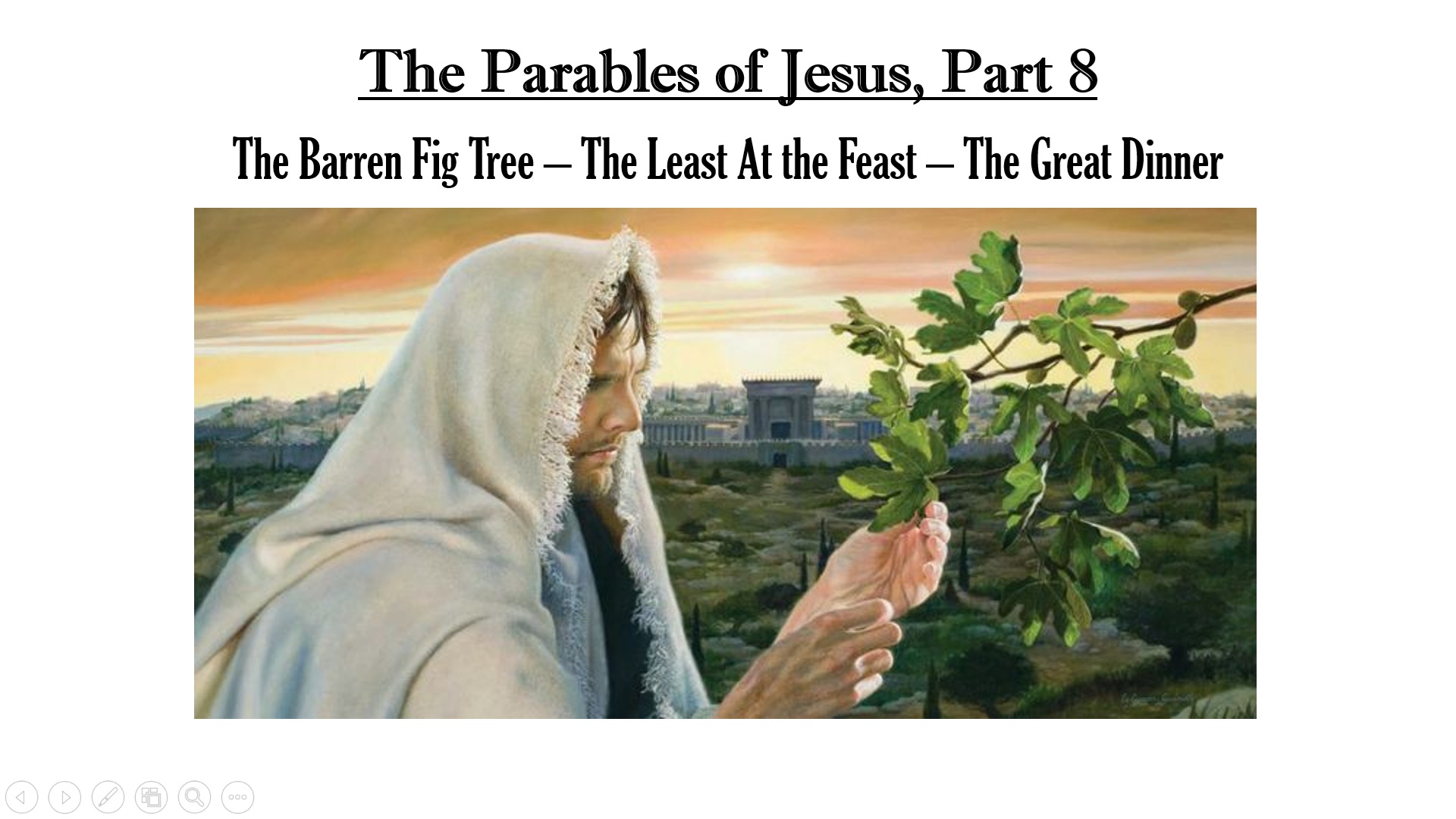
Parables of Jesus - Part 8
Do you know the date on which you were born? Raise your hand if you know your birthday. It is not a trick question. Everybody knows their birthday. Good. Raise your hand if you know the date of your death.
The Barren Fig Tree – The Least at the Feast – The Great Dinner
Do you know the date on which you were born? Raise your hand if you know your birthday. It is not a trick question. Everybody knows their birthday. Good. Raise your hand if you know the date of your death. What? Nobody? While death is a certainty for all of us (obviously unless the Lord returns first), the exact date of our death is known only to our Maker. All we have is today. Yesterday is gone. And we are not guaranteed tomorrow. There is a passage in James that goes along with this. It is in James Chapter 4. It says, “Come now, you who say, ‘Today or tomorrow we will go into such and such a town and spend a year there and trade and make a profit’— yet you do not know what tomorrow will bring. What is your life? For you are a mist that appears for a little time and then vanishes. Instead, you ought to say, ‘If the Lord wills, we will live and do this or that’” (James 4:13-15).
So, the brevity of life and the certainty of death – that is what these three parables that we are going to be looking at today deal with.
The Setting for the First Parable
Now, the setting for our first parable is Jerusalem. Jesus and His disciples are there for the Feast of Dedication. He has been teaching to the large crowds mostly in parables. Many Pharisees are in the crowd and they are listening to Jesus. At the end of Luke Chapter 12 Jesus taught a lesson about judgment and He said – I am paraphrasing here – “you had better settle your case with God before you get to the judgment because when you get before God at the judgment, it is going to be too late.”
So, now we come to Luke Chapter 13. The chapter changes but Jesus is still talking about judgment. Someone in the crowd interrupts Jesus. They bring up a recent event that is fresh on their mind in v 1. Apparently, a group of Roman soldiers killed some Galilean Jews while they were in the temple offering sacrifices. Now, while WE don’t know any of the details, this is something that the locals there in Jerusalem had heard about. Jesus uses this tragedy as a teaching moment and asks the crowd a question in v 2: “Do you think that these Galileans (those who were killed) were worse sinners than all the other Galileans, because they suffered in this way?” Jesus is questioning the conventional theology of the Jews at that time, which is (you see this in the book of Job), if something bad happens to you, it is because God is punishing you for some sin you committed. It is what He is challenging, pushing back on. Well, Jesus quickly answers His own question in v 3 with a resounding, “No!” In other words, they were NOT worse sinners. Then Jesus adds a little statement: “unless you repent, you will all likewise perish.”
So, Q1, what does Jesus urge His listeners to do while they still have time?
Repent! You see, the real tragedy is not that those people were killed in the temple, though that certainly was tragic; the real tragedy is a person [who] does not repent while they still have time. That is the tragedy. Then all of a sudden death strikes and they end up perishing. Remember, Jesus has been talking about eternal judgment. Just because the chapters change does not mean the subject is changing. The chapter divisions were not there in the original text. Jesus is continuing His thought about judgment. You may be alive and well today thinking you have all the time in the world, but the fact is, you are not going to escape divine judgment.
The Bible says, “…it is appointed for men [and women] to die once and after this comes – the answer to Q2 – “judgment” (Hebrews 9:27).
That is what Jesus has been talking about -- judgment. A real tragedy is a person dying and ending up in hell experiencing God’s wrath for eternity because they failed to settle their case before entering God’s courtroom.
To further emphasize this point He brings up another tragic incident. The tower at Siloam collapsed and killed 18 workers. Jesus asks in v 4, “Do you think that they were worse offenders than all the others who lived in Jerusalem? Again, His answer is “No.” The real tragedy is a person not repenting while they still have time.
So, here we get to the Parable of the Barren Fig Tree…
The Barren Fig Tree
People have a tendency to over-analyze tragedies and cast blame after the fact. We see this all the time. One of the big debates going on every time there is a school shooting or a mass shooting is gun control. Could this horrific event have been prevented with stricter gun laws? Of course, one side says, “Yeah, if we just had better gun laws this would never have happened.” Other people will say, “Well, you just need better mental health counseling” and “people just needed to look for the signs.” And all these debates start happening after the fact. There is all this finger pointing going on. Hindsight possesses perfect 20-20 vision. Rather than pointing to the misfortune of others and saying, “Well, if we or they had only done this or that, they might not have been killed”; instead of that, Jesus instructs His listeners to face the harsh reality that death is a certainty; and not just for the unlucky or the less fortunate (like the victims that we just saw), but for everyone.
Just as the victims of these tragic events perished, Jesus is reminding His audience that ALL of us will perish one day. Physical death is a harsh reality. It is part of the [original] curse. We do not know when or how [we are going to die]. These victims had no idea when they got up in the morning that their own death was imminent. It happened suddenly, quite unexpectedly. They probably had plans and likely left many of their hopes and dreams yet unfulfilled. Death will come knocking on OUR door one of these days. Therefore, it is imperative that we prepare for eternity while we still have time.
The Parable of the Barren Fig Tree illustrates the sovereignty of God over our lives. So, let’s read this short parable beginning in Luke Chapter 13, v 6…
And He [Jesus] told this parable: “A man had a fig tree planted in his vineyard, and he came seeking fruit on it and found none. And he said to the vinedresser, ‘Look, for three years now I have come seeking fruit on this fig tree, and I find none. Cut it down. Why should it use up the ground?’ And he [the vinedresser] answered him, ‘Sir, let it alone this year also, until I dig around it and put on manure [fertilize it]. Then if it should bear fruit next year, well and good; but if not, you can cut it down’” (Luke 13:6-9).
Q3, True or false? The owner of the vineyard is disappointed with the fig tree.
True. This particular fig tree is not producing figs. That is what fig trees are supposed to do. It is just taking up space in his vineyard. He is not happy about it.
Q4, what does the owner of the vineyard want to do to the fig tree?
He wants to cut it down. But the vinedresser, the caretaker of the vineyard, urges the owner not to cut the fig tree down, at least not yet. “Give it just a little more time,” he says. “Let me work with it.” Well, based on the parable we just read, does the fig tree get cut down or not?
That is what Q5 asks, at the end of this parable what happens to the fig tree?
We don’t know! It just ends right there. Jesus never says. He leaves it open ended for a reason – to allow us to ponder the uncertainty of life. Maybe the fig tree gets cut down. Maybe it gets a reprieve. We do know that. But, like all other living things on the earth, what we DO know is that the fig tree eventually does die. We don’t know how or when that happens, but it does.
Q6, who will make the final decision regarding the fate of the fig tree?
The owner of the vineyard. The fig tree does not want to get cut down. If the fig tree could talk, it would say. “Please, don’t cut me down!” But it is not the fig tree’s choice, is it? Likewise, the vinedresser, he does not want it cut down. And while he does have some influence over the owner, it is not going to be his decision either. The owner is going to make the decision on the fate of the fig tree. He could cut it down right now and say “don’t give it a year.” He could wait a year and see what happens. We don’t know what happens. Jesus never actually says. But we know that the owner is the one in charge.
That is how it is with our lives. We are a lot like the fig tree. We are often unproductive. We are often wasting the owner’s time and resources, aren’t we? And just as the fig tree in this parable really has no control over its own demise; it is at the mercy of the owner at this point. So, it is with us. Our end is certain. We know that at some point we are going to die. It will happen sooner or later and it will be completely up to our Master.
Now, in this parable the vinedresser intervenes on behalf of the fig tree who I believe is a representation of the Lord Jesus, who intercedes for us before the Father. First John 2:1 says, “But if anyone does sin [that is all of us], we have an advocate [that is somebody who intercedes for us] with the Father, Jesus Christ the righteous.” Hebrews 7:25 says that Jesus “makes intercession” for us.
Truths Taught in This Parable
Q7, this parable teaches us about God (He is the owner), our own lives (we are the fig tree) and the intercession of Christ (represented by the vinedresser).
You were asked to check the ONE statement given that this parable does NOT teach. Let’s go through each statement one by one.
God’s patience will not last forever. That is true. Paul warns in Romans 2:4, “do you presume on the riches of God’s kindness and His patience.” [Someone in class argued that, while this is a true statement it is not taught in the parable. Well, this particular truth is implied in the parable. We know that the owner will not continue indefinitely to put up with an unproductive fig tree. He is already exasperated with the fig tree. At some point he is going to say “enough is enough!”]
Jesus Christ intercedes on our behalf. We just read that.
Our lives are at the mercy of God. Absolutely!
Length of life is uncertain. The fact that none of us knows the date of our death proves that.
God wants our lives to be productive. There are plenty of passages in the Bible that teach that. Jesus’s teachings and many of His parables talk about productivity being important to God.
That leaves the last statement – we have no control over our own life. Now, we know that it is not true that we have no control because otherwise Jesus would not have told us to repent. So, we DO have some control as human beings over our eternal destiny. We DO get to choose.
[I got some pushback in class over the notion that we have some control over our own lives. If the fig tree in this parable is representative of us and we, as agents of free will, CAN make choices, why then does the fig tree have NO control over its own demise? Here is how I reconcile this -- we can choose the direction we will go with our lives based on information that is available to us. But, like that fig tree, we do not control WHEN we die (our own demise). That decision ultimately rests with God. Remember, this parable teaches us about the sovereignty of God]
Jesus’s advice to all who listen to Him is “Repent!” Be prepared to meet your God! When is the best time to repent and turn to Jesus for salvation? Right NOW. As soon as possible. Don’t wait. “Behold now is the acceptable time, behold now is the day of salvation” (2 Corinthians 6:2).
The Least at the Feast
Several months pass between parables. Jesus gets wind of a plot to kill Him while He is in Jerusalem and so, He leaves the city for a while. John’s gospel tells us that “[Jesus] went away again across the Jordan [River] to the place where John [the Baptist] had been baptizing at first, and there He remained” (John 10:40). So, He goes across the Jordan for a while and He is attracting crowds, even out there, and He teaches wherever He goes. He comes to one particular town that is not named, and He is invited to dinner at the home of a Pharisee. That is interesting that there ARE Pharisees that Jesus gets along with. They actually invite Him to their home to eat. And so, that brings us to this next parable which I have entitled, “The Least at the Feast.” Jesus is at this dinner and He is addressing the subject of humility. That was something at the Pharisees really struggled with. While Jesus is at this dinner, He observes some peculiar behavior. And that is where we pick it up in Luke Chapter 14, v 7…
Now He [Jesus] told a parable to those who were invited [to this house], when He noticed how they chose the places of honor, saying to them… (Luke 14:7).
Q8, in this parable, where do many of the guests rush to sit?
The places of honor. They want to sit at the best places. They are eager to raise their social status. They want to rub elbows with the most prestigious people. They want to look good and feel important. That is the setting. That is what is going on at this house. And so, Jesus says to them…
“When you are invited by someone to a wedding feast, do not sit down in a place of honor, lest someone more distinguished than you be invited by him [the host], and he who invited you both [both you and that other person] will come and say to you, ‘Give your place to this person,’ and then you will begin with shame to take the lowest place. But when you are invited, go and sit in the lowest place, so that when your host comes, he may say to you, ‘Friend, move up higher.’ Then you will be honored in the presence of all who sit at the table with you” (Luke 14:8-10).
Q9, where does Jesus teach that the guests ought to sit instead?
They are to sit in the lowest place. In this parable Jesus presents two scenarios that take place at a wedding feast. The two actions taken by two different men contrast two different views of themselves. In the first scenario a man’s inflated ego backfires on him. It leads to his social disgrace -- what I call “involuntary humility.” The second scenario demonstrates how a man’s realistic view of himself leads to his social honor. The lesson here is that we are to voluntarily place ourselves in the seat of service and humility, the lowest places, in the background. By doing so, we allow the host to elevate us at his discretion.
This parable reflects many aspects of our life – the way we act at work, at home, in social gatherings (including here at church), and in our personal relationships. The lesson is simply that we are to seek the lowly places, to be in the background serving others. It is OK, in fact it is honorable to do things behind the scenes rather than seek the spotlight or personal glory.
Application
So, here is the application, v 11… “For everyone who exalts himself will be humbled, and he who humbles himself will be exalted.” It sounds like the Proverbs, doesn’t it. Proverbs 22:4 says, “The reward for humility and fear of the LORD is riches and honor and life.”
So, Q10, True or false? Humility is a virtue that God will reward.
True.
Proverbs 27:2 says, “Let another praise you, and not your own mouth; a stranger, and not your own lips.” A modern way of saying that is “Don’t toot your own horn.” James says, “Humble yourselves before the Lord, and HE will exalt you” (James 4:10). If we will live lives of humility, the Bible teaches that God will honor and bless us.
So, I thought about two good examples for [v 11], one for each of these. I thought of a person who exalted himself and was humbled. Do you all remember King Nebuchadnezzar? In Daniel Chapter 4 the king is walking around on the roof of his royal palace in Babylon. He looks around at his magnificent city and he says, “Is this not the great Babylon that I have built with my own strength and for my own honor?” He is so full of himself and God judges him for his pride. You know the story – old “Nebby” ends up going insane and winds up living out in the fields eating grass with the cows! For seven years!
What about the other extreme, the one who humbles themselves and then is exalted? So, I racked my brain and I came up with a good example of this -- Mother Teresa. In her 30s she moved to India and spent much of her life doing missionary work in the slums of Calcutta. She lived in poverty and devoted her life to helping the poorest of the poor. She ended up receiving the Nobel Peace Prize and was revered by millions around the world, including some of us Baptists.
Jesus Offers A Personal Word
Jesus turns to the man who had invited him to dinner at this house and He offers him a personal word. Jesus tells him how he can put humility into action in his own life…
He [Jesus] said also to the man who had invited Him, “When you give a dinner or a banquet, do not invite your friends or your brothers or your relatives or rich neighbors, lest they also invite you in return and you be repaid. But when you give a feast [here is what you do], invite the poor, the crippled, the lame, the blind, and you will be blessed, because they cannot repay you. For you will be repaid at the resurrection of the just” (Luke 14:12-14).
Q11, Jesus tells the man that he can do WHAT for those who are down and out?
Invite them to dinner.
Q12, why will the man be blessed if he does this?
Because those people cannot repay him. His only motive is doing what is right and what is good; helping other people out; being nice to people who are less fortunate than he is, who cannot repay him, who do not have the means to repay him. That is the point. His reward will come later from God.
Well, at this point someone in the room makes a remark – just out of the blue…
When one of those who reclined at table with him heard these things, he said to Him [Jesus], “Blessed is everyone who will eat bread in the kingdom of God!” (Luke 14:15).
That is a bit like saying “When we all get to heaven, it’s going to be wonderful!” Well, no one is going to argue with that. We all know that is true. Everybody acknowledges that heaven is a great place. The problem is that most people don’t really understand how to get there. Jesus knows this. He knows the heart of the one who just made the statement. He is God! And He knows His audience.
And so, that is what brings us to the third parable we are going to look at this morning, the Parable of the Great Dinner.
The Great Dinner
Now, most people believe that they will make it to heaven by being an overall good person. If you were to go interview people, that is what most people would tell you – something along that line. The average person out there thinks that they will make it to heaven somehow, someway. There are a lot of people who just believe that God will not send anybody to hell. There seems to be a rather flippant attitude about heaven and eternal things and eternity in general. I don’t think people really give it a whole lot of thought. Jesus knows the hearts of those who are listening to Him. They are mostly religious people who view themselves as being pretty good. They are Pharisees. And so, He begins to tell the following parable which offers us Jesus’s insight into heaven. Here it is. It begins in Luke Chapter 14, v 16…
But He [Jesus] said to him, “A man once gave a great banquet and invited many. And at the time for the banquet, he sent his servant to say to those who had been invited [this is the original invitation going out], ‘Come, for everything is now ready.’ But they all alike began to make excuses. The first said to him, ‘I have bought a field, and I must go out and see it. Please have me excused.’ And another said, ‘I have bought five yoke of oxen, and I go to examine them. Please have me excused.’ And another said, ‘I have married a wife, and therefore I cannot come.’ So, the servant came and reported these things to his master. Then the master of the house became angry and said to his servant, ‘Go out quickly to the streets and lanes of the city, and bring in the poor and crippled and blind and lame.’ And the servant said, ‘Sir, what you commanded has been done, and still there is room [in the banquet hall].’ And the master said to the servant, ‘Go out to the highways and hedges and compel people to come in, that my house may be filled. I tell you, none of those men who were invited [originally] shall taste my banquet’” (Luke 14:16-24).
The great dinner represents heaven. The master, the host is God. He sought out certain ones to come be His honored guests. And what happens? Those who initially received his invitation to the dinner come up with all sorts of excuses why they cannot make it, why they cannot come to the dinner. Basically, they are too busy with various things in their own lives.
Q13, True or false? The many excuses offered for not accepting the invitation to the dinner, legitimate or not, indicate the priorities of the recipients.
That is true and here is why – because we all make time for what is important to us, don’t we? V 21 says that the host, the master of the house became angry. You can go ahead and check that one on your list. That happened. He was insulted that anyone would refuse His invitation. This is a huge dinner. It is a big deal. He has put a lot of money into this thing. It is the chance of a lifetime to come and be a part of a feast! Why would anybody turn it down. It did not cost them anything. Just come!
So, Q14, what does the host do after his original invitations are declined?
Well, besides getting angry, He turns his attention to the needy, to the hurting people, whose hearts are tender and who recognize a good thing when they see it. What does he do? He invites them to attend his dinner. So, you can check that one also.
Now, most of this second group accepts His invitation and comes. But the master’s house is a big house. There is still plenty of room for many more to attend. So, his invitation goes out to the highways and outlying areas.
Q15, in this parable, do the people who originally declined the invitation get another chance to accept?
V 24 seems to indicate to me rather strongly that the answer to that question is “No, they don’t.” This is a very sobering thought, isn’t it? They missed their one opportunity to come to the big dinner. They never got another chance. This is a sad story.
In Q16 we get the application. In this parable, the master, the host of the dinner represents God. That being the case, what do the invitations to the great dinner represent?
God’s call to salvation. He sends out His invitation through the Holy Spirit. Now God uses people to bring the Gospel message – preachers, missionaries, parents, teachers, all kinds of people that He can use to lead people to Christ. But the Holy Spirit is the one who invites them to receive Christ. God wants us to accept His invitation! “It is not God’s will for any to perish, but for all to come to repentance” (2 Peter 3:9). That is what God wants. He wants everybody to accept His invitation. It is the invitation of a lifetime!
BUT God, like this man in the parable, is not going to beg us or force us to accept His invitation. He is not going to. We get to choose. It is a dangerous thing for someone to harden their heart to God. How often will the Holy Spirit knock on the door of our hearts? How many times will we receive an invitation to His “great dinner in heaven”? We don’t know. But we DO know from scripture is that if we resist Him long enough, one day there will be no more knocking. He won’t bother us anymore. By the way, that is why you continue to pray for your loved ones who do not know Christ, that God will not do that, but will keep on knocking. In Genesis 6:3 (NASB) God warns that “My Spirit shall not strive with man forever.” Paul talks about this in Romans Chapter 9. As tolerant and gracious as God is, He will not strive with man forever. He won’t wait forever for us to repent. We only have so long to live, don’t we?
Application
When God calls us to follow Him, whether that be a call to salvation (like in this case) or a call to discipleship or to the mission field or whatever; He expects us to drop everything that we are doing and follow Him, just like Jesus’s disciples did. Do you think that they were not busy men that had things to do? But they dropped everything and followed Jesus. That is what God wants us to do.
So, in closing, how about you? Have you been making any excuses for why you cannot do what God is calling you to do, whatever that is? Are you putting off doing what you know that you need to do? And you know because God has told you. Today is the day to answer His invitation to come, to be obedient to His call, whatever it is. Don’t put it off any longer.
Questions
Note: To better help you to answer these questions you are encouraged to use the English Standard Version translation of the Bible.
Parables of Jesus - Part 8
Part 8 Questions
Prelude to the Parables (Luke 13:1-5 and Hebrews 9:27)
1. In the Luke 13 passage above, what does Jesus urge His listeners to do while they still have time? (Circle one)
CREATE A WILL HUG YOUR KIDS REPENT TRAVEL
2. According to the writer of Hebrews in the passage mentioned above, each person is destined to die once and after that comes what? __________________________
The Barren Fig Tree (Luke 13:6-9)
3. True or false? The owner of the vineyard is disappointed with the fig tree.
T F
4. What does the owner of the vineyard want to do to the fig tree in this parable? (Check the best answer)
___ he wants to cut it down ___ he wants to add fertilizer to it
___ he wants to transplant it ___ he wants to prune it
5. At the end of this parable what happens to the fig tree? (Circle one)
CUT DOWN TRANSPLANTED FERTILIZED PRUNED WE DON’T KNOW
6. Who will make the final decision regarding the fate of the fig tree? (Circle one)
FIG TREE GOVERNMENT OWNER OF THE VINEYARD VINEDRESSER
7. This parable teaches us about God (the owner), our own lives (fig tree) and the intercession of Christ (vinedresser). Check the ONE statement below that this parable does NOT
___ God’s patience will not last forever ___ Length of life is uncertain
___ Jesus Christ intercedes on our behalf ___ God wants our lives to be productive
___ Our lives are at the mercy of God ___ We have no control over our own life
The Least at the Feast (Luke 14:7-15)
8. In this parable, where do many of the guests rush to sit? (Circle the best answer)
FRONT ROW IN THE SHADE NEAR THE WINDOW PLACE OF HONOR
9. Where does Jesus teach that they ought to sit instead? (Circle the best answer)
BACK ROW IN THE CORNER LOWEST PLACE OUTSIDE
10. True or false? Humility is a virtue that God will reward (see Proverbs 22:4).
T F
11. In v 12-14 Jesus offers the man who invited him to dinner a practical way that he can practice humility in his own life. He can do WHAT for those who are down and out? (Check the best answer)
___ give them money ___ invite them to dinner
___ pray for them ___ provide them with a place to live
12. Why will the man be blessed if he does what Jesus suggests in Question 11? “Because they cannot ________________ you.”
The Great Dinner (Luke 14:16-24)
13. True or false? The many excuses offered for not accepting the invitation to the dinner, legitimate or not, indicate the priorities of the recipients.
T F
14. What does the host do after his original invitations are declined? (Check all that apply)
___ He begged those who declined to come anyway ___ He became angry
___ He invited the down and out to attend instead ___ He cancelled the dinner
15. In this parable, do the people who originally declined the invitation get another chance to accept? (Circle the best answer)
YES, THEY DO NO, THEY DON’T WE DON’T KNOW
16. In this parable, the master, the host of the dinner represents God. That being the case, what do the invitations to the great dinner represent? (Check the best answer)
___ Invitation to church ___ Call to salvation ___ Religious commitment